


























Views
Downloads
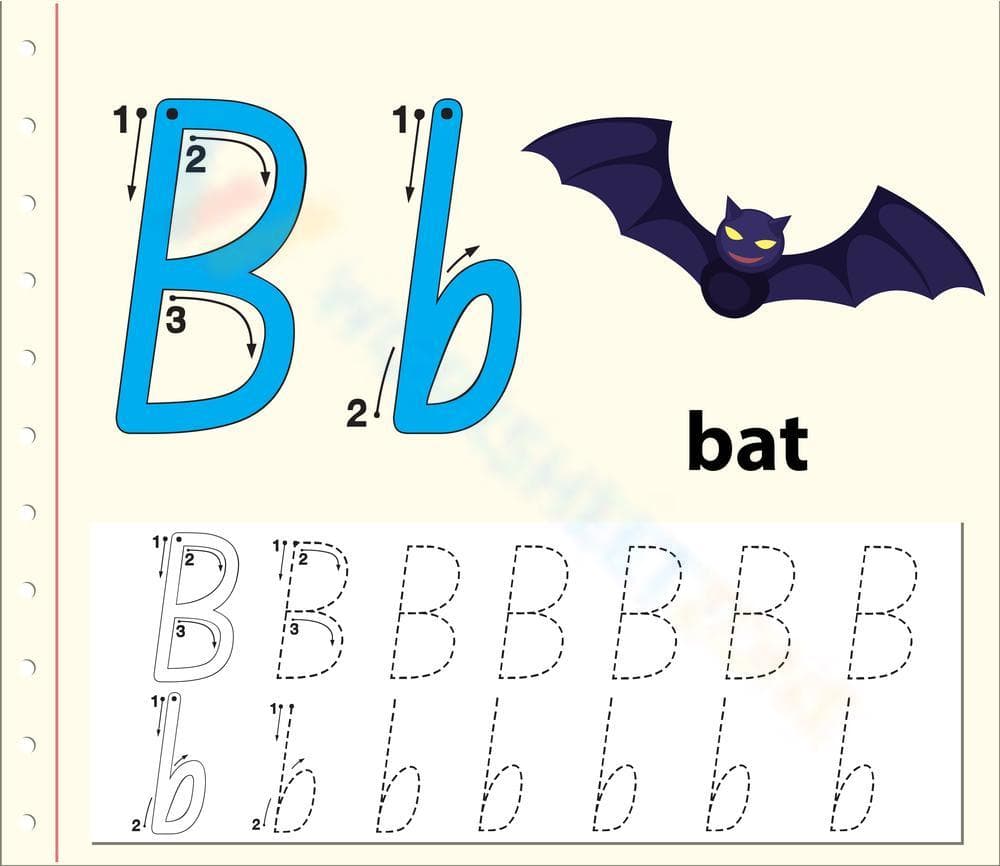

Letter B Writing Practice | Grade 1 Printable Guide
Paste this activity's link or code into your existing LMS (Google Classroom, Canvas, Teams, Schoology, Moodle, etc.).
Students can open and work on the activity right away, with no student login required.
You'll still be able to track student progress and results from your teacher account.
This Grade 1 handwriting worksheet provides immediate practice for mastering the letter B through structured tracing and visual cues. Students develop fine motor control and letter-sound correspondence by connecting the "B" sound to the bat illustration. The clear stroke guides ensure proper formation from the very first attempt, leading to legible and confident writing habits.
At a Glance
- Grade: 1 · Subject: English
- Standard:
CCSS.ELA-LITERACY.L.1.1.A— Print all upper- and lowercase letters correctly and legibly- Skill Focus: Letter B Formation
- Format: 1 page · 14 problems · Answer key included · PDF
- Best For: Independent morning work or literacy centers
- Time: 10–15 minutes
The worksheet features two large, numbered stroke guides for both uppercase "B" and lowercase "b," providing a clear visual roadmap for beginners. Below the guides, students find two rows of dedicated tracing space, containing 7 uppercase and 7 lowercase letters. The inclusion of a spooky bat illustration serves as a mnemonic device, reinforcing the phonetic link between the letter and its common starting sound in a fun, engaging way.
This resource is designed for a zero-prep classroom environment. Teachers can print the single-page PDF in less than 30 seconds. Distribution takes only a minute during transition periods. Because the stroke guides are self-explanatory, students can begin working immediately without lengthy verbal instructions. Reviewing the work is a simple visual check of line adherence, requiring less than 5 minutes for an entire class set.
This resource is strictly aligned to `CCSS.ELA-LITERACY.L.1.1.A`, which requires students to print all upper- and lowercase letters. By focusing specifically on the letter B, it provides the targeted repetition necessary for muscle memory development. This standard code can be copied directly into lesson plans, IEP goals, or district curriculum mapping tools to ensure compliance with foundational literacy requirements.
Use this worksheet during the "You Do" phase of a gradual release lesson on the alphabet. It is particularly effective as a formative assessment tool; observe students as they trace to identify those struggling with top-to-bottom stroke order. Completion typically takes 10 to 15 minutes, making it an ideal filler for students who finish other literacy tasks early or as a quiet-time activity.
This practice sheet is designed for Grade 1 students, though it is equally valuable for Kindergarteners ready for advanced tracing or older English Language Learners (ELL) focusing on basic orthography. It pairs naturally with an anchor chart featuring the letter B or a short phonics reader about animals. The high-contrast lines are helpful for students with visual processing needs who require clear boundaries.
According to Fisher & Frey (2014), the gradual release of responsibility model is most effective when students have access to clear, scaffolded independent practice materials. This worksheet fulfills that need by providing explicit stroke numbering (scaffolding) before moving to independent tracing. Research from the NAEP highlights that foundational writing skills, such as legible letter formation, are strong predictors of later composition success. By mastering the letter B through these 14 specific tracing tasks, students build the mechanical fluency required for more complex writing assignments. The integration of phonetic imagery, like the bat illustration, aligns with multisensory learning theories that suggest combining visual, motor, and auditory cues improves retention of letter-sound relationships. This resource provides a structured, evidence-based approach to early literacy that fits easily into any comprehensive English Language Arts curriculum.


