


























Views
Downloads



Printable Subtraction within 10 Worksheet | Grade 1 Ready
Paste this activity's link or code into your existing LMS (Google Classroom, Canvas, Teams, Schoology, Moodle, etc.).
Students can open and work on the activity right away, with no student login required.
You'll still be able to track student progress and results from your teacher account.
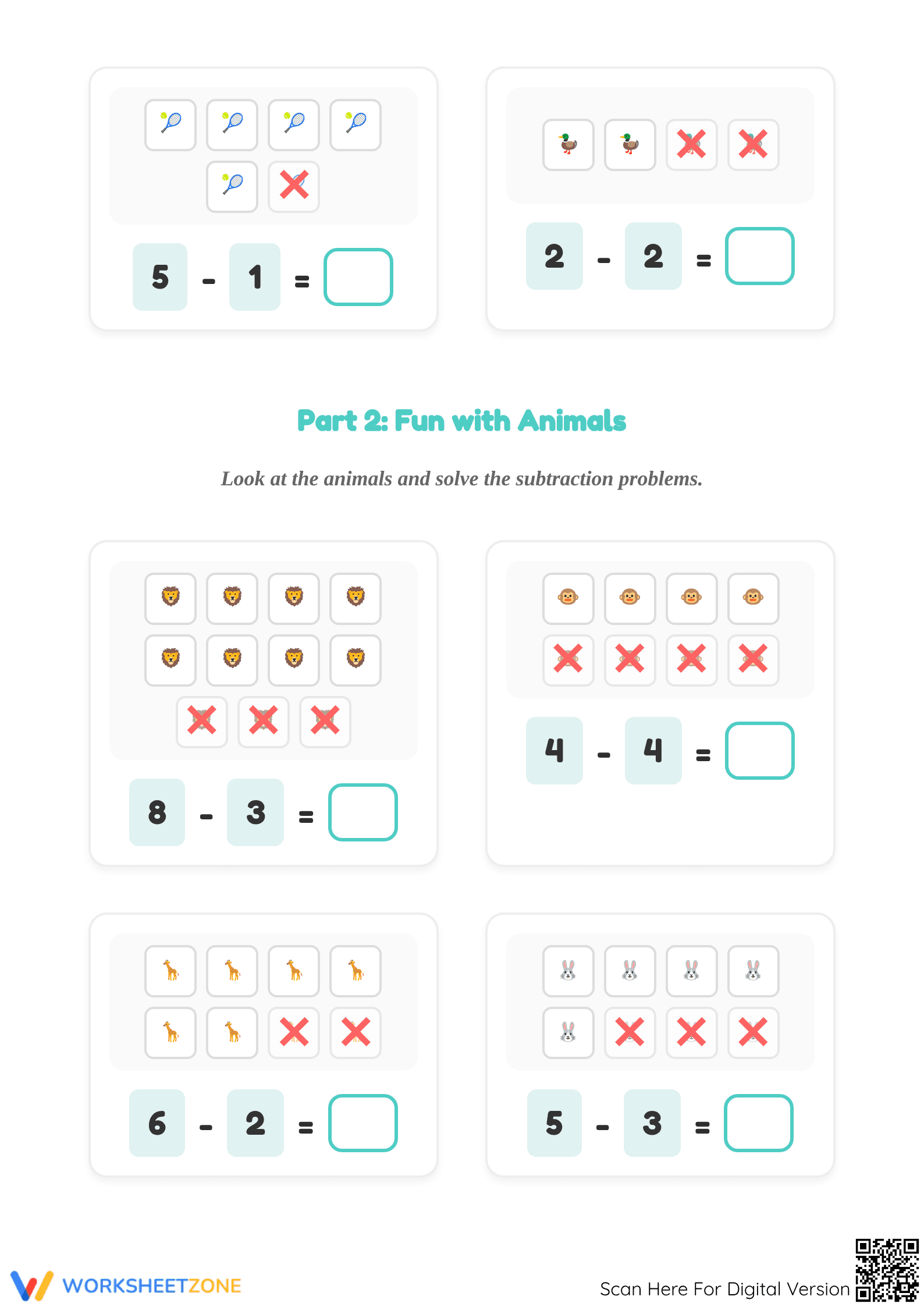
This comprehensive subtraction packet helps early learners master basic arithmetic by transitioning from concrete visual models to abstract number sentences. Students practice taking away items across 16 structured problems, ensuring they understand the fundamental concept of subtraction as finding the remainder. This printable resource provides a clear, logical progression for kindergarten and first-grade math foundations.
At a Glance
- Grade: 1 · Subject: Math
- Standard:
CCSS.MATH.CONTENT.K.OA.A.1— Represent subtraction with objects, drawings, and equations to find the difference.- Skill Focus: Subtraction within 10
- Format: 4 pages · 16 problems · Answer key included · PDF
- Best For: Daily math centers and independent practice
- Time: 15–20 minutes
What's Inside
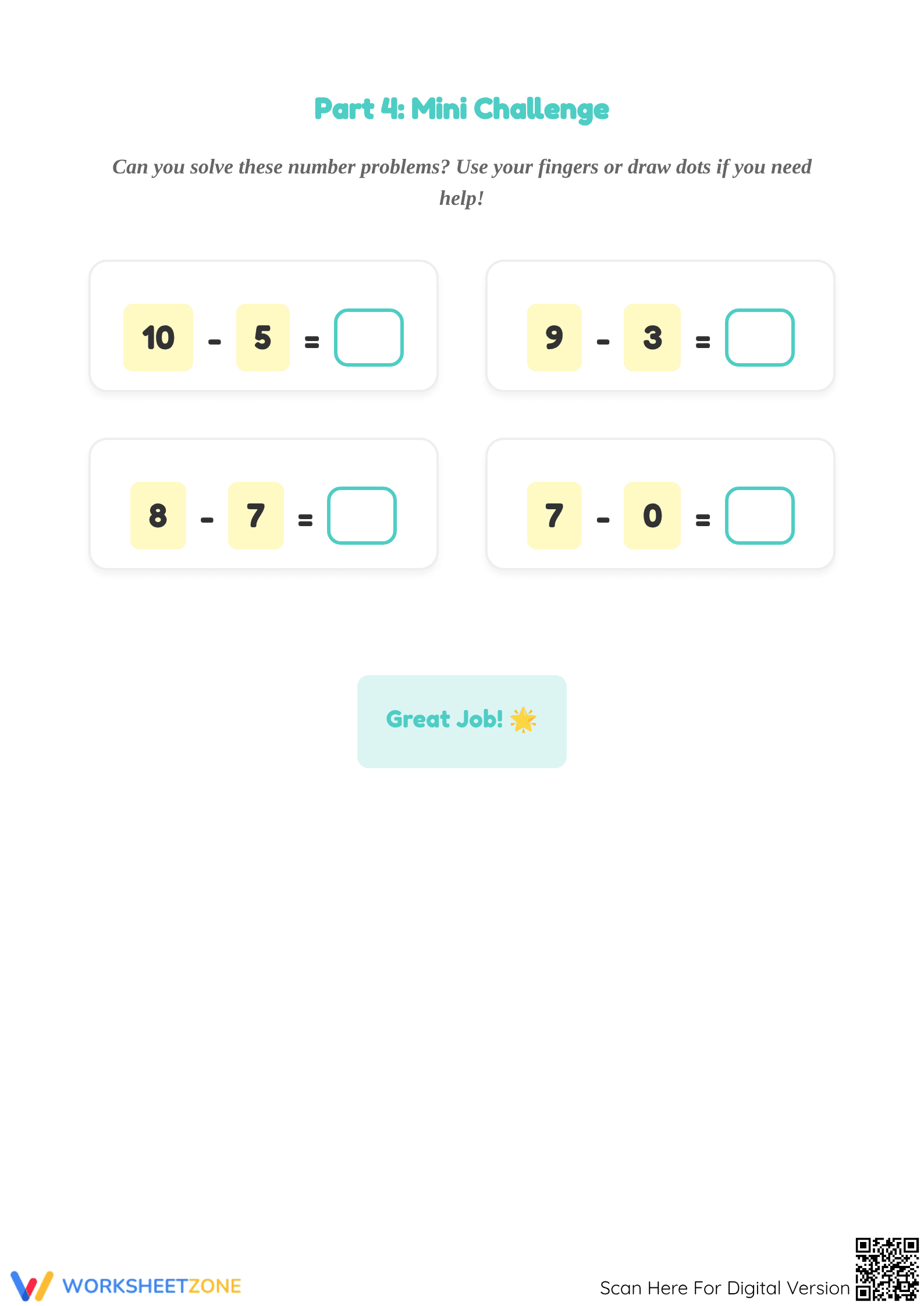
This four-page instructional packet is divided into logical skill-building segments. Part one focuses on Picture Subtraction using common icons like elephants and roses. Parts two and three introduce animal and fruit themes to maintain engagement, while the final Mini Challenge removes visual scaffolds to test mental math. Each page includes clear instructions and spacious response boxes, supported by a full answer key for grading.
Zero-Prep Workflow
Designed for immediate implementation, this resource requires exactly zero minutes of teacher preparation beyond the initial printing. Simply print the four-page PDF (1 minute), distribute the packets to your students (1 minute), and allow them to work through the visual prompts. The final answer key enables a rapid 30-second review at the end of the lesson or can be provided for student self-correction.
Standards Alignment
The primary alignment for this resource is `CCSS.MATH.CONTENT.K.OA.A.1`, which requires students to represent addition and subtraction with objects, mental images, and drawings. It also supports `CCSS.MATH.CONTENT.1.OA.A.1` by using subtraction within 20 to solve problems involving taking from. These standard codes can be copied directly into lesson plans, IEP goals, or district curriculum mapping tools to document progress.
How to Use It
Use this packet during the independent practice phase of your subtraction unit once the concept of taking away has been introduced. It serves as an excellent formative assessment tool; observe if students still need to manually count the crossed-out items or if they have begun to recognize the numerical patterns. Expected completion time for the full 16-problem sequence is approximately 20 minutes.
Who It's For
This resource is tailored for Kindergarten and Grade 1 students who are developing their initial fluency with numbers 1-10. It is particularly effective for visual learners and students requiring RTI Tier 2 support, as the consistent crossing out model provides a tangible bridge to abstract math. Pair this worksheet with physical counters or an anchor chart showing subtraction symbols.
According to the NAEP Mathematics Framework, early mastery of subtraction within 10 is the primary predictor of success in multi-digit arithmetic and algebraic thinking. This worksheet utilizes the cross-out visual strategy, which Fisher & Frey (2014) identify as a critical scaffolding technique for moving students from concrete to representational math. By providing 16 distinct opportunities to practice CCSS.MATH.CONTENT.K.OA.A.1, this packet ensures that the relationship between the whole and the parts is clearly visualized before students face complex word problems. Research from EdReports 2024 emphasizes that high-quality math materials must provide consistent alignment between visual models and symbolic equations to prevent cognitive overload. This printable resource delivers that alignment through thematic repetition, making it an essential component of any early elementary numeracy curriculum.


