


























Views
Downloads
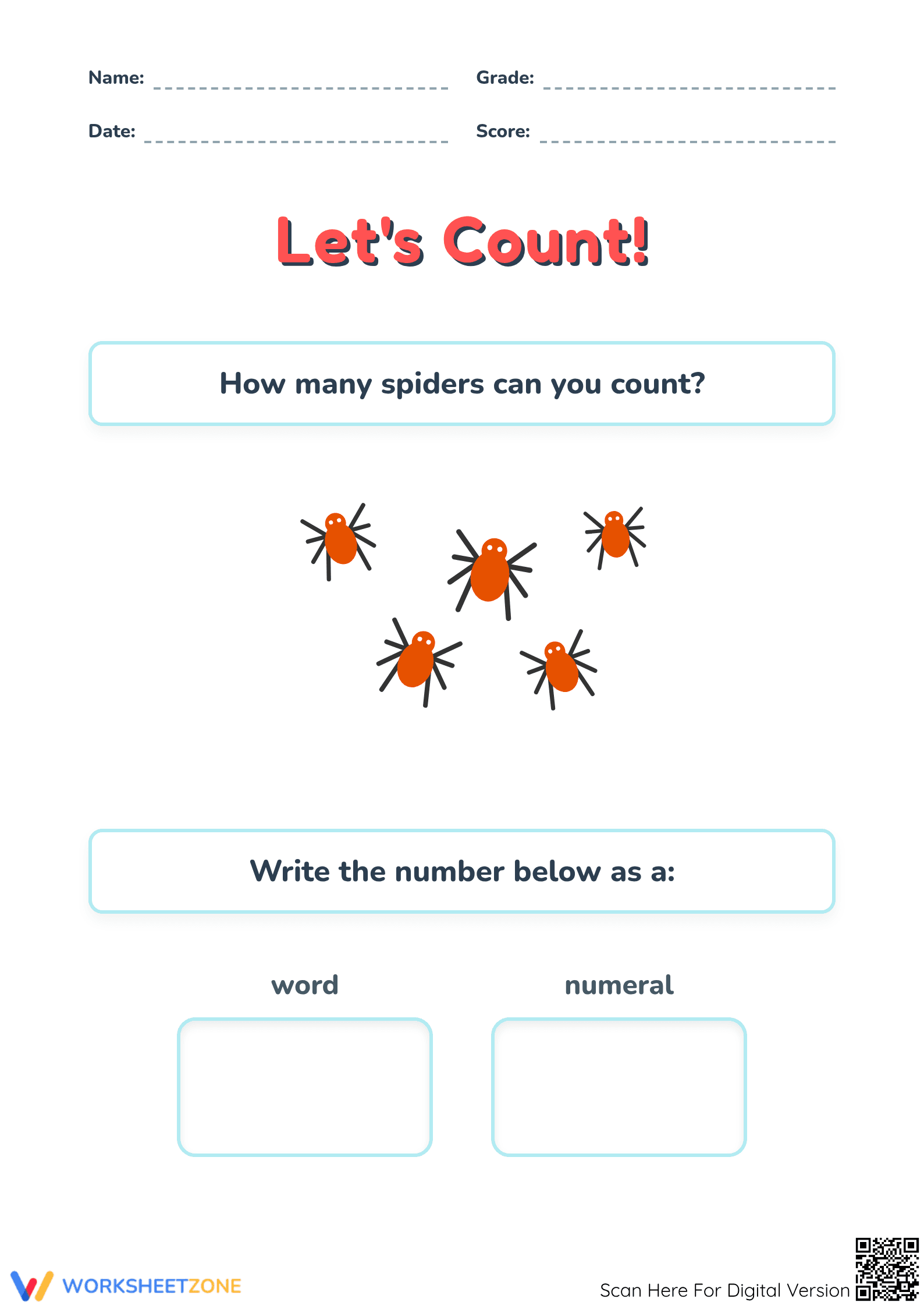
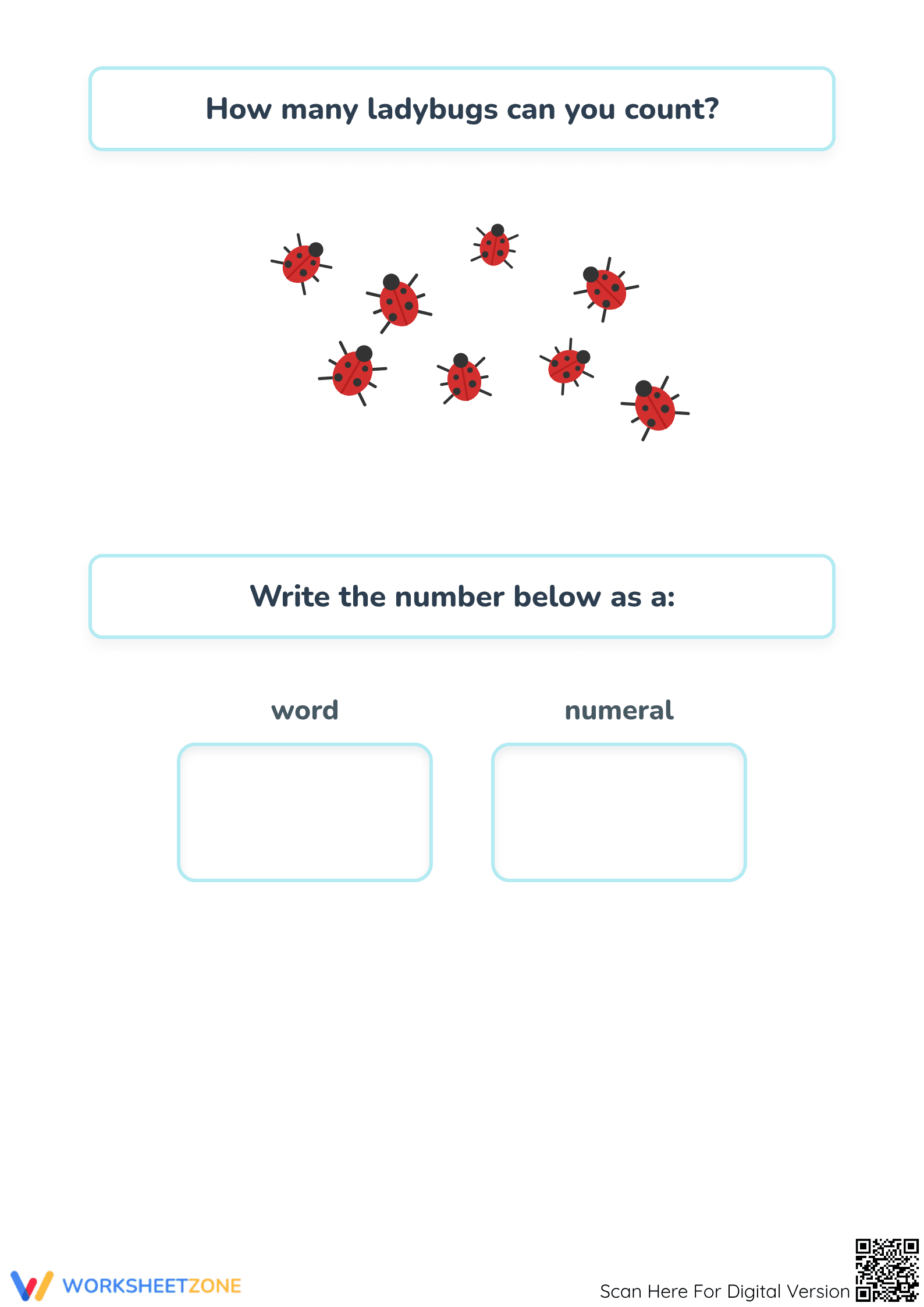

Printable Let's Count Spider & Ladybug Worksheet | Grade K
Paste this activity's link or code into your existing LMS (Google Classroom, Canvas, Teams, Schoology, Moodle, etc.).
Students can open and work on the activity right away, with no student login required.
You'll still be able to track student progress and results from your teacher account.
This interactive counting worksheet helps Kindergarten students master the relationship between quantities and their representative forms. By engaging with friendly spider and ladybug illustrations, learners practice one-to-one correspondence and transition from counting objects to writing numbers in both word and numeral formats. It is an essential tool for building foundational numeracy skills in early childhood classrooms.
At a Glance
- Grade: K · Subject: Math
- Standard:
K.CC.B.5— Count to answer how many questions about as many as 20 things- Skill Focus: Counting and number representation
- Format: 2 pages · 2 problems · Answer key included · PDF
- Best For: Kindergarten counting practice and number formation
- Time: 5–10 minutes
The download contains two high-quality worksheet pages featuring vibrant insect illustrations designed to capture student interest. Each page presents a group of insects—spiders on the first and ladybugs on the second—and asks the student to count them. Below the visual prompt, students find dedicated boxes to record their findings as a written word and a standard numeral, supporting dual-coding of mathematical concepts. A complete answer key is provided for rapid grading.
Zero-Prep Workflow
This resource is engineered for immediate classroom integration with a total teacher prep time of under 2 minutes. The workflow is simple: print the two-page document, distribute it to your students, and review the results using the included key. The self-explanatory layout makes it an ideal candidate for emergency sub plans, morning work stations, or quick formative assessments during a direct instruction unit on counting and cardinality.
Standards Alignment
The primary focus of this worksheet is `CCSS.MATH.CONTENT.K.CC.B.5`, which requires students to count to answer "how many?" questions about as many as 20 things arranged in a line, a rectangular array, or a scattered configuration. It also provides supporting practice for `K.CC.A.3`, which involves writing numbers from 0 to 20. Both standard codes can be copied directly into lesson plans, IEP goals, or district curriculum mapping tools to ensure instructional compliance.
How to Use It
Use this worksheet during small-group rotations to observe students' one-to-one correspondence—look for students who point to each insect as they count. It also functions well as an exit ticket following a lesson on number words. Most Kindergarten students will complete both pages within 10 minutes, providing a clear snapshot of their ability to translate a visual count into written symbolic and verbal representations of quantity.
Who It's For
This resource is designed for Kindergarten students but is also suitable for Preschoolers ready for number writing. It pairs naturally with physical manipulatives like counters or insect figurines, allowing students to "match" the worksheet's visuals with tangible objects before writing their answers. It is especially helpful for learners who struggle with the abstract concept of number-to-symbol mapping and need structured practice with number word spelling.
Foundational math instruction requires frequent opportunities for students to bridge the gap between concrete counting and abstract number notation. This printable resource targets `CCSS.MATH.CONTENT.K.CC.B.5` by providing a structured environment for one-to-one correspondence and multi-modal number representation. According to research from Rand AIRS (2024), high-interest visuals like insects significantly increase engagement in early numeracy tasks. The design encourages students to process quantities visually before encoding them as numerals and words, supporting long-term mathematical fluency. Teachers can implement this tool knowing it aligns with national standards for early childhood education. The inclusion of both word and numeral forms ensures students develop a holistic understanding of number systems, preparing them for more complex arithmetic operations in subsequent grades. This resource is a verified addition to any elementary math toolkit, offering clear evidence of student mastery in number representation and counting.


