


























Views
Downloads

Printable Counting Snails Worksheet | Grade K Math
Paste this activity's link or code into your existing LMS (Google Classroom, Canvas, Teams, Schoology, Moodle, etc.).
Students can open and work on the activity right away, with no student login required.
You'll still be able to track student progress and results from your teacher account.
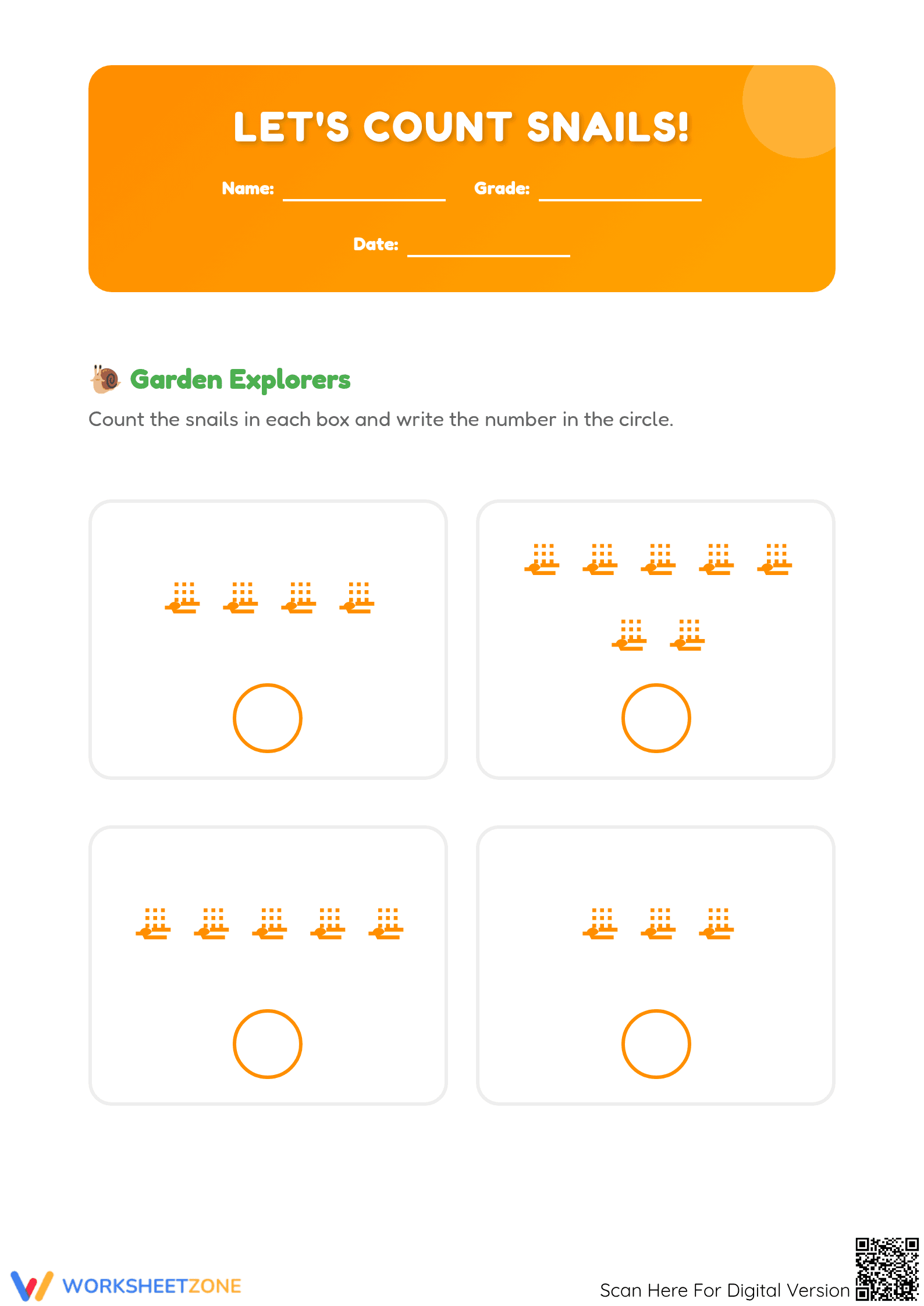
This Grade K counting worksheet provides a structured environment for young learners to practice one-to-one correspondence and cardinality. By engaging with charming garden-themed illustrations, students transition from simple counting to representing quantities with written numerals. This essential math resource ensures children develop a solid foundation in number recognition and basic arithmetic operations through visual engagement.
At a Glance
- Grade: K · Subject: Math
- Standard:
K.CC.B.4— Understand the relationship between numbers and quantities; connect counting to cardinality.- Skill Focus: One-to-one correspondence
- Format: 2 pages · 8 problems · Answer key included · PDF
- Best For: Independent math centers and homework practice
- Time: 10–15 minutes
What's Inside
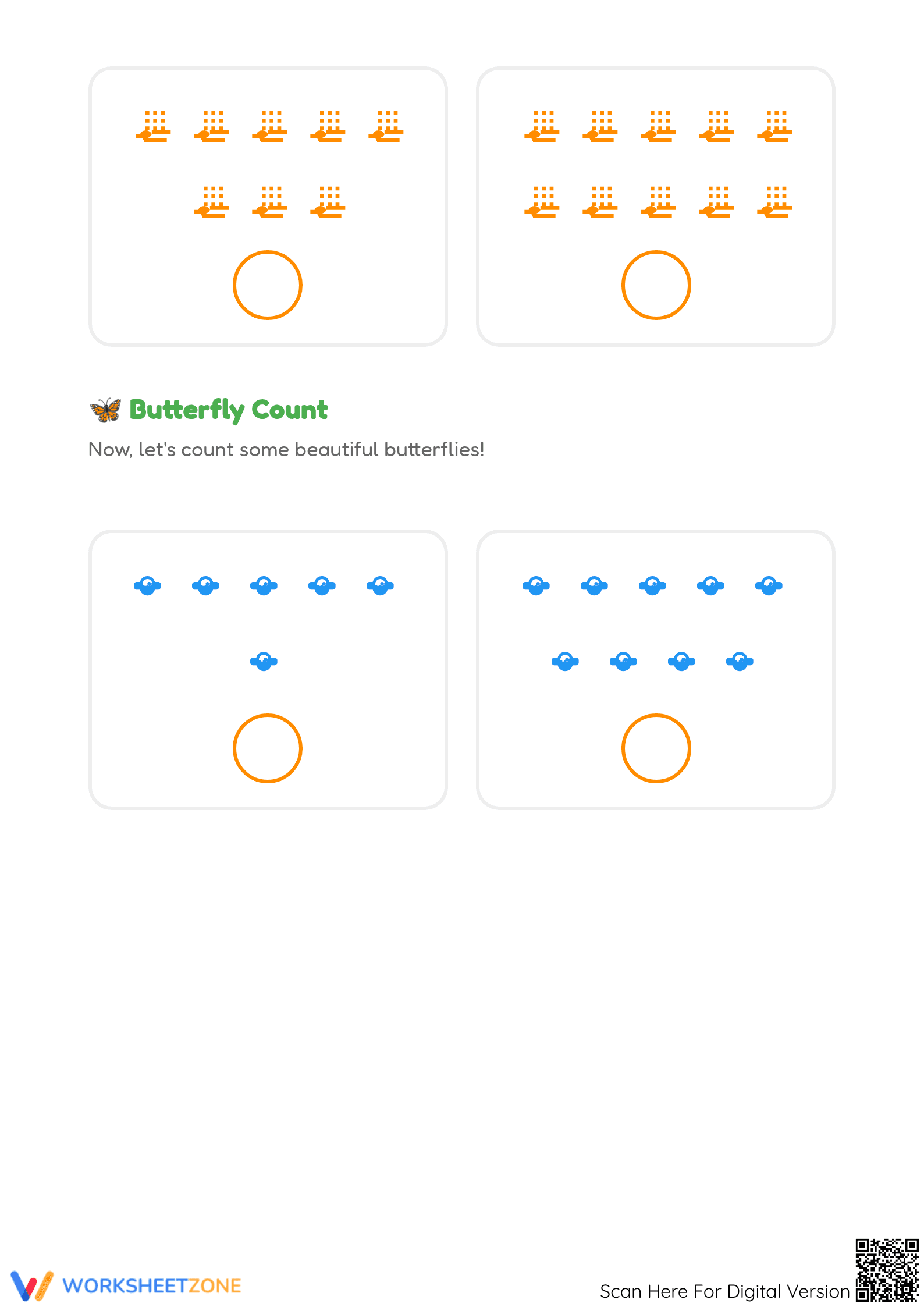
The worksheet features two pages of counting exercises. Page one focuses on "Garden Explorers" where students count snails in four boxes. Page two continues the snail theme before introducing "Butterfly Count" for the final two tasks. Each of the eight problems includes a box of objects and a designated circle for recording the total count. A full answer key is provided.
Zero-Prep Workflow
Teacher preparation is minimal. First, spend less than 30 seconds printing the 2-page PDF. Second, spend 1 minute handing out sheets and explaining the simple "count and write" instruction. Third, use the included answer key for a 30-second visual check of student work. This resource is perfect for substitute folders, as it requires zero prep time and no specialized supplies beyond a pencil.
Standards Alignment
The primary alignment is K.CC.B.4, which requires students to understand that each object corresponds to exactly one number name and the last number named tells the total. This activity also supports K.CC.A.3 by asking students to write numbers from 0-20. Both standard codes can be copied directly into lesson plans, IEP goals, or district curriculum mapping tools.
How to Use It
Use this as a "bell ringer" activity immediately following a morning meeting to settle students into math mode. It serves as an excellent formative assessment tool; observe if students use their finger to point to each object, indicating established one-to-one correspondence. Expect students to complete both pages within 10 to 15 minutes, depending on their numeral writing speed and fine motor development.
Who It's For
This resource is designed for Kindergarten students or Pre-K learners ready for formal number sense instruction. It provides high-contrast visuals for students needing visual support and can be paired with physical counters for those requiring tactile reinforcement. It naturally pairs with a garden-themed read-aloud or a life cycles science lesson on insects and gastropods.
According to NAEP (2024), early proficiency in one-to-one correspondence is the strongest predictor of success in algebraic thinking. This worksheet leverages the research-backed "Representational" phase of the CRA sequence, bridging physical objects and abstract numerals. Research by Fisher & Frey (2014) emphasizes that high-quality, independent practice allows teachers to conduct small-group interventions while the class engages in meaningful, standards-aligned tasks. The Garden Explorers activity specifically addresses standard K.CC.B.4 by requiring students to count objects and associate the final count with a written symbol. By consolidating foundational skills through 8 focused tasks, the resource reduces cognitive load while maximizing student engagement. This printable PDF ensures that students achieve mastery of cardinality in a self-contained format effective for initial instruction and subsequent reinforcement in early childhood settings.


