


























0
Views
0
Downloads

0.0
0
Save
0 Likes
Share
Compare Worksheet
0 Views
0 Downloads
Paste this activity's link or code into your existing LMS (Google Classroom, Canvas, Teams, Schoology, Moodle, etc.).
Students can open and work on the activity right away, with no student login required.
You'll still be able to track student progress and results from your teacher account.
Information
Description
What It Is:
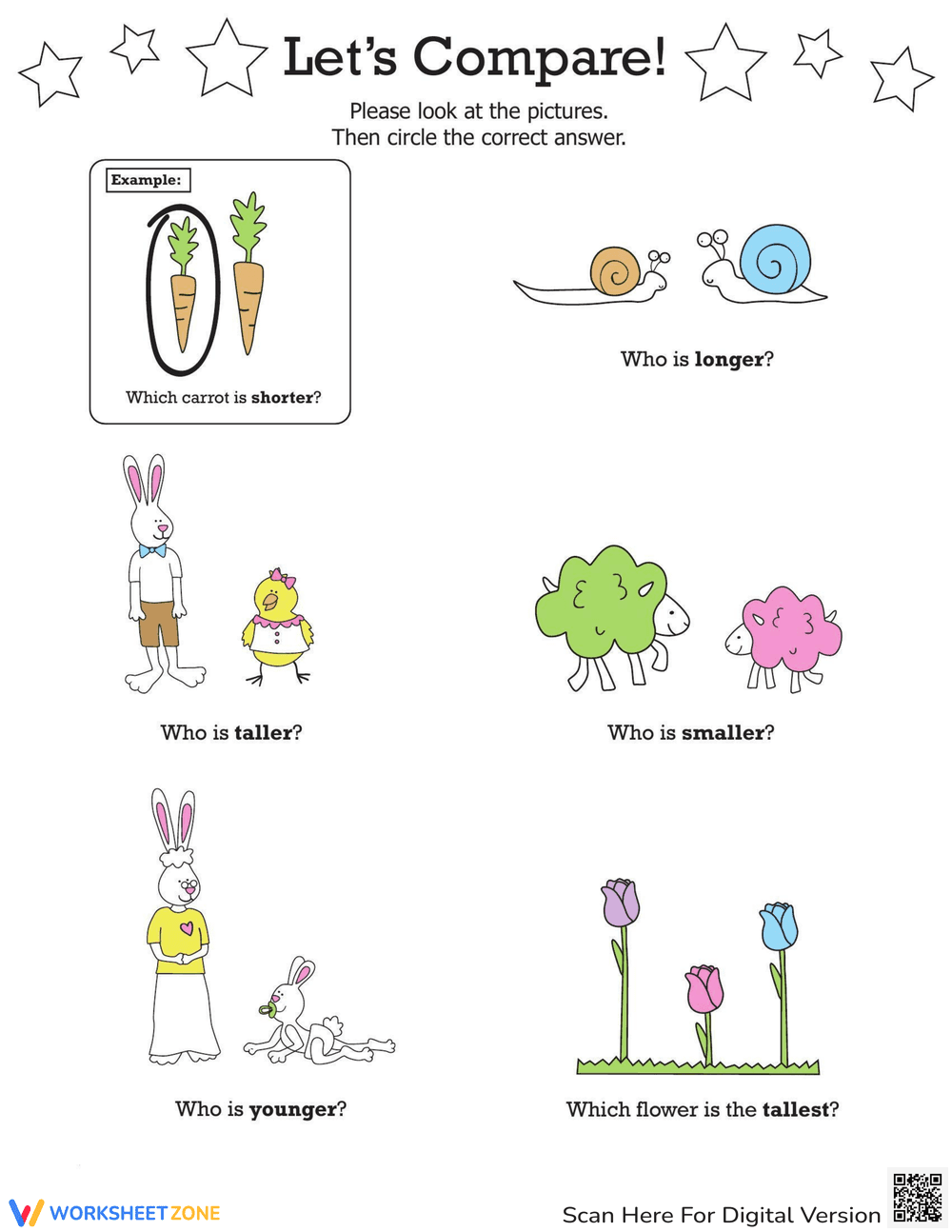
This is a printable educational worksheet titled 'Let's Compare!'. It features several comparison activities. Children are asked to compare two or three images in each question and circle the correct answer. The questions include: 'Who is longer?' (comparing two snails), 'Who is taller?' (comparing a rabbit and a chick), 'Who is smaller?' (comparing two sheep), 'Who is younger?' (comparing two rabbits), and 'Which flower is the tallest?' (comparing three flowers). An example is provided showing two carrots and asking 'Which carrot is shorter?'.
Grade Level Suitability:
This worksheet is suitable for preschool and kindergarten (ages 3-6). The concepts of comparing sizes (longer, shorter, taller, smaller, younger, tallest) are fundamental early learning skills. The simple illustrations and clear instructions make it accessible to young children.
Why Use It:
This worksheet helps children develop critical thinking skills, visual discrimination, and the ability to compare and contrast objects based on different attributes. It reinforces vocabulary related to size and age comparisons. It also improves fine motor skills through circling the correct answers.
How to Use It:
Print the worksheet and provide a pencil or crayon. Instruct the child to look at each set of pictures and read the question aloud. Help them understand what they are being asked to compare. Then, guide them to circle the image that answers the question correctly.
Target Users:
This worksheet is designed for preschool and kindergarten children, homeschoolers, early childhood educators, and parents who want to reinforce early math and comparison skills.
This is a printable educational worksheet titled 'Let's Compare!'. It features several comparison activities. Children are asked to compare two or three images in each question and circle the correct answer. The questions include: 'Who is longer?' (comparing two snails), 'Who is taller?' (comparing a rabbit and a chick), 'Who is smaller?' (comparing two sheep), 'Who is younger?' (comparing two rabbits), and 'Which flower is the tallest?' (comparing three flowers). An example is provided showing two carrots and asking 'Which carrot is shorter?'.
Grade Level Suitability:
This worksheet is suitable for preschool and kindergarten (ages 3-6). The concepts of comparing sizes (longer, shorter, taller, smaller, younger, tallest) are fundamental early learning skills. The simple illustrations and clear instructions make it accessible to young children.
Why Use It:
This worksheet helps children develop critical thinking skills, visual discrimination, and the ability to compare and contrast objects based on different attributes. It reinforces vocabulary related to size and age comparisons. It also improves fine motor skills through circling the correct answers.
How to Use It:
Print the worksheet and provide a pencil or crayon. Instruct the child to look at each set of pictures and read the question aloud. Help them understand what they are being asked to compare. Then, guide them to circle the image that answers the question correctly.
Target Users:
This worksheet is designed for preschool and kindergarten children, homeschoolers, early childhood educators, and parents who want to reinforce early math and comparison skills.


