Worksheetzone logo

Printable Lesson Plans by Grade & Subject

Lesson Plan Collections from Worksheetzone

Explore Freemium Printable Lesson Plans by Grade & Subject, designed for teachers, homeschoolers, and parents seeking turnkey curriculum solutions that deliver real results. Each ready-to-use plan in Freemium Printable Lesson Plans by Grade & Subject promotes engagement, critical thinking, and skill mastery across a range of educational topics. Whether you’re planning a single lesson or structuring a full week of instruction, this organized library helps you save prep time while improving learning outcomes. Unlike scattered, unreliable online materials, Freemium Printable Lesson Plans by Grade & Subject offers age-appropriate, standards-aligned content that’s immediately ready to implement. You’ll find everything you need to guide students with clarity and purpose. With Freemium Printable Lesson Plans by Grade & Subject, teaching becomes more efficient, focused, and impactful—allowing you to spend less time searching and more time inspiring meaningful learning.

Home

/Lesson Plans
Argument Writing
Verified
2 pages

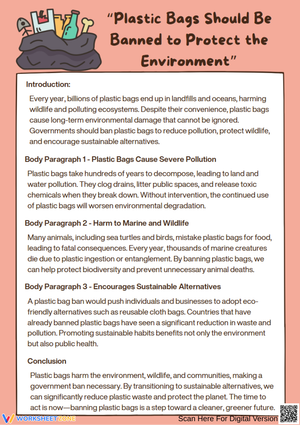
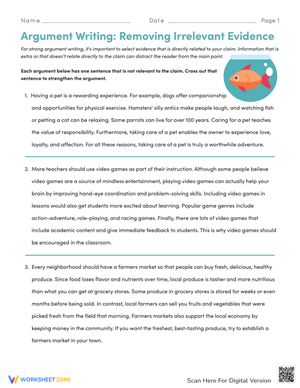
Argument Writing

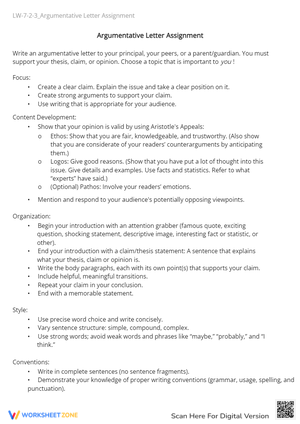
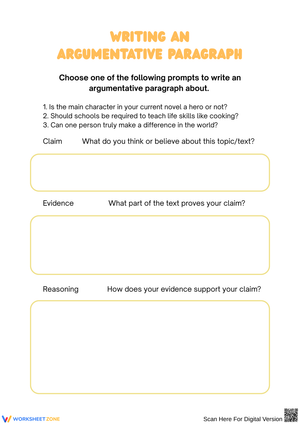
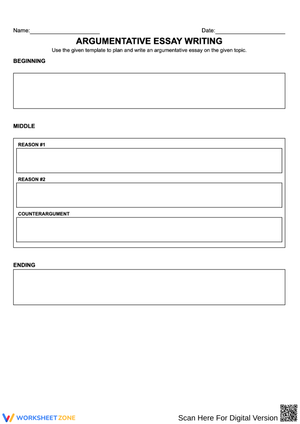
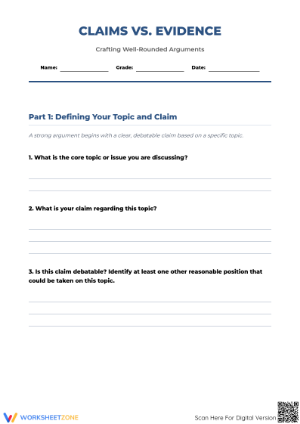
The writer's position on a problem or issue is called the: claim. In order to write a successful argument, you must use ___ to support claims, and ____ to support your reasons: reasons, evidence. When gathering evidence, use credible ___ and take notes: sources. Always make sure to disprove the ___ argument: opposing.      This element is the first line of your writing: Hook. Acknowledging why someone may disagree with you is known as this: Counterclaim. This is based on personal experience, quotes, facts and statistics that support your reasons: Reason. This is a debatable statement that forms the main point of your argument: Claim. This helps support your main claim and gives the reader a basis for accepting your main claim: Reason. This element wraps up all loose ends and finishes strong: Conclusion. This is the part of the introduction paragraph that catches readers’ attention: Hook. This shows how you know you’re right: Evidence. This disputes or disagrees with your claim: Counterclaim. This follows your claim: Reason. Introduce this with statements such as, “It may be argued that ….”, “Contrary to evidence…”,  “It is true, however, ….” or any other statement that acknowledges conflicting viewpoints: Counterclaim. What type of hook is this?I was living in Arkansas the first time I met prejudice face to face: Personal Anecdote. What type of hook is this?Each year there is one Lego block made for every person in the world. Think about it: Fascinating Fact. One type of hook you can use for writing is called an anecdote. What is the definition of anecdote? : A short story or scene. Which type of hook is this?John Wooden once said, "Never mistake activity for achievement." : Quote

Grade:Grade 6_AI - Grade 8_AI
7
Argumentative Writing Vocabulary
Verified
2 pages

Argumentative Writing Vocabulary

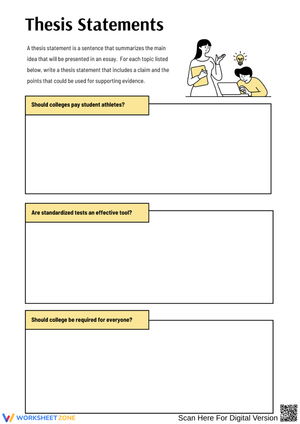
the intended readers of specific types of texts : audience. the reason for writing; what the writer hopes to accomplish: purpose. words or phrases that connect ideas, details, or events in writing: transitions. academic writing that shows care and appropriate language: formal style. closely connected or appropriate to what is being done, said, or considered : relevant. able to be believed : credible. state or assert that something is the case : claim. giving credit to the authors of source information: citation. a sentence, in the introduction of an essay, that states the writer’s position or opinion on the topic of the essay: thesis statement. the opening paragraph of an essay, which must get the reader’s attention and indicate the topic: introduction. occurs at the end of an argumentative text to make clear what the writer or speaker wants the audience to think or do: call to action. a paragraph that contains a topic sentence, supporting details and commentary, and a concluding sentence and that is usually part of a longer text: body paragraph. an important topic or problem for debate or discussion: issue. a sentence that states the main idea of a paragraph; in an essay, it also makes a point that supports the thesis statement: topic sentence. the ending of a paragraph or essay, which brings it to a close and leaves an impression with the reader : conclusion. facts or reasoning offered to support a position as being true : argument

Grade:Grade 7_AI - Grade 12_AI
3
Arguments and Persuasion (Complete set)
Verified
7 pages

Arguments and Persuasion (Complete set)

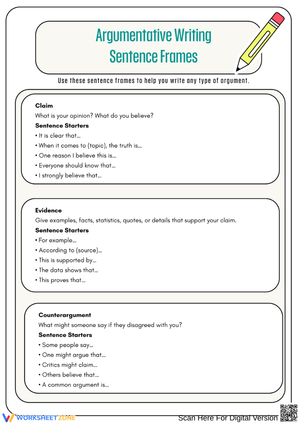
the quality of being believable or trustworthy: credibility. informational literature that includes a writer's opinions and feelings: subjective point of view. informational literature that does not includes a writer's opinions and feelings; factual: objective point of view. A statement that can be proved: fact. numerical data: Statistics. to repeat exactly what someone else has said or written: quote. a specific case used to illustrate or represent a group of people, ideas, conditions, experiences, or the like: example. Appeal that relies on the speaker's credibility: Ethos. Appeal to emotion: pathos. Appeal to logic: Logos. A statement put forth and supported by evidence: Argument. a point of view or general standpoint from which different things are viewed, physically or mentally: Perspective. the writer's position on an issue or problem, usually supported by evidence: claim. a cause, explanation, or justification for an action or event: reason. proof, usually found directly in the text: evidence. an opposing argument to the one a writer is putting forward: counterargument. A counterargument, especially in debate: rebuttal. An original document containing the observations, ideas, and conclusions of an individual. It is a firsthand account presented by someone present or actively participating in the event. Examples include manuscripts, photographs, oral histories, and personal journals: Primary Source. A secondhand account of an event or a retelling of another person's observations written by someone who did not witness or actually participate in the events. Includes sources that combine, synthesize, and or interpret information from primary sources. Examples include encyclopedias, textbooks, and reviews: Secondary Source. prejudice in favor of or against one thing, person, or group compared with another: bias

Grade:Grade 6_AI - Grade 8_AI
--