


























Views
Plays


Essential Spelling Practice Worksheet | Grade 1 English
Paste this activity's link or code into your existing LMS (Google Classroom, Canvas, Teams, Schoology, Moodle, etc.).
Students can open and work on the activity right away, with no student login required.
You'll still be able to track student progress and results from your teacher account.
This Grade 1 spelling worksheet provides a rigorous approach to word recognition and orthographic accuracy. By presenting students with 20 distinct multiple-choice challenges, the resource helps learners identify correct letter sequences in complex, multisyllabic words. This targeted practice ensures that students move beyond simple phonics to master conventional spelling patterns required for fluent writing and reading comprehension.
At a Glance
- Grade: 1 · Subject: English
- Standard:
CCSS.ELA-LITERACY.L.1.2.E— Spell untaught words phonetically and apply common spelling patterns for grade-level words- Skill Focus: Multisyllabic spelling and suffix usage
- Format: 2 pages · 20 problems · Answer key included · PDF
- Best For: Weekly spelling assessments or morning work
- Time: 15–20 minutes
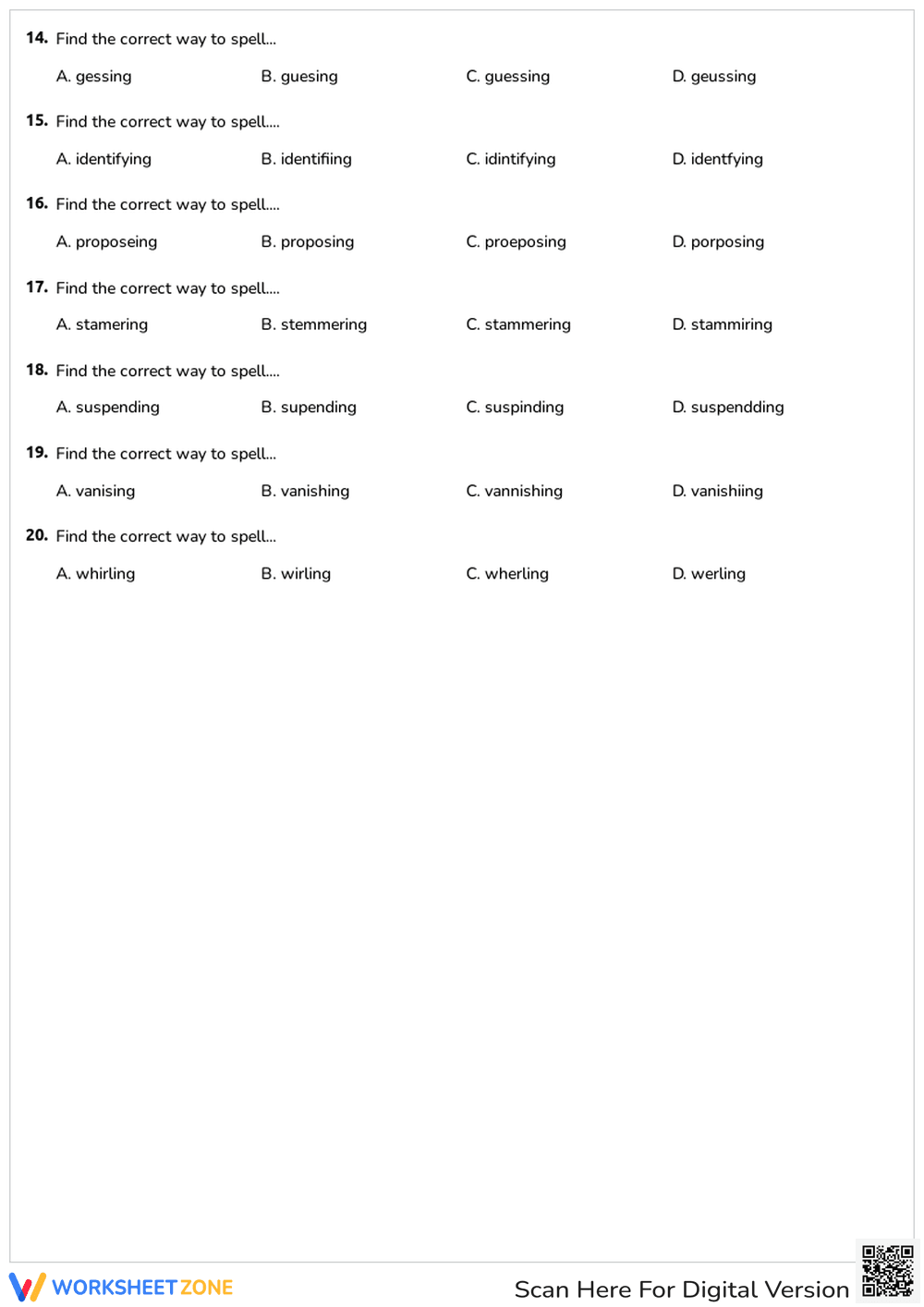
What's Inside: This comprehensive 2-page PDF features 20 high-frequency and academic vocabulary words, including terms like "applauded," "concentrated," and "identifying." Each question follows a consistent four-option multiple-choice format, designed to isolate common phonetic errors and visual spelling traps. The layout is clean and distraction-free, allowing students to focus entirely on the linguistic task at hand. A full answer key is provided for rapid grading.
Zero-Prep Workflow
- Print (1 minute): Simply select the two pages and print enough copies for your roster. No cutting or assembly required.
- Distribute (30 seconds): Hand out the worksheets as a quiet-start activity or a formal spelling quiz. The instructions are self-explanatory for young readers.
- Review (30 seconds): Use the included answer key for immediate feedback or peer-grading sessions to reinforce correct spelling visually.
This resource is specifically designed to function as a standalone sub plan or a quick formative assessment, requiring less than two minutes of total teacher preparation time.
Standards Alignment: This worksheet aligns with `CCSS.ELA-LITERACY.L.1.2.E`, focusing on the application of conventional spelling patterns. While the vocabulary is advanced, it challenges students to apply their knowledge of suffixes like -ed and -ing to root words. Both standard codes can be copied directly into lesson plans, IEP goals, or district curriculum mapping tools.
How to Use It: Assign this worksheet during the "You Do" phase of a gradual release lesson on spelling conventions. It serves as an excellent formative assessment tool; teachers should observe if students are struggling with specific suffix transitions (e.g., doubling consonants before adding -ed). Expect most students to complete the 20 questions within a 15-to-20-minute window.
Who It's For: This resource is ideal for Grade 1 students who are ready for advanced spelling challenges or for Grade 2 and 3 students needing remedial support with multisyllabic words. It pairs naturally with a weekly spelling list or an anchor chart detailing the rules for adding suffixes to verbs.
According to Fisher & Frey (2014), the use of multiple-choice formats in spelling instruction allows students to engage in critical visual discrimination, a key component of orthographic mapping. This worksheet utilizes 20 specific tasks to reinforce the standard CCSS.ELA-LITERACY.L.1.2.E, ensuring students can distinguish between phonetically plausible but incorrect spellings and the conventional forms of academic words. By focusing on words with complex internal structures, the resource bridges the gap between basic phonics and mature literacy. Research indicates that frequent, low-stakes testing of spelling patterns significantly improves long-term retention compared to rote memorization alone. This document provides a structured, evidence-based method for assessing student progress in English Language Arts, making it a reliable tool for classroom teachers and literacy specialists seeking to document mastery of foundational writing conventions in early elementary education.


