


























Views
Downloads

Printable Animal Movement Worksheet | Grade 1 Science
Paste this activity's link or code into your existing LMS (Google Classroom, Canvas, Teams, Schoology, Moodle, etc.).
Students can open and work on the activity right away, with no student login required.
You'll still be able to track student progress and results from your teacher account.
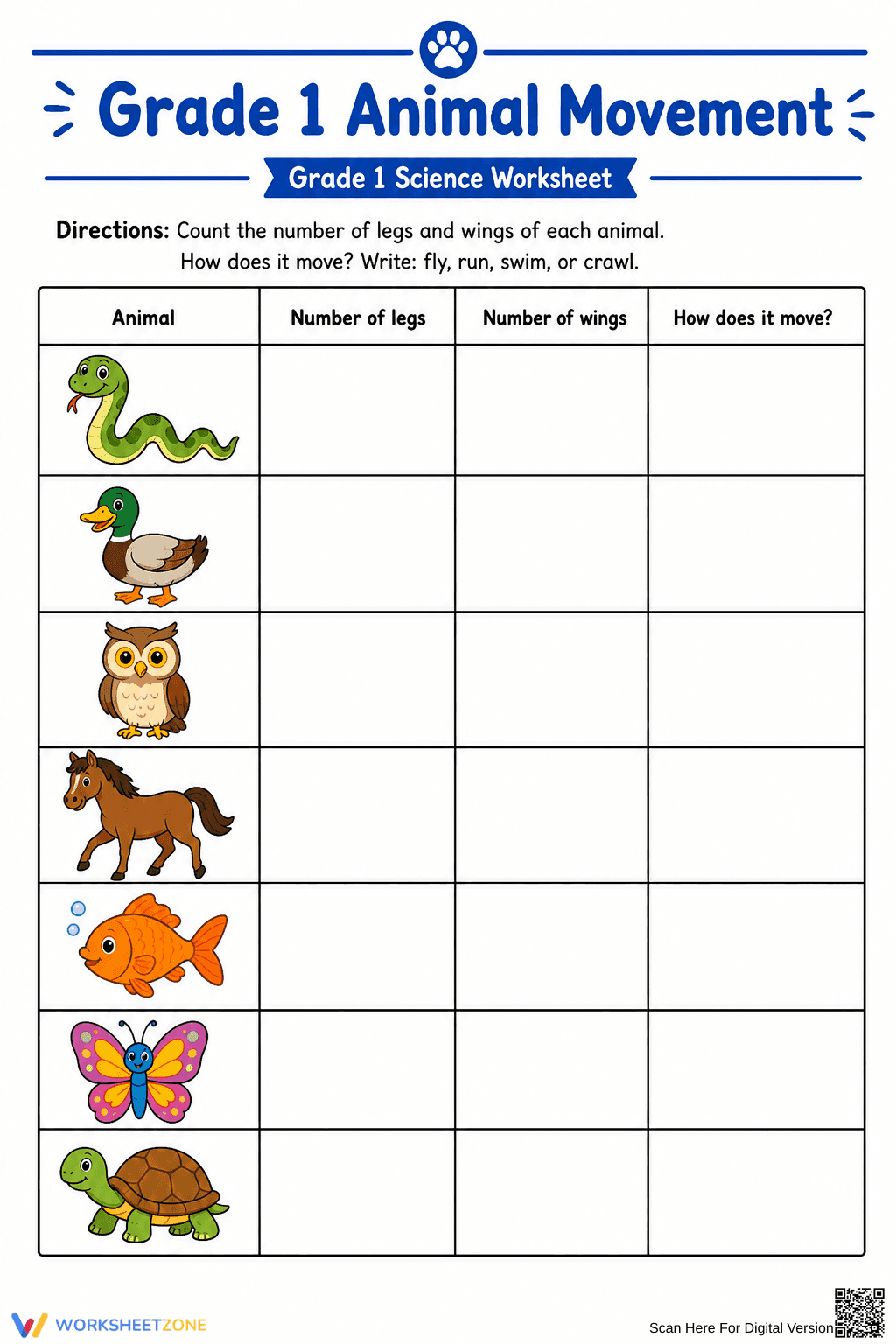
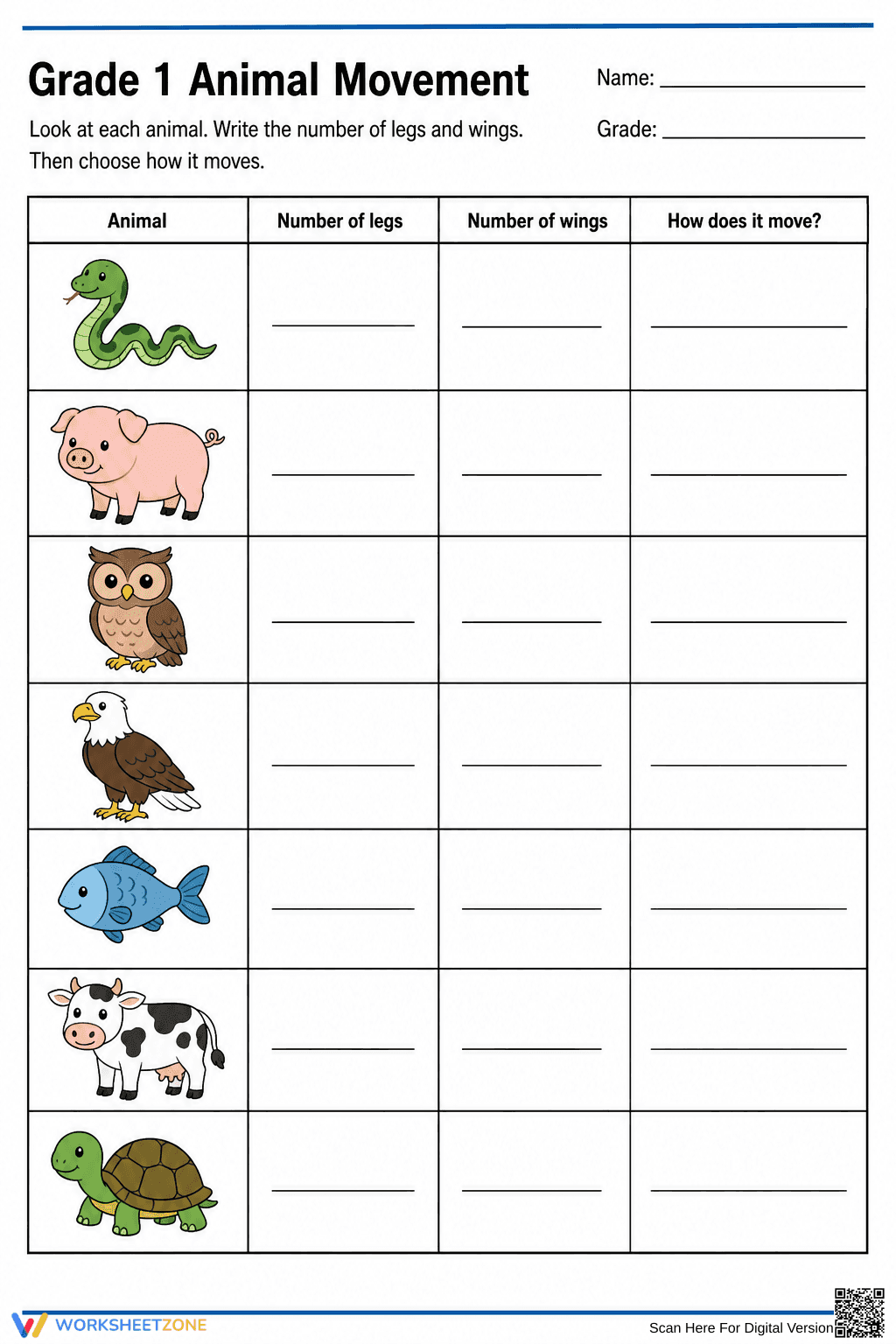
This Grade 1 science worksheet helps young learners observe and classify how different animals use their external features to navigate their environments. Students identify the number of legs and wings on various animals, connecting these physical structures to specific movements like swimming, flying, or crawling to build foundational biological observation skills.
At a Glance
- Grade: 1 · Subject: Science
- Standard:
1-LS1-1— Identify how animals use external parts to move- Skill Focus: Structural Observation & Classification
- Format: 2 pages · 14 problems · Answer key included · PDF
- Best For: Independent Practice or Science Centers
- Time: 15–20 minutes
What's Inside
The PDF package contains two pages of student activities and a corresponding answer key for rapid grading. The worksheet features a clean tabular layout with high-contrast animal illustrations, including a snake, eagle, fish, and turtle. Students record the number of legs and wings for each specimen and select the appropriate movement category from a provided word list.
Zero-Prep Workflow
This resource is designed for a zero-prep workflow in busy classrooms. Teachers can print the pages in under 30 seconds, distribute them to the class for immediate engagement, and review the results using the provided answer key in less than a minute. Total teacher prep time is under two minutes. The intuitive layout makes it an ideal choice for emergency sub plans or quick transitions.
Standards Alignment
This activity is aligned with 1-LS1-1, which requires students to understand how organisms have external parts that help them survive, grow, and meet their needs. By analyzing the relationship between physical structures (wings and legs) and functions (movement), students master the core concepts of biological structure and function. Both standard codes can be copied directly into lesson plans, IEP goals, or district curriculum mapping tools.
How to Use It
Use this worksheet as a formative assessment after a direct instruction lesson on animal habitats or physical traits. It works effectively as an independent practice activity to gauge student understanding of how physical features dictate behavior. Teachers should observe if students correctly identify the absence of legs in snakes and fish to assess their attention to detail. Expected completion time is 15 to 20 minutes.
Who It's For
This resource is perfect for first-grade students or Kindergarteners in need of a challenge. It provides visual scaffolding through clear illustrations, making it accessible for English Language Learners and students with varied reading levels. Pair this worksheet with a short video clip showing the animals in motion or an anchor chart displaying animal body parts.
Scientific literacy in early childhood begins with the ability to observe and categorize physical traits. This Grade 1 worksheet aligns with the 1-LS1-1 standard by requiring students to analyze external animal parts and their functional roles in movement. According to the RAND AIRS 2024 report, structured classification tasks in primary science significantly improve retention of biological concepts and prepare students for higher-order ecological reasoning. By identifying that an eagle uses wings to fly while a cow uses legs to run, students develop a functional understanding of structure-function relationships. This activity provides the quantitative practice necessary for mastery, featuring fourteen distinct animal examples that challenge common misconceptions about locomotion. High-quality, print-ready science materials reduce teacher administrative burden, allowing for more focused direct instruction. This comprehensive worksheet ensures that learners can independently verify their observations, fostering a sense of scientific agency within a standard-aligned framework.


