


























Views
Downloads
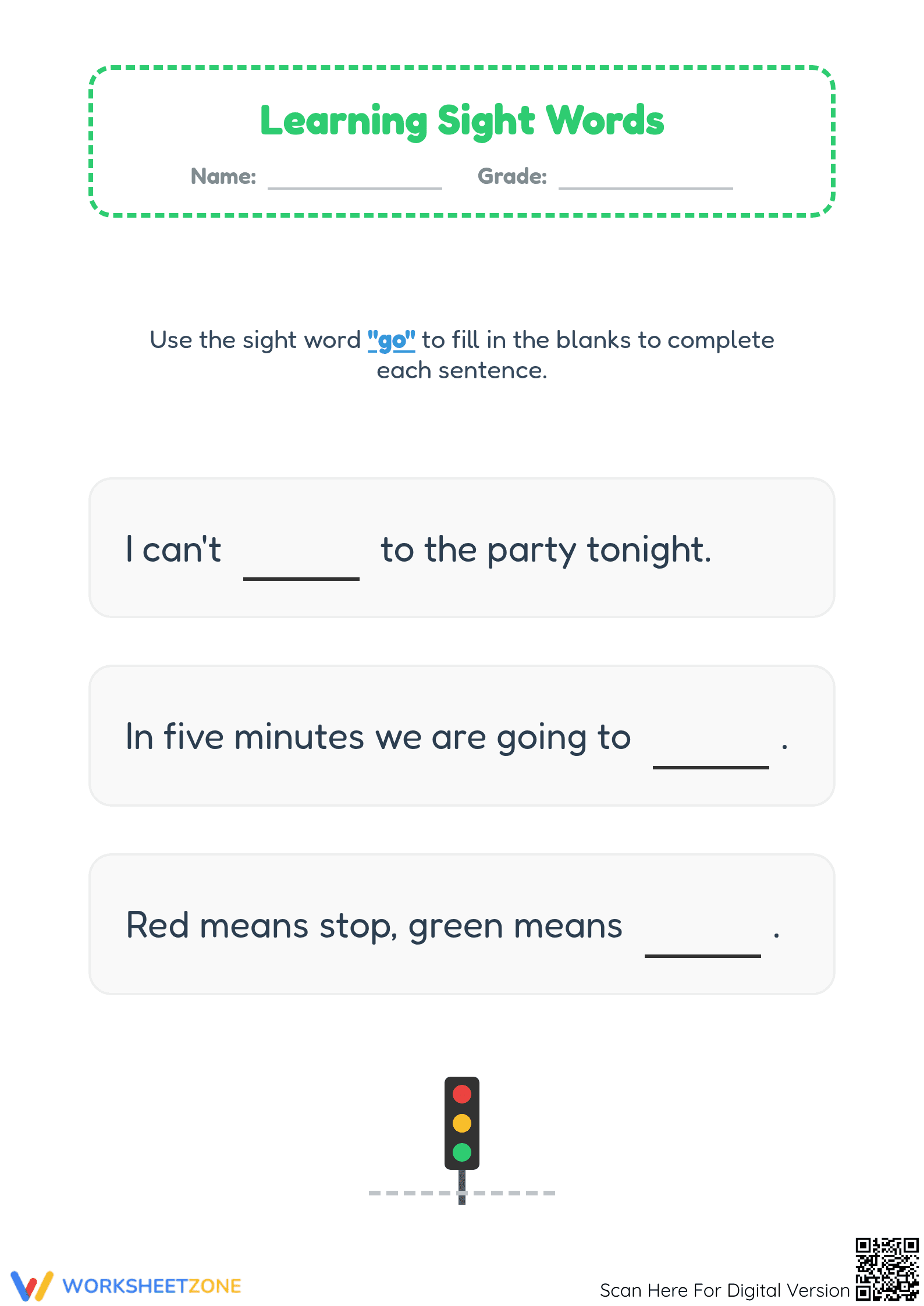


"Go" Sight Word Worksheet | Essential Kindergarten English
Paste this activity's link or code into your existing LMS (Google Classroom, Canvas, Teams, Schoology, Moodle, etc.).
Students can open and work on the activity right away, with no student login required.
You'll still be able to track student progress and results from your teacher account.
This Kindergarten sight word worksheet provides targeted practice for the high-frequency word "go." Students engage in sentence completion to build automaticity and context-based recognition. By integrating handwriting with reading, the resource ensures that learners develop a multi-sensory connection to this essential vocabulary term, leading to improved fluency in early reading stages.
At a Glance
- Grade: Kindergarten · Subject: English
- Standard:
RF.K.3.C— Read common high-frequency words by sight (e.g., the, of, to, you, she, my, is, are, do, does)- Skill Focus: Sight word "go" recognition and usage
- Format: 2 pages · 7 problems · Answer key included · PDF
- Best For: Literacy centers and morning work routines
- Time: 10–15 minutes
This 2-page PDF features seven distinct fill-in-the-blank sentences designed for early readers. Each task provides a clear context clue to help students identify where the word "go" belongs. The layout includes large, legible fonts and ample writing space for developing fine motor skills. A comprehensive answer key is provided to facilitate quick grading or self-correction.
- Guided practice: The first page introduces the word "go" in simple, declarative sentences with visual cues like a traffic light to reinforce meaning.
- Supported practice: Students transition to more complex sentence structures, including negative contractions like "can't," requiring higher cognitive engagement.
- Independent practice: The second page offers four additional sentences, including questions and imperatives, to solidify the word's versatility in different grammatical contexts.
This worksheet follows a gradual-release model, moving from highly scaffolded visual associations to independent application in varied sentence types.
This resource is directly aligned with CCSS.ELA-LITERACY.RF.K.3.C, which requires students to read common high-frequency words by sight. It specifically targets the word "go," a foundational component of the Kindergarten sight word list. This standard code can be copied directly into lesson plans, IEP goals, or district curriculum mapping tools.
Use this worksheet during small-group literacy rotations as a formative assessment tool. Observe if students can read the surrounding words or if they rely solely on the prompt to fill the blank. Alternatively, assign it as a no-prep morning work activity to reinforce word recognition immediately upon arrival. Completion typically takes 10 to 15 minutes.
This resource is designed for Kindergarten students beginning their journey into phonics and sight word recognition. It is also suitable for English Language Learners (ELL) or older students in Tier 2 intervention who need repetitive exposure to high-frequency words. Pair this with a "go" themed anchor chart or a leveled reader for maximum impact.
High-frequency word instruction is a cornerstone of early literacy development, as these words often do not follow standard phonetic rules. According to Fisher & Frey (2014), the gradual release of responsibility—moving from teacher-led modeling to independent student practice—is vital for ensuring that foundational skills like sight word recognition are internalized. This worksheet applies that research by providing 7 structured opportunities for students to interact with the word "go" in context. By requiring students to physically write the word within a sentence, the resource leverages the generation effect, where the act of producing the word strengthens the neural pathways associated with memory and recall. Aligned to CCSS.ELA-LITERACY.RF.K.3.C, this tool helps Kindergarteners achieve the automaticity required for fluent reading. Educators can use this data-driven approach to bridge the gap between isolated word recognition and functional reading comprehension in early childhood classrooms.


