


























Views
Downloads

Printable Lowercase Letters o-u Tracing Worksheet | Grade K
Paste this activity's link or code into your existing LMS (Google Classroom, Canvas, Teams, Schoology, Moodle, etc.).
Students can open and work on the activity right away, with no student login required.
You'll still be able to track student progress and results from your teacher account.
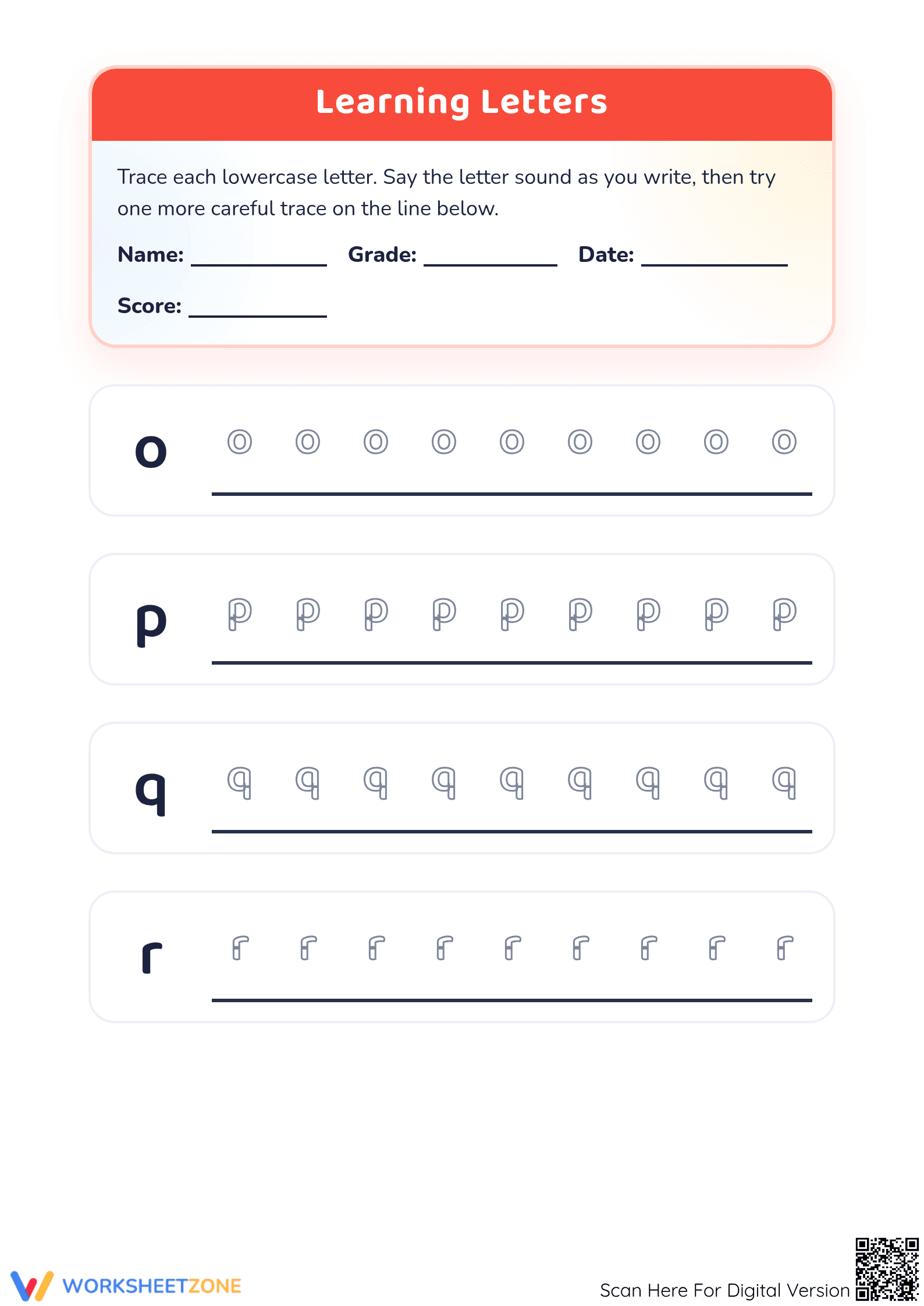
This comprehensive 2-page alphabet worksheet focuses on the precise formation of lowercase letters o through u. Students engage in repetitive tracing and independent printing to solidify their fine motor control and letter-sound associations. By integrating kinesthetic writing with phonemic awareness, this resource ensures early learners develop the foundational skills necessary for fluent reading and writing.
At a Glance
- Grade: Kindergarten · Subject: English Language Arts
- Standard:
CCSS.ELA-LITERACY.L.K.1.A— Print lowercase letters o-u with correct formation, directionality, and spacing- Skill Focus: Lowercase Handwriting (o-u)
- Format: 2 high-quality pages · 70 tasks · Answer key included · PDF
- Best For: Essential daily handwriting practice or student morning work
- Time: 15–20 minutes
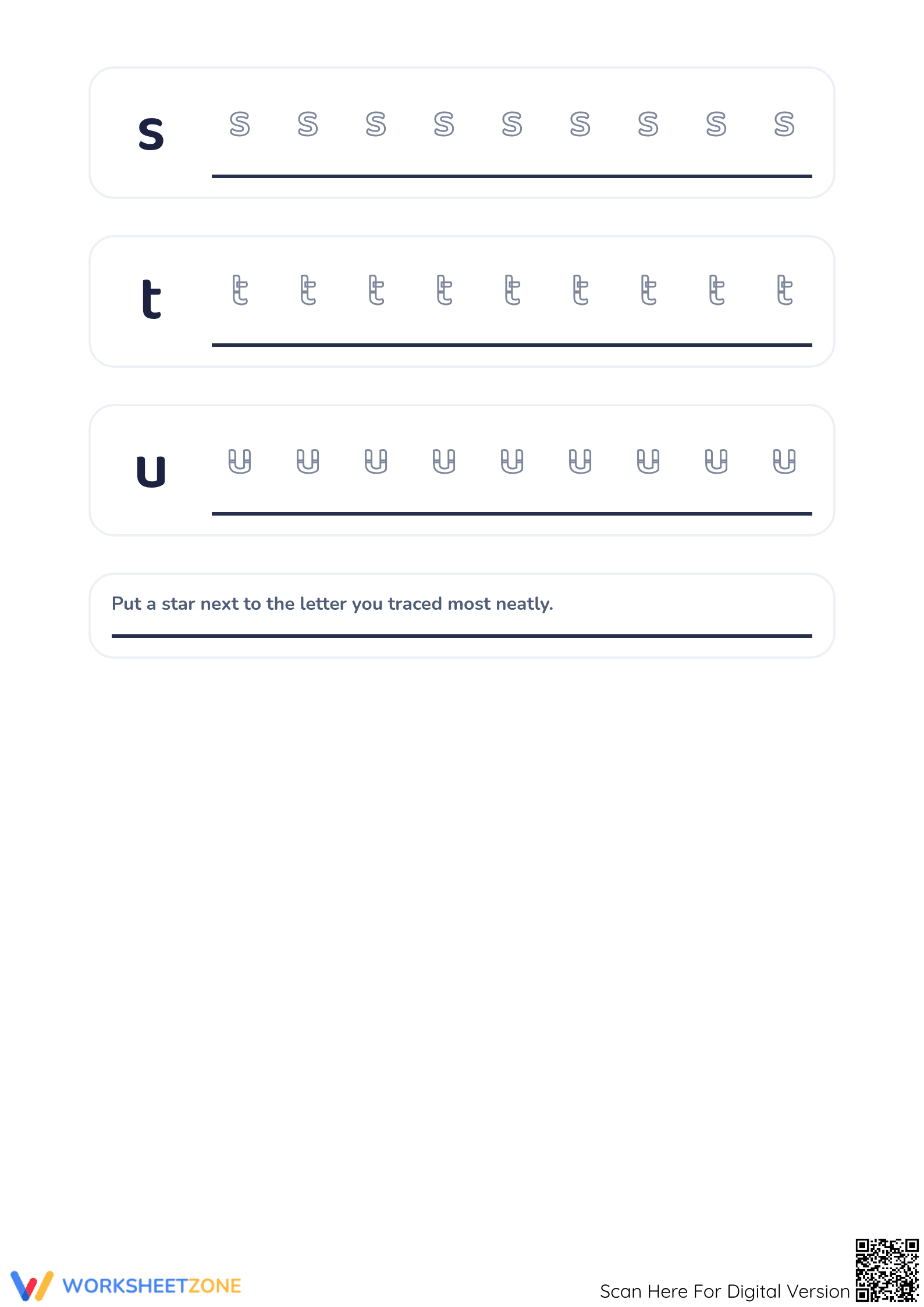
This printable resource contains two pages of targeted alphabet practice. Each letter section (o, p, q, r, s, t, u) features a clear reference letter, followed by a row of nine tracing prompts to guide the initial stroke pattern. Below the tracing row, a solid line provides space for students to attempt independent letter formation. The second page concludes with a unique self-evaluation prompt, encouraging students to place a star next to their neatest work.
The worksheet follows a structured release of responsibility to ensure student success. First, Guided Practice utilizes faint tracing prompts to establish the correct starting points and directional paths for each letter. Next, Supported Practice allows students to transition from tracing to freehand writing on a guided baseline. Finally, Independent Practice is achieved through the free-writing section where students apply their learned muscle memory. This gradual progression effectively bridges the gap between mechanical tracing and autonomous letter production.
The primary standard addressed is `CCSS.ELA-LITERACY.L.K.1.A`, which requires students to print many upper- and lowercase letters correctly. This worksheet specifically isolates the lowercase sequence from o to u, allowing for deep concentration on similar stroke patterns. Both standard codes can be copied directly into lesson plans, IEP goals, or district curriculum mapping tools.
Incorporate this worksheet during your literacy center rotation or as a quiet morning work activity. Before students begin, model the 'trace and say' method mentioned in the instructions to reinforce letter-sound correspondence. As a formative assessment, observe students' pencil grip and the direction of their strokes—particularly the 'tail' on the letter 'q' and 'p'—to ensure they are forming letters from top to bottom. Expect most kindergarteners to complete both pages within 20 minutes.
This resource is designed for preschool and kindergarten students beginning their handwriting journey, as well as first-grade students needing remedial fine motor support. It pairs naturally with letter-of-the-week curriculum models or phonics anchor charts.
Effective handwriting instruction in early childhood is a critical predictor of later writing success, as students who can form letters automatically can devote more cognitive resources to higher-order composition tasks. According to Fisher & Frey (2014), the gradual release of responsibility model—moving from guided tracing to independent writing—is essential for internalizing the fine motor patterns required for the `CCSS.ELA-LITERACY.L.K.1.A` standard. This worksheet provides the exact volume of practice needed to move from recognition to production of lowercase letters o-u. By emphasizing the letter sounds during the writing process, teachers can simultaneously address phonemic awareness and orthographic mapping. Standardized analysis from the NAEP consistently highlights that early mastery of letter formation correlates with higher literacy scores in subsequent grade levels, making this targeted practice an essential component of a classroom-ready ELA curriculum.


