


























Views
Downloads
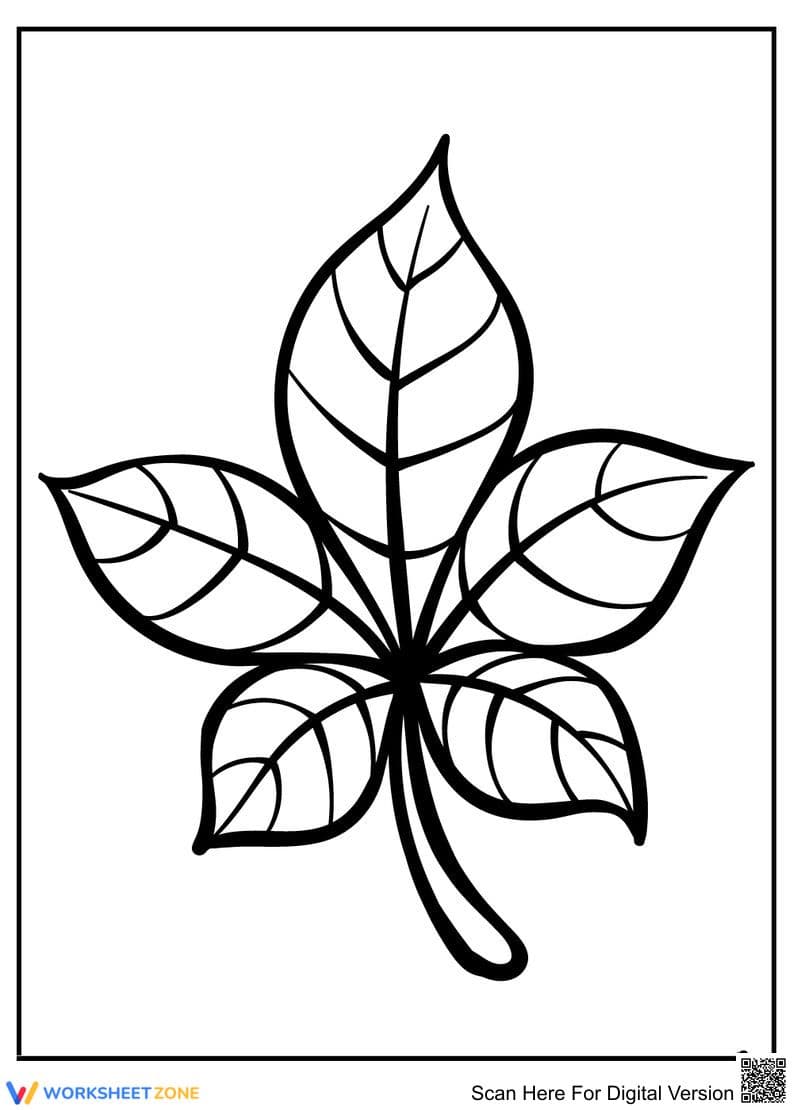

Leaf Coloring Page | Essential Nature Ready Printable
Paste this activity's link or code into your existing LMS (Google Classroom, Canvas, Teams, Schoology, Moodle, etc.).
Students can open and work on the activity right away, with no student login required.
You'll still be able to track student progress and results from your teacher account.
This printable leaf coloring worksheet provides students with a high-quality nature illustration to develop fine motor control and artistic expression. By focusing on the intricate veins and lobes of the leaf, learners engage in observational science while practicing the precision required for handwriting and creative arts.
At a Glance
- Grade: K-5 · Subject: Arts & Nature
- Standard:
K-LS1-1— Use observations to describe patterns of what plants and animals need to survive- Skill Focus: Fine motor precision and botanical observation
- Format: 1 page · 1 task · No answer key needed · PDF
- Best For: Morning work or science center activity
- Time: 10–15 minutes
Inside this resource, you will find a single-page PDF featuring a large, five-lobed leaf with clear, bold outlines. The design includes detailed internal vein structures, providing multiple small areas for students to practice color blending or shading. This 1-page layout is optimized for standard printer paper and requires no additional materials beyond crayons or markers.
The zero-prep workflow for this worksheet is designed for maximum efficiency. First, print the single-page PDF (30 seconds). Second, distribute the sheets to students along with coloring supplies (1 minute). Third, review the finished work or use it as a springboard for a nature discussion. Total teacher preparation time is under 2 minutes, making it an ideal sub plan or transition activity.
This activity aligns with `K-LS1-1`, as it encourages students to observe the physical structures of plants. By identifying the stem, veins, and lobes, students build the foundational knowledge necessary for more complex biological studies. This standard code can be copied directly into lesson plans, IEP goals, or district curriculum mapping tools.
Use this worksheet during a science unit on seasons or plant life cycles. It serves as an excellent formative assessment for fine motor development in younger grades. For older students, use it as a mindfulness activity or a fast finisher task. Expected completion time ranges from 10 to 15 minutes depending on the level of detail applied.
This resource is designed for Preschool through Grade 5 students, particularly those needing extra practice with grip strength and hand-eye coordination. It pairs naturally with a nature walk or a read-aloud book about autumn leaves and forest ecosystems.
Research from the RAND AIRS 2024 report emphasizes that integrating tactile activities like coloring into early childhood education supports the development of intrinsic motivation and spatial awareness. This leaf coloring page addresses the K-LS1-1 standard by facilitating botanical observation through artistic engagement. Studies in the Fisher & Frey (2014) framework suggest that visual-motor tasks are critical precursors to formal writing skills. By providing a clear, structured image, this worksheet allows students to practice staying within the lines, a fundamental skill for developing the muscle memory required for letter formation. Furthermore, the use of nature-themed content aligns with NAEP recommendations for environmental literacy in early elementary grades. This 1-page printable is a reliable tool for educators seeking to bridge the gap between creative play and standards-based science observation in a classroom setting.


