


























Views
Downloads

Latin Adverbs and Conjunctions Sorting | Essential Grade 6
Paste this activity's link or code into your existing LMS (Google Classroom, Canvas, Teams, Schoology, Moodle, etc.).
Students can open and work on the activity right away, with no student login required.
You'll still be able to track student progress and results from your teacher account.
This Latin grammar worksheet helps middle school students master the distinction between adverbs and conjunctions through active classification. By sorting high-frequency Latin vocabulary, learners build foundational linguistic skills necessary for translation. This resource ensures students can identify word functions before applying them in original writing exercises.
At a Glance
- Grade: 6 · Subject: ELA Grammar
- Standard:
CCSS.ELA-LITERACY.L.6.1— Demonstrate command of the conventions of standard grammar and usage when writing- Skill Focus: Latin Adverbs vs. Conjunctions
- Format: 2 pages · 14 problems · Answer key included · PDF
- Best For: Latin introductory lessons or grammar reinforcement
- Time: 15–20 minutes
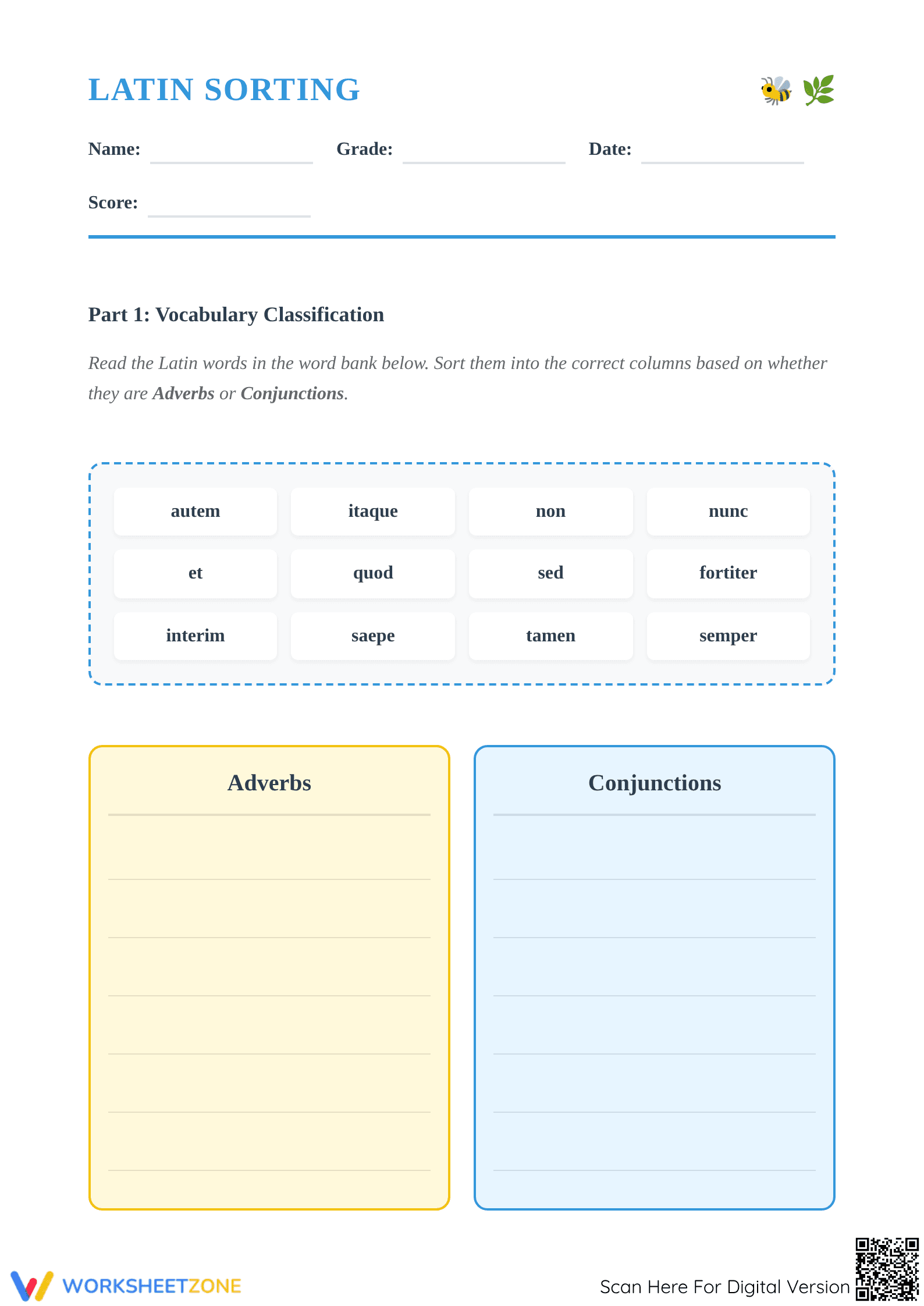
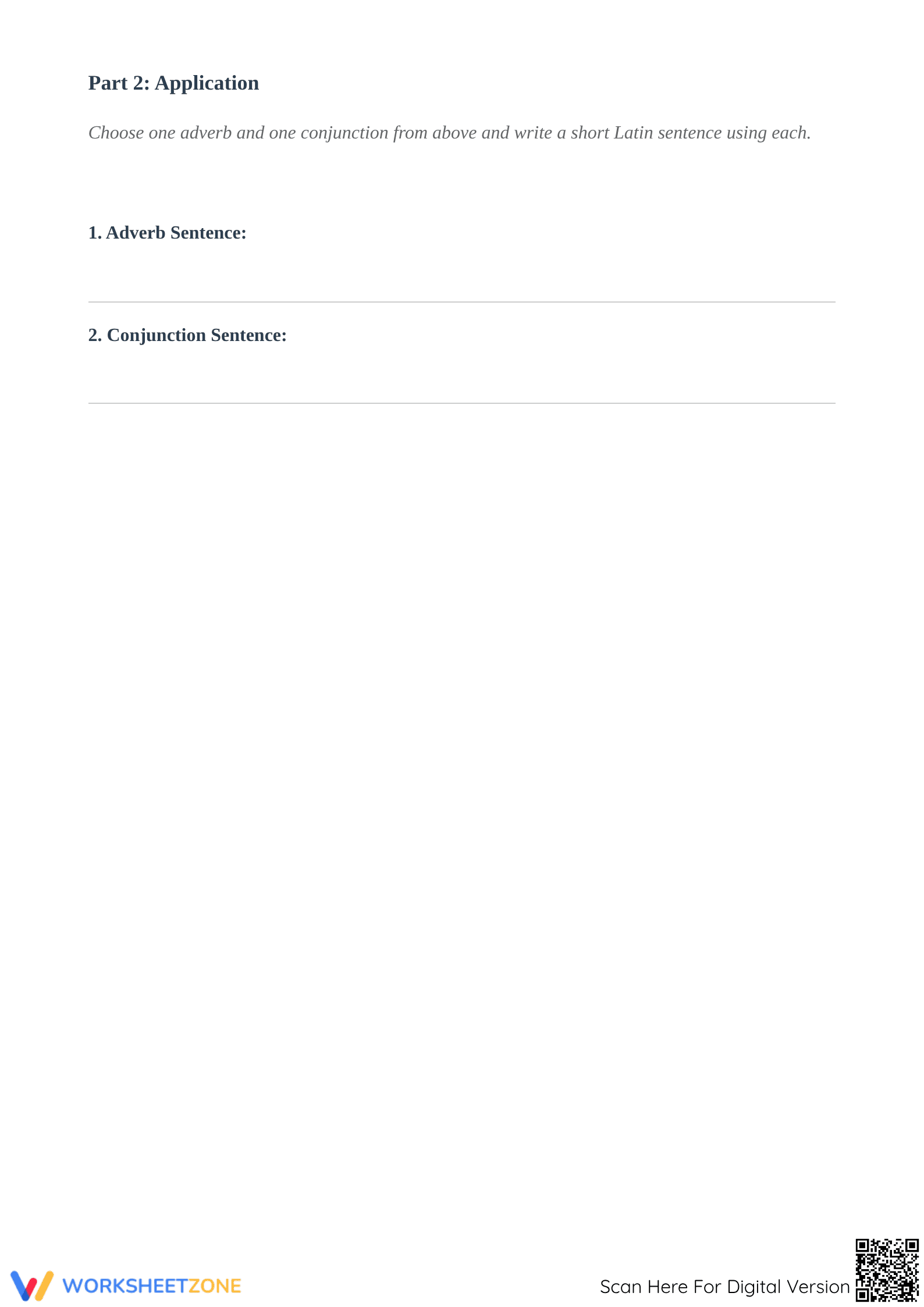
The worksheet features a clear, two-page layout. Page one contains a word bank with 12 essential Latin terms, including "autem" and "semper," for categorization into a two-column table. Page two moves into application, providing space for students to compose original Latin sentences using the classified words. A complete answer key is included for rapid grading.
The zero-prep design allows for immediate classroom implementation. First, print the two-page PDF (30 seconds). Second, distribute the worksheets for independent sorting (10-15 minutes). Finally, use the provided answer key to review the 12 classification items and 2 application sentences (5 minutes). This workflow minimizes administrative time while maximizing student engagement with Latin vocabulary.
This resource is aligned with CCSS.ELA-LITERACY.L.6.1, which requires students to demonstrate command of the conventions of standard grammar and usage. While focused on Latin, the exercise reinforces the universal understanding of parts of speech and how they function within a sentence. Both standard codes can be copied directly into lesson plans, IEP goals, or district curriculum mapping tools.
Use this worksheet as a formative assessment after introducing Latin parts of speech. It works effectively as a bell-ringer or homework. During sorting, observe if students confuse "itaque" with adverbs; this provides a perfect opening for a mini-lesson on conjunctions. Expect students to complete the full activity in 15 to 20 minutes.
This activity is tailored for Grade 6 and 7 students beginning Latin or ELA students exploring linguistic roots. It provides scaffolding for visual learners through the sorting table. Pair this worksheet with a Latin dictionary or an anchor chart to support students who require additional vocabulary assistance during the writing phase.
According to Fisher & Frey (2014), the use of categorization and sorting tasks is a fundamental instructional strategy for developing cognitive flexibility and linguistic precision. This Latin Sorting worksheet directly addresses CCSS.ELA-LITERACY.L.6.1 by requiring students to distinguish between functional parts of speech, specifically adverbs and conjunctions. By isolating 12 specific Latin terms, students engage in comparative analysis that strengthens their understanding of how words modify actions or connect ideas. Research indicates that cross-linguistic studies, such as comparing Latin structures to English grammar, enhance metalinguistic awareness and vocabulary acquisition. This resource provides 14 distinct opportunities for students to apply classification skills before transitioning to independent sentence construction. The inclusion of a comprehensive answer key ensures that educators can provide immediate feedback, a critical component of the gradual release of responsibility model. This structured approach facilitates the transition from rote memorization to active grammatical application in middle school curricula.


