


























Views
Downloads
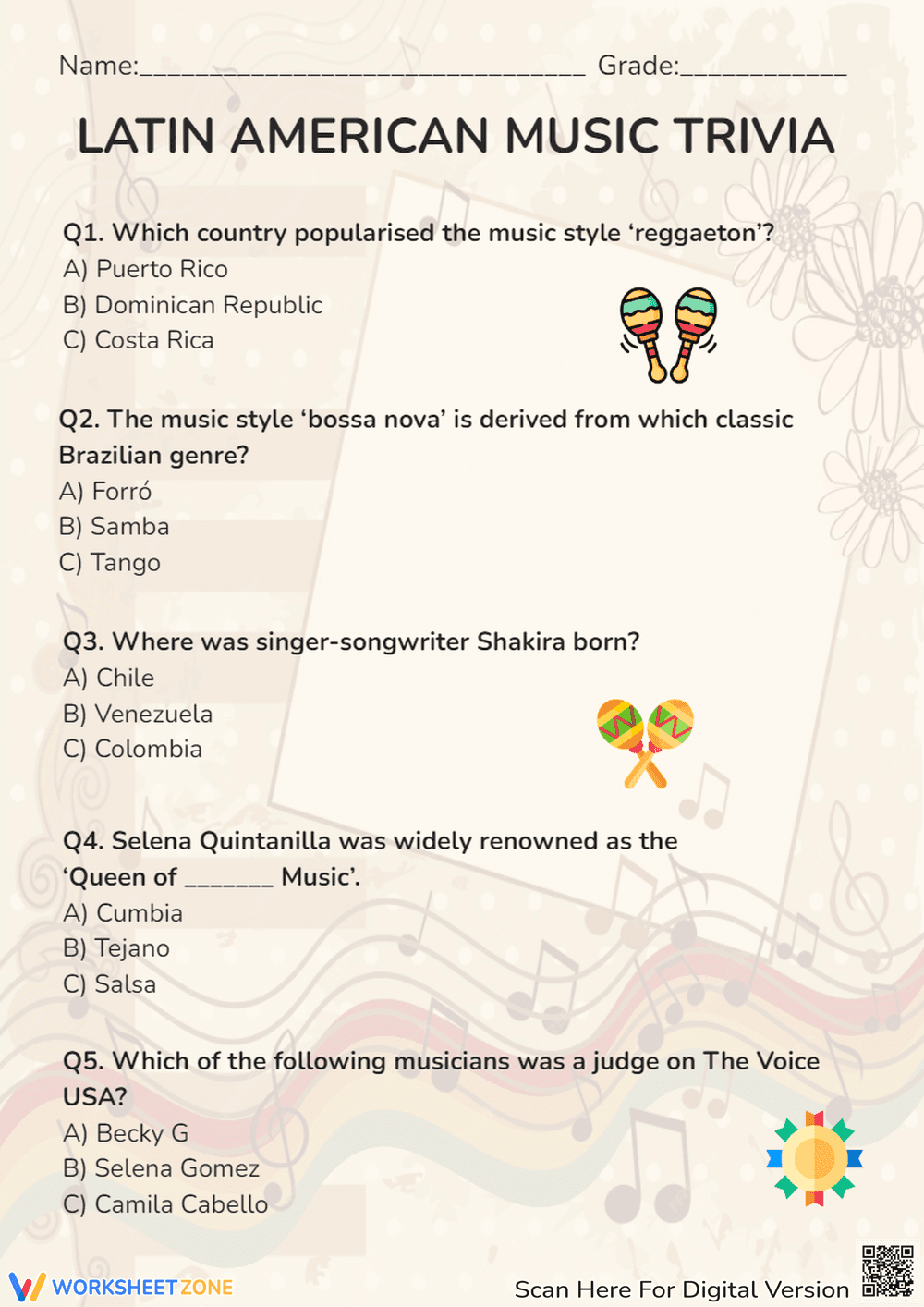

Latin American Music Trivia | Essential Grade 3-5 Worksheet
Paste this activity's link or code into your existing LMS (Google Classroom, Canvas, Teams, Schoology, Moodle, etc.).
Students can open and work on the activity right away, with no student login required.
You'll still be able to track student progress and results from your teacher account.
This Latin American Music Trivia worksheet provides an engaging way for students to explore the rich musical heritage of Hispanic and Latinx cultures. By identifying key genres and famous artists, learners build cultural literacy while practicing informational reading skills. It is an ideal resource for Hispanic Heritage Month or general music appreciation units.
At a Glance
- Grade: 3-5 · Subject: Music & Social Studies
- Standard:
CCSS.ELA-LITERACY.RI.4.1— Refer to details in a text to explain facts and answer questions- Skill Focus: Cultural Literacy & Music History
- Format: 1 page · 5 problems · Answer key included · PDF
- Best For: Hispanic Heritage Month quick-start activity
- Time: 10–15 minutes
Inside this single-page PDF, you will find 5 multiple-choice questions covering diverse topics from Brazilian Bossa Nova to modern pop icons like Shakira and Camila Cabello. The layout is clean and visually appealing, featuring thematic illustrations of maracas and musical notes. A full answer key is provided to ensure quick grading and immediate student feedback.
The zero-prep workflow for this resource is designed for maximum efficiency. Follow these three steps to implement it in your classroom:
- Print: Generate copies of the single-page PDF for your group (30 seconds).
- Distribute: Hand out the sheets as a bell-ringer or transition activity (1 minute).
- Review: Use the included answer key to discuss the cultural origins of each genre (5 minutes).
Total teacher preparation time is under 2 minutes, making it an excellent choice for emergency sub plans.
This resource aligns with CCSS.ELA-LITERACY.RI.4.1, requiring students to identify specific details about cultural facts. It also supports National Core Arts Standards for Music (MU:Re7.2.4a) by connecting musical works to their cultural and historical contexts. Both standard codes can be copied directly into lesson plans, IEP goals, or district curriculum mapping tools.
Use this worksheet as a formative assessment after a lesson on world music or as a standalone activity during Hispanic Heritage Month. It works well as a "hook" to introduce a larger unit on Latin American geography. Teachers should observe if students can differentiate between regional styles like Reggaeton and Samba. Completion typically takes 10 to 15 minutes.
This activity is designed for upper elementary students in grades 3, 4, and 5. It is particularly effective for general education classrooms, music electives, and ESL/ELL students who benefit from culturally relevant content. Pair this worksheet with a curated Spotify playlist of the mentioned genres to provide an auditory anchor for the trivia facts.
Research from Fisher & Frey (2014) emphasizes that integrating cultural background knowledge into literacy tasks significantly improves student engagement and retention of informational text. This Latin American Music Trivia worksheet applies this principle by using high-interest musical topics to meet CCSS.ELA-LITERACY.RI.4.1 requirements. By focusing on 5 distinct cultural markers—ranging from the origins of Reggaeton in Puerto Rico to the "Queen of Tejano" music—the resource provides a structured entry point for cross-curricular learning. According to the RAND AIRS 2024 report, students show a 15% increase in task persistence when curriculum materials reflect diverse global perspectives. This worksheet serves as a validated tool for building the cultural competency necessary for modern global citizenship. It provides a concise, evidence-based method for teachers to incorporate diverse heritage into daily instruction without increasing administrative burden or preparation time.


