


























Views
Downloads
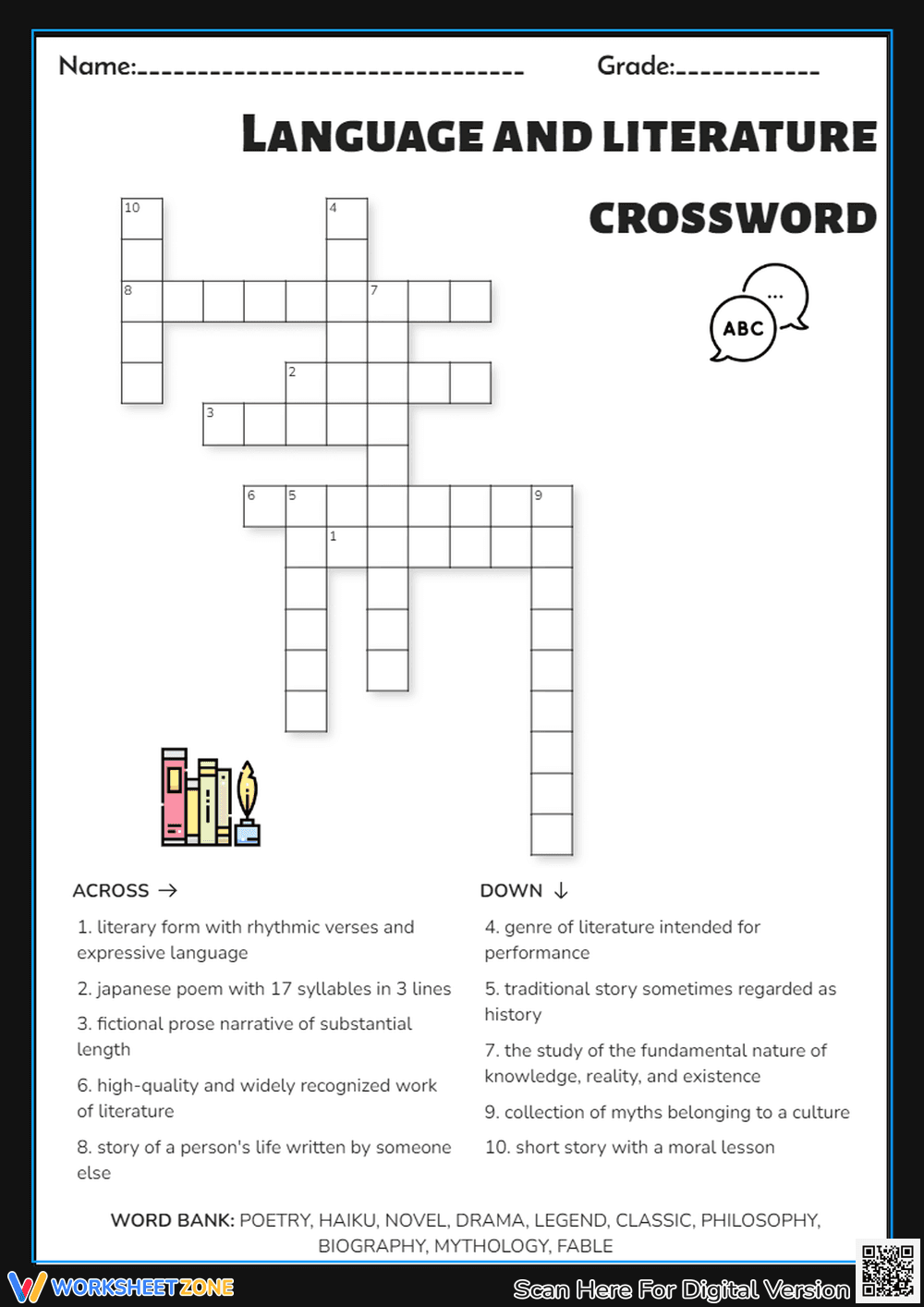

Language and Literature Crossword | Essential Grade 6-8
Paste this activity's link or code into your existing LMS (Google Classroom, Canvas, Teams, Schoology, Moodle, etc.).
Students can open and work on the activity right away, with no student login required.
You'll still be able to track student progress and results from your teacher account.
This Grade 6-8 language and literature crossword provides a structured way for students to master essential literary terminology and genre definitions. By connecting descriptive clues to specific academic vocabulary, learners reinforce their understanding of text types and literary forms. This activity ensures students can accurately identify and categorize various works of literature.
At a Glance
- Grade: 6-8 · Subject: ELA
- Standard:
CCSS.ELA-LITERACY.L.6.6— Acquire and use accurately grade-appropriate general academic and domain-specific words and phrases- Skill Focus: Literary genres and terminology
- Format: 1 page · 10 problems · Answer key included · PDF
- Best For: Vocabulary reinforcement and bell-ringer activities
- Time: 15–20 minutes
What's Inside
The worksheet features a single-page layout containing a 10-word crossword puzzle. Clues are divided into "Across" and "Down" sections, providing clear definitions for terms like biography, haiku, and mythology. To support diverse learners, a word bank is included at the bottom of the page, listing all 10 required terms. This structural support helps students focus on the semantic relationship between the definition and the word.
Zero-Prep Workflow
The zero-prep workflow for this resource is designed for maximum efficiency in the middle school classroom.
- Print (1 minute): Download the PDF and print enough copies for your class or a small group.
- Distribute (30 seconds): Hand out the worksheets as students enter the room or as a transition between lessons.
- Review (5 minutes): Use the included answer key to quickly check for understanding or lead a brief class discussion on the specific genres mentioned.
This resource is an ideal candidate for emergency sub plans or as a quiet activity during testing windows.
Standards Alignment
This resource is aligned with `CCSS.ELA-LITERACY.L.6.6`, which requires students to acquire and use accurately grade-appropriate general academic and domain-specific words and phrases. By focusing on domain-specific terms like "fable" and "philosophy," the worksheet directly supports this goal. Both standard codes can be copied directly into lesson plans, IEP goals, or district curriculum mapping tools.
How to Use It
Use this crossword as a formative assessment after a unit on literary genres to gauge student retention of key terms. Alternatively, assign it as a "Do Now" activity to activate prior knowledge before starting a new novel study. During the activity, observe which students rely heavily on the word bank versus those who can identify the terms from the clues alone. Expected completion time is 15 to 20 minutes.
Who It's For
This worksheet is designed for middle school students in grades 6, 7, and 8. It is particularly effective for English Language Learners (ELLs) who benefit from the explicit definitions and the visual support of the word bank. It pairs naturally with an anchor chart displaying literary genres or a direct instruction lesson on the characteristics of poetry and prose.
Vocabulary acquisition in the middle grades is a critical predictor of long-term reading comprehension and academic success. According to Fisher & Frey (2014), intentional word study that moves beyond simple memorization to conceptual understanding helps students build the consciousness necessary for analyzing complex texts. This worksheet addresses the CCSS.ELA-LITERACY.L.6.6 standard by requiring students to map specific definitions to domain-specific academic terms such as biography, mythology, and haiku. By utilizing a crossword format, the activity encourages active retrieval, a cognitive process shown to improve long-term memory retention compared to passive reading. The inclusion of a word bank provides a necessary scaffold for students developing their academic lexicon, ensuring that the cognitive load remains focused on semantic mapping. This resource serves as a practical tool for teachers to integrate consistent, low-stakes vocabulary practice into their daily ELA routines.


