




























Views
Downloads
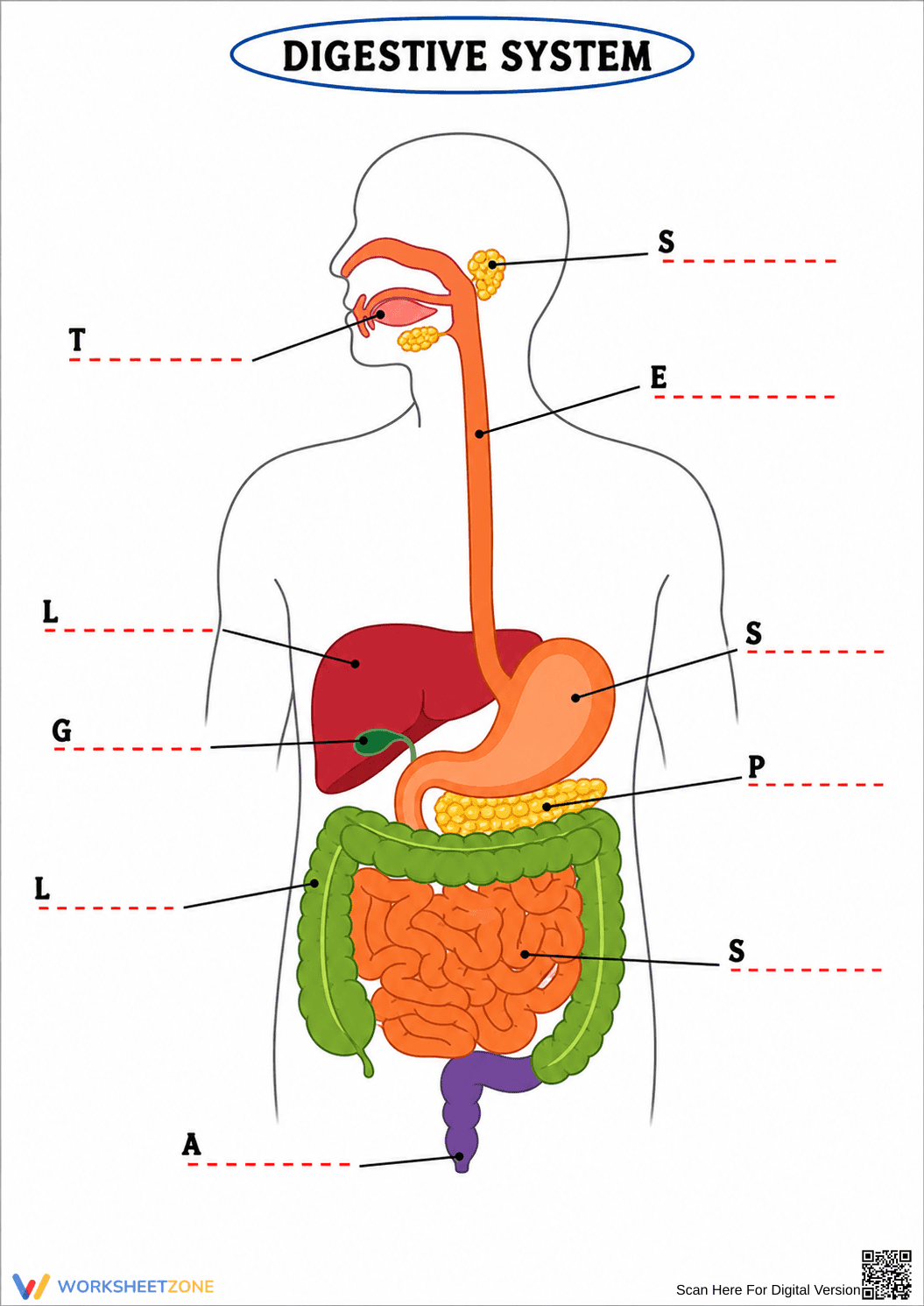

Grade 7 Digestive System — Printable No-Prep Worksheet

Paste this activity's link or code into your existing LMS (Google Classroom, Canvas, Teams, Schoology, Moodle, etc.).
Students can open and work on the activity right away, with no student login required.
You'll still be able to track student progress and results from your teacher account.
This Grade 7 science worksheet provides students with a clear, visual diagram to identify and label the major organs of the human digestive system. By completing this activity, learners will reinforce their anatomical vocabulary and understand the structural sequence of digestion from the mouth to the lower intestines.
At a Glance
- Grade: 7 · Subject: Science
- Standard:
MS-LS1-3— Identify interacting body system components- Skill Focus: Labeling digestive organs
- Format: 1 page · 10 problems · PDF
- Best For: Independent practice or review
- Time: 10–15 minutes
Inside this resource, educators will find a single-page, high-quality diagram of the human torso highlighting the digestive tract. The worksheet features 10 fill-in-the-blank labeling tasks, each providing the first letter of the target organ as a helpful scaffold. Students will identify key structures including the esophagus, stomach, liver, pancreas, and intestines.
This resource is designed for immediate classroom implementation with a zero-prep workflow.
- Print (1 minute): Simply download the PDF and print a class set.
- Distribute (1 minute): Hand out the worksheets as a warm-up or exit ticket.
- Review (3 minutes): Go over the anatomical terms together using a document camera.
Total teacher prep time is under two minutes, making this an excellent, self-explanatory option for emergency sub plans.
This activity aligns with MS-LS1-3: Use argument supported by evidence for how the body is a system of interacting subsystems composed of groups of cells. By mapping the specific organs, students build the foundational knowledge needed to explain how these subsystems interact to process food. Both standard codes can be copied directly into lesson plans, IEP goals, or district curriculum mapping tools.
Teachers can deploy this worksheet during direct instruction as guided notes, allowing students to label the diagram as each organ's function is introduced. Alternatively, it serves as an effective formative assessment after a unit on human body systems. As a quick observation tip, check if students correctly distinguish between the small and large intestines, as these are commonly confused. Expect completion to take 10 to 15 minutes.
This resource is ideal for middle school life science students learning human anatomy. The first-letter scaffolds make it highly accessible for English Language Learners and students needing vocabulary support. It pairs perfectly with a 3D anatomical model demonstration or a textbook passage detailing the chemical and mechanical breakdown of food.
Integrating visual diagrams into anatomy instruction significantly improves student retention of complex biological systems. According to ScienceDirect TpT Analysis, spatial learning tools like labeled diagrams help students map abstract concepts to concrete physical structures, reducing cognitive load. This worksheet supports that research by providing a clean, uncluttered visual model for students to practice identifying interacting body system components. Aligned with the MS-LS1-3 standard, the activity ensures learners can accurately locate the organs responsible for digestion. By combining visual cues with first-letter scaffolds, the task builds confidence and reinforces essential scientific vocabulary. Regular practice with these types of spatial mapping exercises ensures students are better prepared for advanced physiological concepts in high school biology.


