


























Views
Downloads


Lab Equipment Worksheet | Grade 8 Science Printable
Paste this activity's link or code into your existing LMS (Google Classroom, Canvas, Teams, Schoology, Moodle, etc.).
Students can open and work on the activity right away, with no student login required.
You'll still be able to track student progress and results from your teacher account.
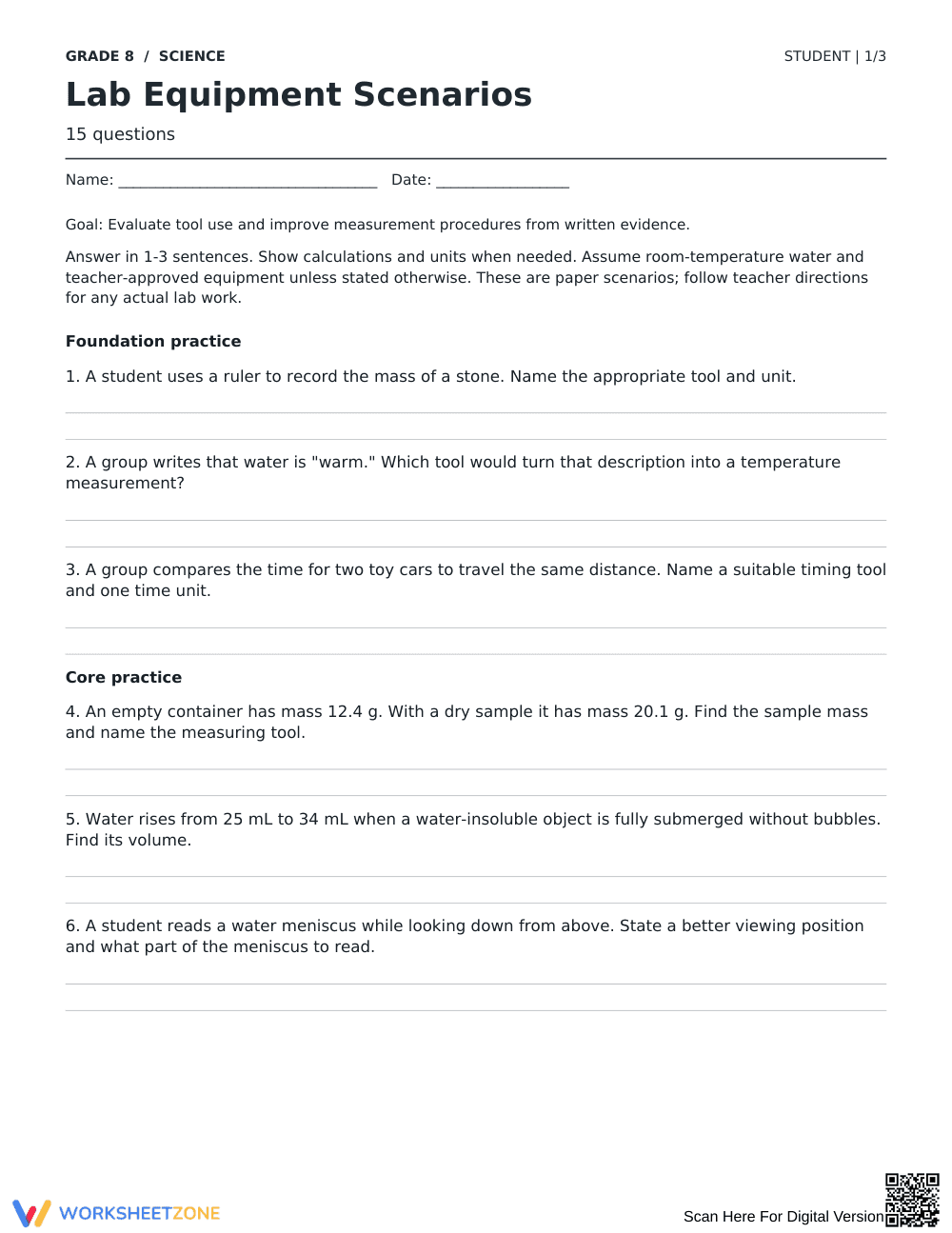
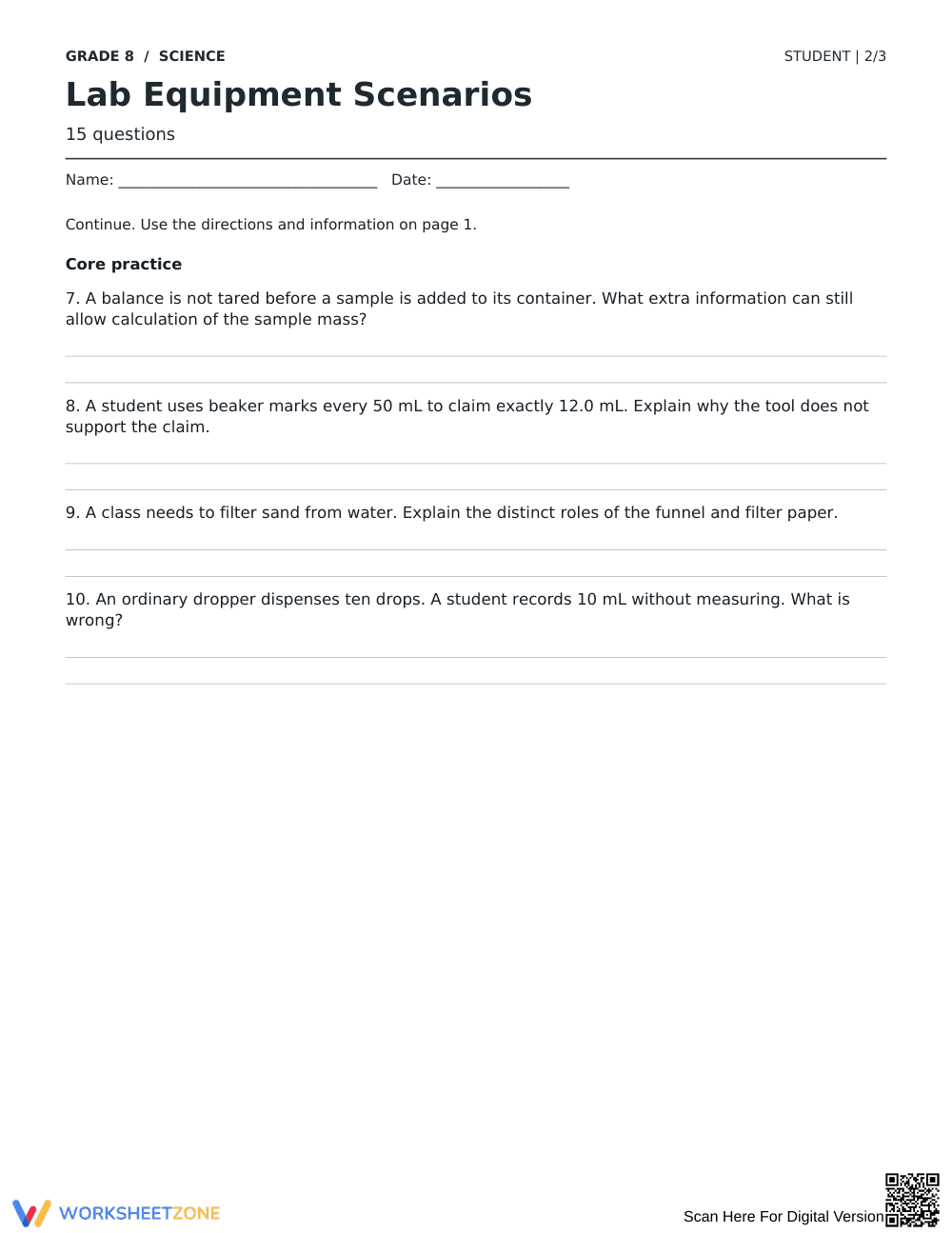
This Grade 8 science worksheet builds students' ability to match laboratory equipment to real-world experimental scenarios, giving them 20 structured problems that reinforce tool identification, purpose, and safe selection before, during, or after a lab unit.
At a Glance
- Grade: 8 · Subject: Science
- Standard:
MS-ETS1-1— Define problems using criteria and constraints to identify appropriate scientific tools- Skill Focus: Selecting and justifying appropriate lab equipment for given scenarios
- Format: 3 pages · 20 problems · Answer key included · PDF
- Best For: Pre-lab review or independent practice stations
- Time: 20–30 minutes
The worksheet spans three student pages and presents 20 scenario-based questions in which students read a brief experimental situation and identify the correct piece of lab equipment. Task formats include multiple choice, matching, and short written justification items. A complete answer key covers all 20 items with correct responses clearly labeled, making grading fast and consistent.
- Guided practice: The first 6 problems pair each scenario with a visual equipment bank, reducing cognitive load while students build familiarity with tool names and functions.
- Supported practice: Problems 7–14 remove the visual bank but retain context clues within each scenario, prompting students to recall equipment purpose from prior instruction.
- Independent practice: Problems 15–20 present open-ended scenarios requiring students to name the correct tool and briefly explain their choice, mirroring the reasoning demanded in lab settings.
This gradual-release structure follows the I Do, We Do, You Do framework, allowing teachers to model thinking on early items before releasing students to work independently through the final section.
Standards Alignment
Primary standard: MS-ETS1-1 — Define the criteria and constraints of a design problem with sufficient precision to ensure a successful solution, including identifying appropriate tools for scientific investigation. Supporting standard MS-ETS1-3 applies where students analyze data to determine which equipment best meets a scenario's criteria. Both codes can be copied directly into lesson plans, IEP goals, or curriculum mapping tools.
How to Use It
Use this worksheet before a hands-on lab as a pre-assessment to surface gaps in equipment knowledge; students who struggle with problems 15–20 may need a brief equipment-identification mini-lesson first. Alternatively, assign it after direct instruction as a formative check — scan responses to problems 7–14 to identify which tools (e.g., graduated cylinder vs. beaker) are still being confused. If more than one-third of the class misidentifies the same tool, address that item whole-group before the lab begins. Most students complete the worksheet in 20–30 minutes.
Who It's For
This worksheet is designed for Grade 8 science students in life, physical, or earth science courses where lab safety and equipment literacy are foundational skills. It works well for on-grade learners needing structured practice and for students who benefit from scenario-based context rather than isolated vocabulary drills. Pair it with a lab equipment anchor chart or a measurement-tools lesson to maximize retention.
Lab equipment literacy is a documented gap in middle school science readiness. The NAEP Science framework expects Grade 8 students to demonstrate understanding of scientific tools and their appropriate use as a core science practice. This worksheet targets the precise skill of matching tools to experimental criteria — a competency supporting accurate data collection and safe lab participation. Fisher & Frey (2014) identify scenario-based practice as a high-leverage strategy for transferring declarative knowledge into procedural fluency, particularly when problems escalate in cognitive demand. This 20-problem worksheet applies that principle directly, moving students from scaffolded identification to independent justification within one sitting.


