


























Views
Downloads


Lab Equipment Worksheet | Grade 8 Science Printable
Paste this activity's link or code into your existing LMS (Google Classroom, Canvas, Teams, Schoology, Moodle, etc.).
Students can open and work on the activity right away, with no student login required.
You'll still be able to track student progress and results from your teacher account.
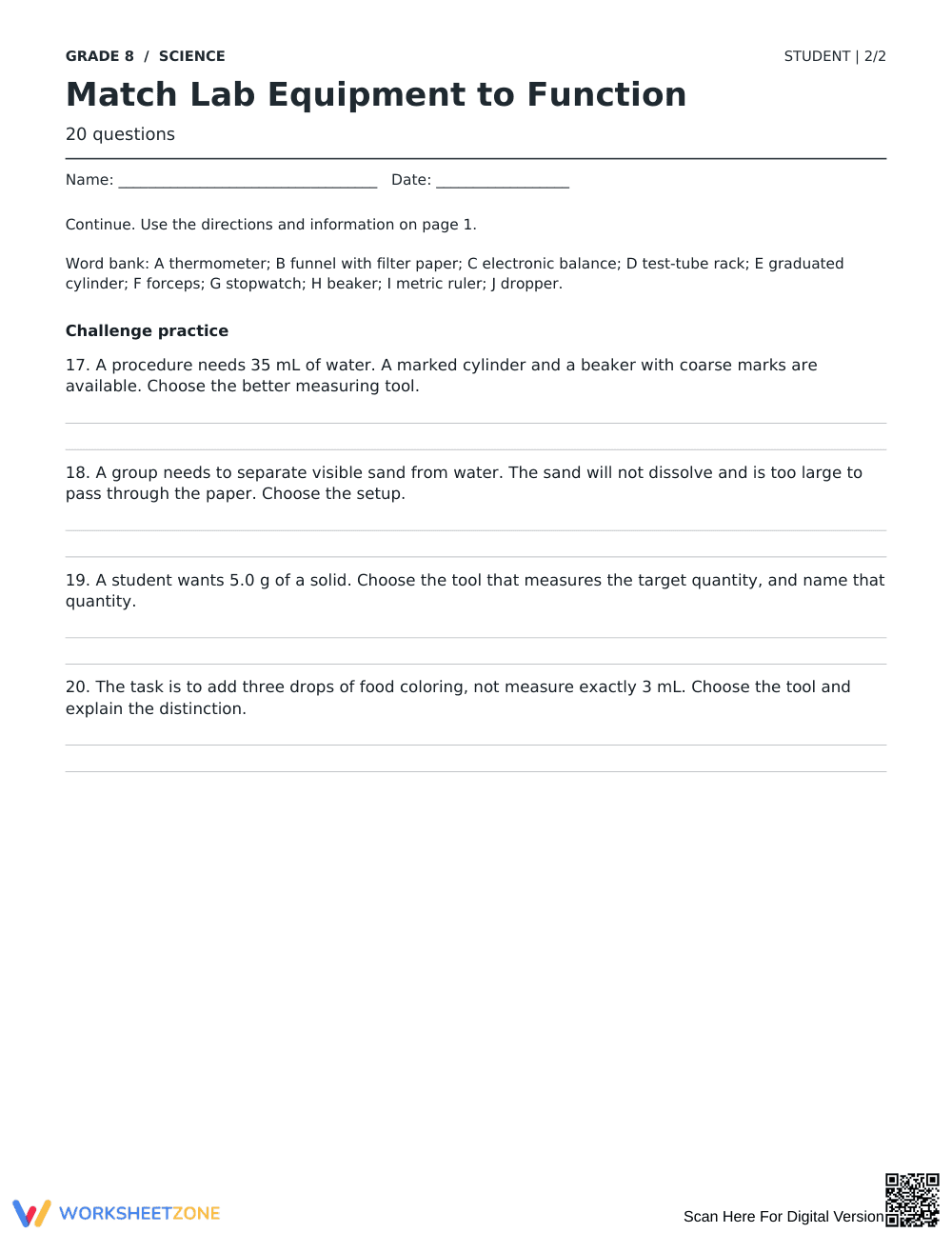
This Grade 8 science worksheet builds students' ability to identify common laboratory equipment and match each tool to its correct function, giving students 20 structured matching problems that reinforce the vocabulary and procedural knowledge needed for safe, effective lab work.
At a Glance
- Grade: 8 · Subject: Science
- Standard:
MS-ETS1-1— Define problems using scientific tools and criteria to identify solutions- Skill Focus: Matching laboratory equipment to its function
- Format: 2 pages · 20 problems · Answer key included · PDF
- Best For: Lab safety intro or equipment review
- Time: 15–25 minutes
The worksheet spans two student pages and presents common lab tools — including beakers, graduated cylinders, Bunsen burners, forceps, and thermometers — alongside a bank of function descriptions. Students write the letter of the matching function for each piece of equipment. The full answer key provides correct pairings for all 20 items, making scoring fast and consistent.
Skill Progression
- Guided practice (Problems 1–7): High-frequency, visually familiar tools (beaker, ruler, magnifying glass) with function descriptions that closely mirror everyday language, providing maximum scaffold for students new to lab vocabulary.
- Supported practice (Problems 8–14): Moderately specialized equipment (graduated cylinder, Erlenmeyer flask, spring scale) where function descriptions require students to distinguish between similar tools.
- Independent practice (Problems 15–20): Less common instruments (Bunsen burner, forceps, crucible tongs, triple-beam balance) with concise function statements that demand accurate recall without scaffolding.
This gradual-release structure mirrors the I Do, We Do, You Do model: early items build confidence, middle items prompt comparison, and final items require independent retrieval — preparing students to use equipment correctly in actual lab settings.
Standards Alignment
The primary standard is MS-ETS1-1: students define the criteria and constraints of a design problem with sufficient precision, including the role of scientific tools in carrying out investigations. Recognizing which instrument measures, contains, heats, or manipulates materials is foundational to planning any middle school lab. A supporting connection exists with MS-PS1-3, which requires students to gather information about substance properties — work that depends on correct equipment selection.
How to Use It
Use this worksheet before direct lab instruction as a pre-assessment to surface gaps in equipment knowledge, or after a lab-safety lesson as a formative check. As students work, note which tool categories (measurement vs. heating vs. containment) generate the most errors — this pinpoints which equipment clusters need re-teaching. Most students complete all 20 items in 15–25 minutes, making it a practical warm-up, exit ticket, or substitute-day activity.
Who It's For
This worksheet is designed for Grade 8 science students beginning a new lab unit or reviewing equipment prior to a practical assessment. Students needing additional support benefit from pairing this sheet with a labeled equipment anchor chart. Advanced students can write an original function sentence for any three tools not included, extending recall into generative application.
Accurate identification of laboratory equipment is a prerequisite for safe science investigation. The NAEP Science Framework expects middle school students to demonstrate familiarity with standard scientific tools as part of science and engineering practices. Structured matching tasks with immediate corrective feedback — such as a same-day answer key review — strengthen procedural vocabulary retention in content-area classrooms, making this worksheet an effective tool for pre-assessment, formative monitoring, or end-of-unit review.


