


























Views
Downloads

Lab Equipment & Safety Worksheet | Grade 8 Science Ready
Paste this activity's link or code into your existing LMS (Google Classroom, Canvas, Teams, Schoology, Moodle, etc.).
Students can open and work on the activity right away, with no student login required.
You'll still be able to track student progress and results from your teacher account.
This Grade 8 science worksheet equips students to master laboratory safety protocols and measurement tools before conducting investigations. Learners identify essential apparatus, evaluate hazardous classroom scenarios, and articulate correct measurement techniques. The comprehensive exercise reinforces procedural awareness to prevent accidents and ensure reliable data collection.
At a Glance
- Grade: 8 · Subject: Science
- Standard:
MS-PS1-2— Analyze and interpret data on the properties of substances to conduct safe and accurate investigations- Skill Focus: Laboratory equipment selection, volume meniscus reading, and emergency safety protocols
- Format: 3 pages · 25 problems · Answer key included · PDF
- Best For: Beginning-of-term laboratory safety certification and procedural review
- Time: 30–40 minutes
What's Inside
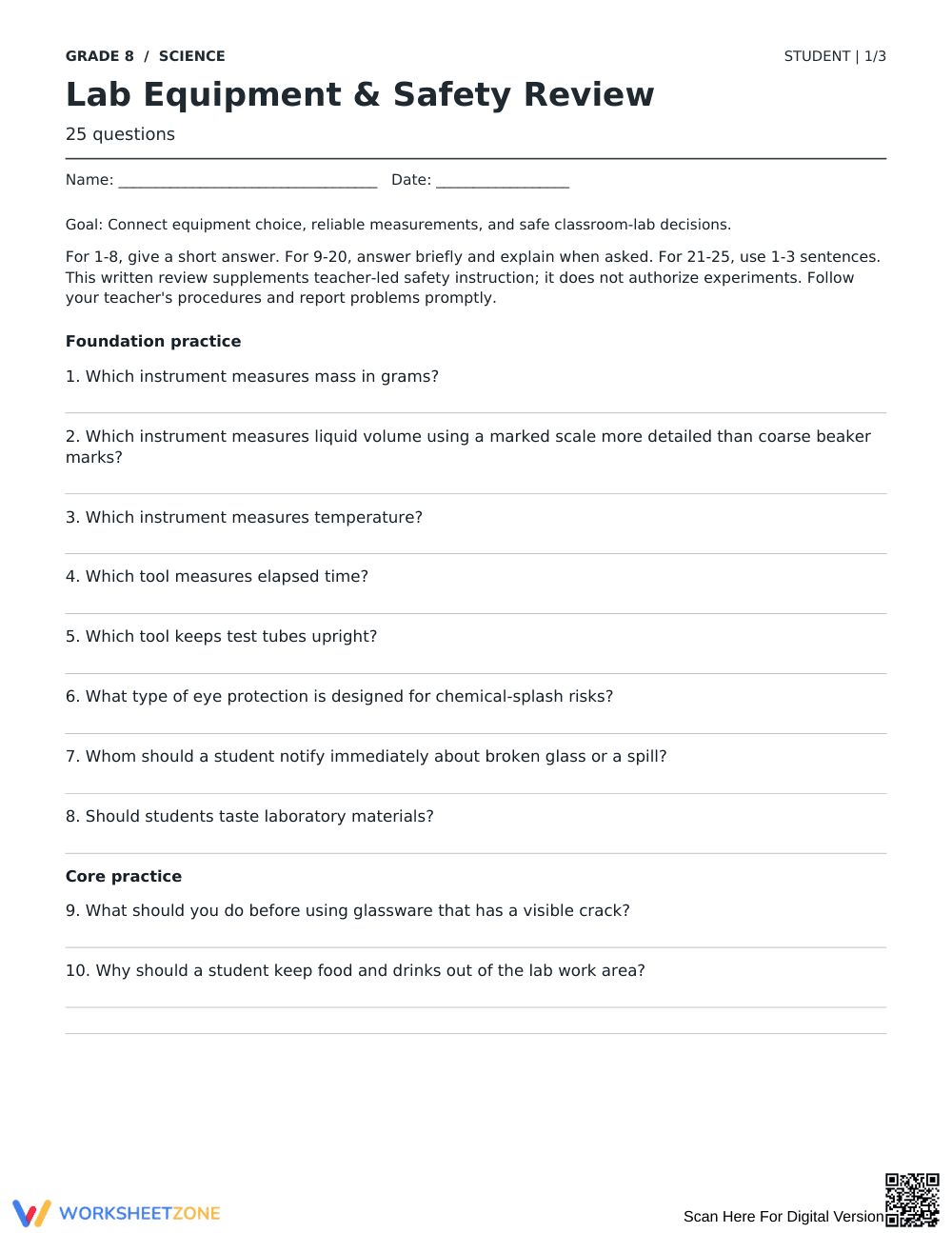
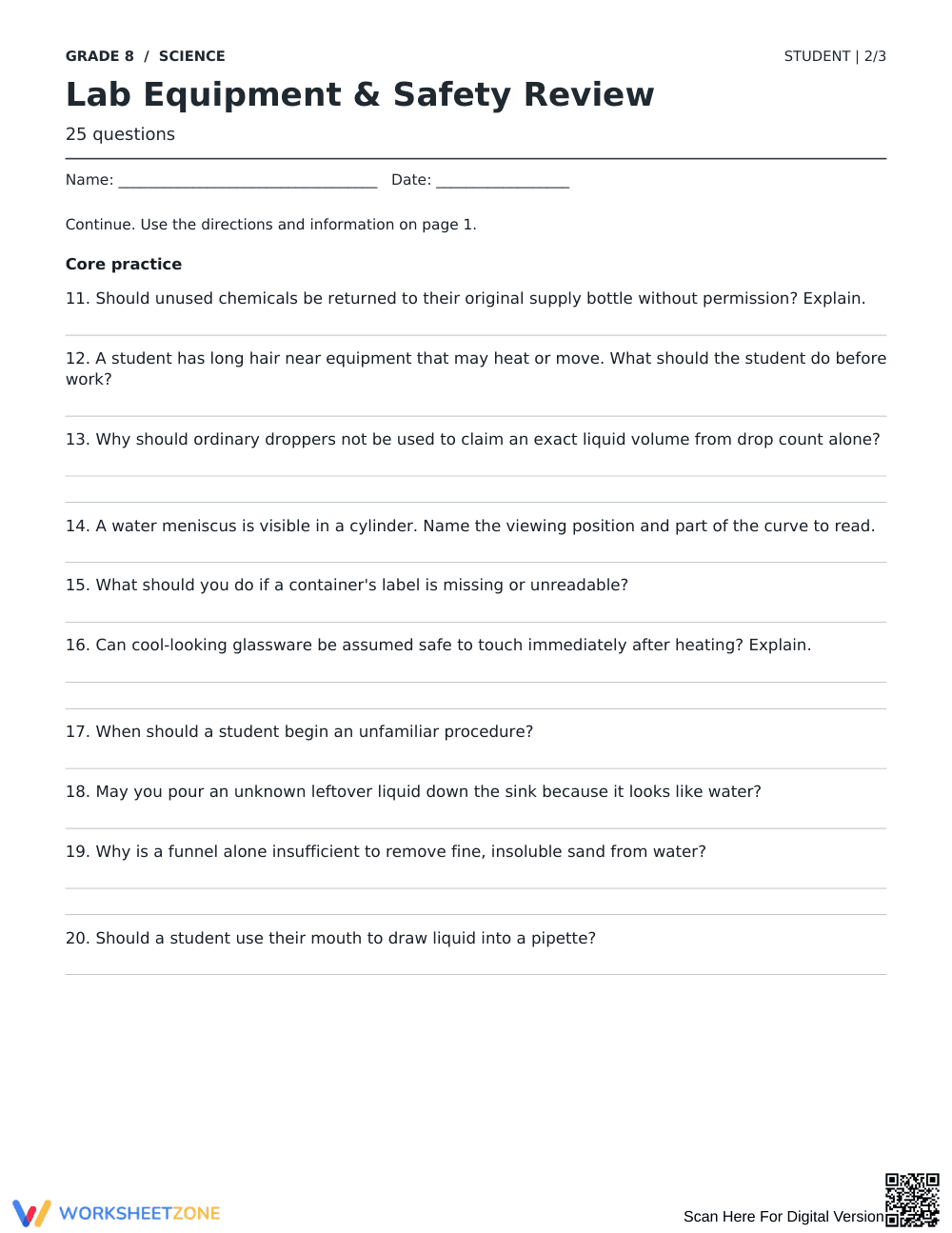
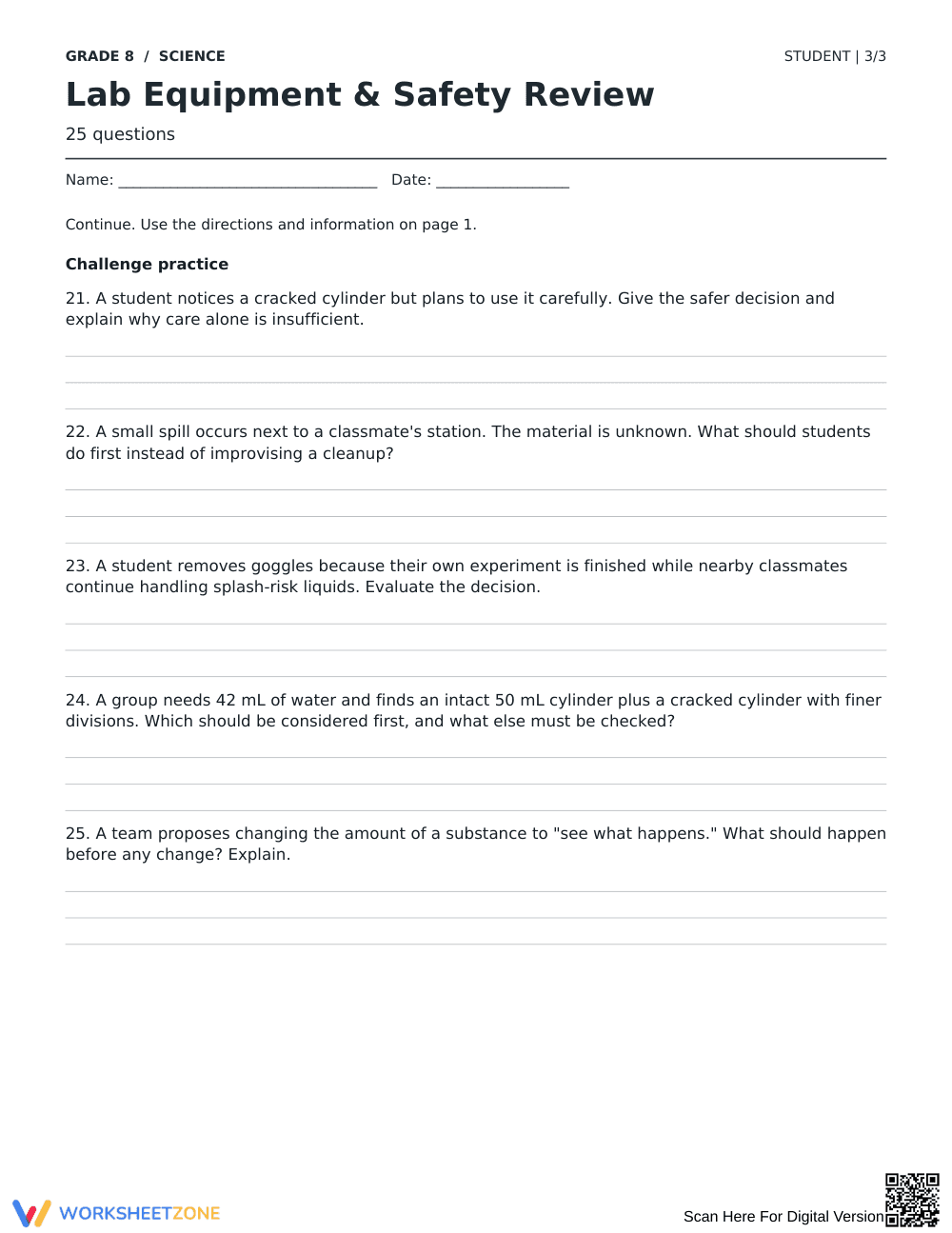
This 3-page printable science review contains 25 prompts arranged across three sequential tiers. Students identify common lab apparatus, evaluate routine safety precautions, and analyze complex hazard scenarios. The resource includes student response lines for short and extended explanations, plus a 2-page teacher answer key with a 48-point scoring guide.
Skill Progression
- Guided practice (Questions 1–8): Foundation questions require direct recall to identify core apparatus like balances, graduated cylinders, and splash goggles.
- Supported practice (Questions 9–20): Core prompts ask students to explain laboratory rules, including meniscus reading and inspecting glassware for cracks.
- Independent practice (Questions 21–25): Challenge scenarios demand independent evaluation of hazards, requiring students to justify emergency actions in multi-sentence responses.
This scaffolding operationalizes the gradual release model, guiding learners from vocabulary recall to autonomous laboratory decision-making.
Standards Alignment
This review targets `MS-PS1-2`: Analyze and interpret data on the properties of substances before and after the substances interact to determine if a chemical reaction has occurred, requiring precise tool usage and hazard mitigation. It also reinforces `MS-ETS1-2` by having students evaluate systematic safety procedures. Both standard codes can be copied directly into lesson plans, IEP goals, or district curriculum mapping tools.
How to Use It
Administer this worksheet after direct instruction on lab safety contracts as a prerequisite check before conducting experiments. Alternatively, deploy it during mid-year review to refresh lab procedures. For formative assessment, examine student responses on Question 14 (meniscus reading) and Question 21 (cracked glassware) to identify misconceptions regarding precision and equipment integrity. Most students complete all sections within 30 to 40 minutes.
Who It's For
This worksheet serves general Grade 8 science classes, physical science units, and middle school laboratory electives. For English learners or students needing reading support, pair this activity with a visual equipment anchor chart. Advanced learners can expand Challenge practice items by drafting emergency procedures for unexpected chemical spills.
According to Fisher & Frey (2014), structured cognitive scaffolding effectively bridges explicit direct instruction and independent student competency in secondary science classrooms. This Grade 8 science review operationalizes that pedagogical framework by addressing NGSS MS-PS1-2, guiding students through laboratory equipment identification, volume measurement accuracy, and proactive hazard prevention. By transitioning learners systematically from direct recall of foundational apparatus to complex evaluative scenario analysis, the 25-item task structure ensures that middle school students cultivate rigorous analytical reasoning alongside procedural safety compliance. Educational research confirms that structured, written pre-laboratory evaluations significantly reduce procedural errors, prevent chemical contamination, and eliminate equipment mishandling during inquiry-based investigations. Consequently, this resource serves as an essential evidence-based checkpoint that ensures all learners understand scientific measurement conventions, adhere to safety guidelines, and execute responsible decisions before entering active classroom laboratory environments.


