


























Views
Downloads
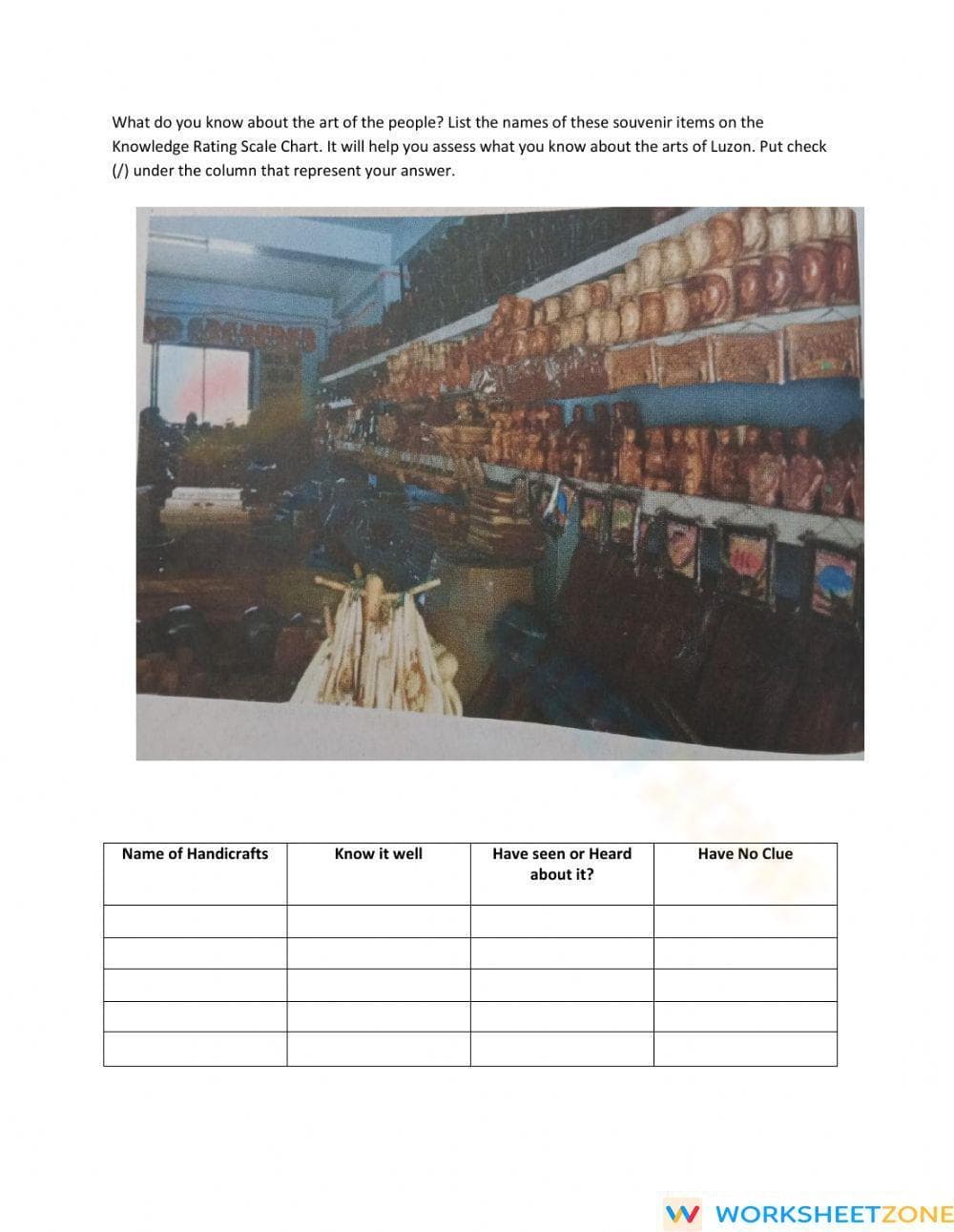


Arts of Luzon: Knowledge Rating Scale Chart | Grade 7 Ready
Paste this activity's link or code into your existing LMS (Google Classroom, Canvas, Teams, Schoology, Moodle, etc.).
Students can open and work on the activity right away, with no student login required.
You'll still be able to track student progress and results from your teacher account.
This Arts of Luzon Knowledge Rating Scale Chart empowers students in Grades 7-10 to systematically evaluate their prior knowledge of cultural handicrafts. By using a structured self-assessment framework, learners identify domain-specific terminology they master versus concepts requiring further instruction, ensuring an efficient and focused introduction to regional Philippine arts.
At a Glance
- Grade: 7 · Subject: English Language Arts
- Standard:
CCSS.ELA-LITERACY.RI.7.1— Cite several pieces of textual evidence to support analysis of what the text says- Skill Focus: Prior Knowledge Assessment & Vocabulary Strategy
- Format: 1 page · 6 problems · Answer key not applicable · PDF
- Best For: Introductory activity for cultural art units
- Time: 5–10 minutes
What's Inside
This single-page PDF features a high-quality visual anchor image showcasing traditional Luzon handicrafts and souvenir items. Below the prompt, a "Knowledge Rating Scale Chart" provides six dedicated rows for listing specific items. The chart includes three evaluative columns—"Know it well," "Have seen or Heard about it?," and "Have No Clue"—enabling a quick diagnostic of class-wide cultural literacy.
Zero-Prep Workflow
Implementing this worksheet requires minimal instructional overhead, making it ideal for busy classrooms or sub plans.
- Step 1: Print (1 minute) – Generate copies for the class or upload the digital PDF to your learning management system.
- Step 2: Distribute (1 minute) – Hand out the charts at the start of a unit on Southeast Asian culture to engage student interest.
- Step 3: Review (3 minutes) – Conduct a brief Think-Pair-Share where students compare ratings to identify common misconceptions before starting direct instruction.
Standards Alignment
The worksheet is primarily aligned to `CCSS.ELA-LITERACY.RI.7.1`, focusing on citing evidence to support analysis of visual texts. It also supports `CCSS.ELA-LITERACY.L.7.6` regarding the acquisition of domain-specific academic vocabulary. These standard codes can be copied directly into lesson plans, IEP goals, or district curriculum mapping tools for seamless documentation.
How to Use It
Use this chart as a pre-reading strategy before starting a text about Luzon history or geography. It serves as a formative assessment tool that reveals which students possess deep background knowledge and which require additional scaffolding. Alternatively, assign it as an exit ticket after a virtual tour to track how student perception has shifted from "No Clue" to "Know it well."
Who It's For
This resource is designed for middle and high school students in ELA, Social Studies, or Fine Arts classrooms. It is particularly effective for English Language Learners as it uses visual cues to anchor new vocabulary. Pair this worksheet with an anchor chart on Philippine geography or a short passage about wood-carving traditions for a comprehensive learning experience.
The Knowledge Rating Scale (KRS) is a proven strategy for improving reading comprehension and vocabulary acquisition. According to research by Fisher & Frey (2014), self-assessment tools like the KRS encourage metacognitive awareness, allowing students to monitor their own learning progress. By requiring students to interact with the standard `CCSS.ELA-LITERACY.RI.7.1` through the lens of prior knowledge, this worksheet bridges the gap between passive observation and active analysis. Studies from NAEP emphasize that students who engage in pre-reading self-assessment demonstrate higher retention rates of domain-specific terminology. This worksheet provides the "Ready" framework necessary for teachers to implement these evidence-based practices without extra prep time. The structured columns help quantify qualitative knowledge, making it an essential tool for any standards-aligned ELA curriculum focusing on cultural literacy and informational text analysis.


