


























Views
Downloads


Kinetic and Potential Energy Worksheet | Grade 8 Essential
Paste this activity's link or code into your existing LMS (Google Classroom, Canvas, Teams, Schoology, Moodle, etc.).
Students can open and work on the activity right away, with no student login required.
You'll still be able to track student progress and results from your teacher account.
This Grade 8 science resource provides comprehensive practice for calculating kinetic and potential energy. Students identify energy types based on real-world scenarios and apply the correct mathematical formulas to find mass, velocity, height, or total energy. It ensures students move beyond conceptual understanding into quantitative mastery of physical science principles.
At a Glance
- Grade: 8 · Subject: Science
- Standard:
MS-PS3-1— Calculate kinetic and potential energy using mass, velocity, and height- Skill Focus: Energy Calculation Formulas
- Format: 3 pages · 16 problems · Answer key included · PDF
- Best For: Independent practice and formative assessment
- Time: 35–45 minutes
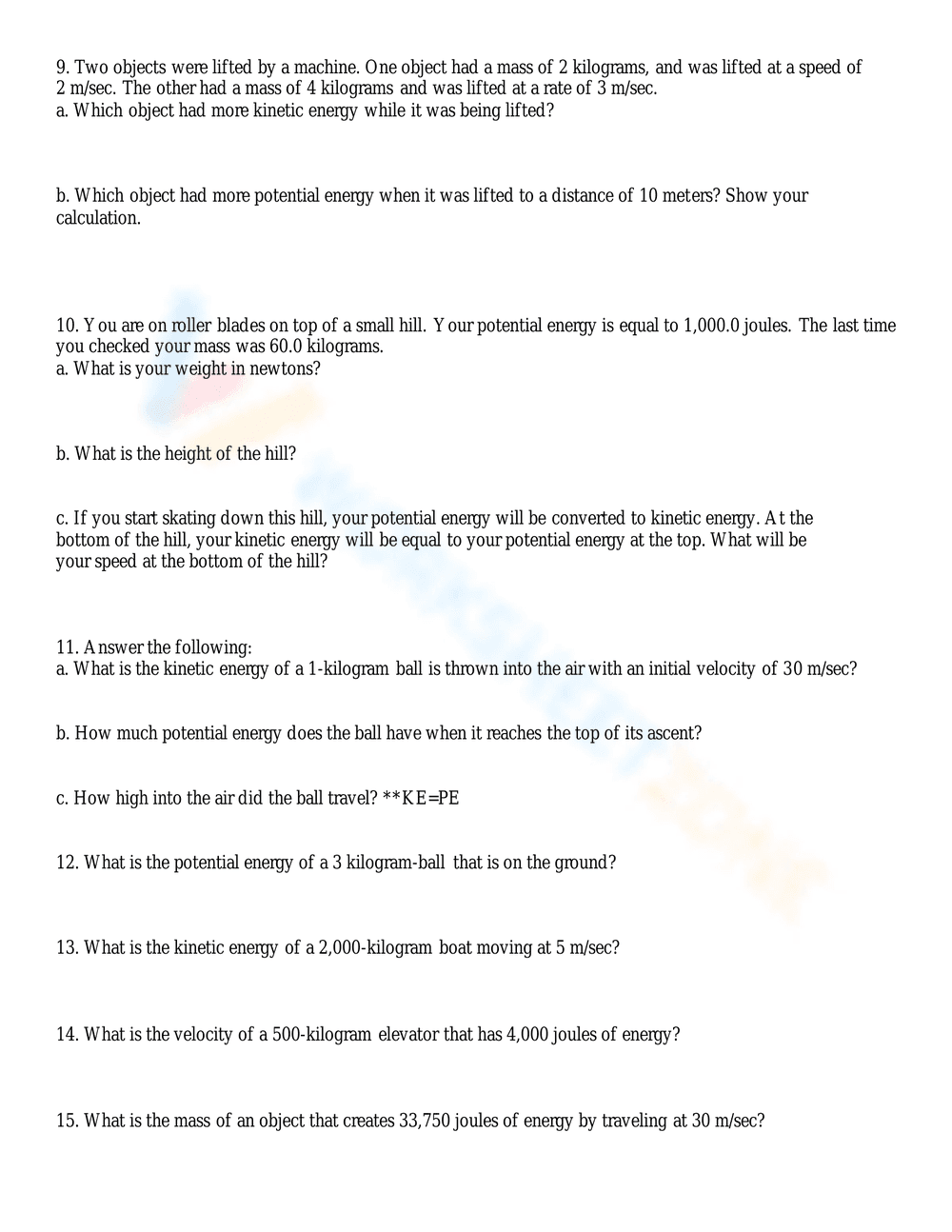
The packet contains three pages of rigorous physics problems. It begins with identifying energy types—kinetic or potential—before requiring students to select and solve using KE = 1/2 mv² or PE = mgh. The layout provides ample space for showing work, which is critical for identifying calculation errors in multi-step physics problems.
Skill Progression
- Guided practice: The first 6 problems provide clear scenarios where students must first identify the energy type before calculating, reinforcing the relationship between motion, position, and energy.
- Supported practice: Problems 7 through 10 introduce variable isolation, asking students to solve for mass or height rather than just the total energy value.
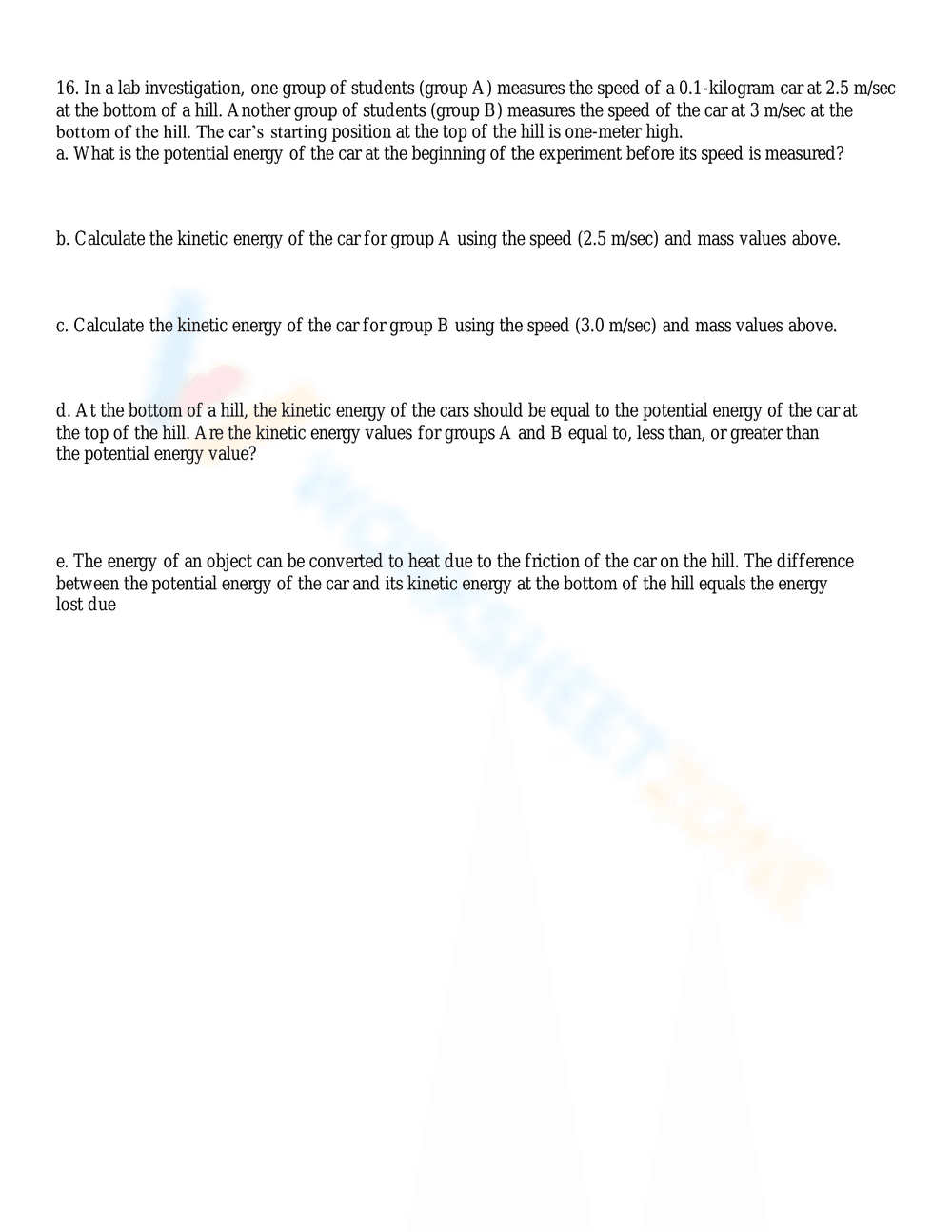
- Independent practice: The final section features complex, multi-part lab investigations and energy conversion scenarios, including friction and heat loss calculations.
This gradual-release model ensures students build confidence with the formulas before tackling higher-order conservation of energy questions.
Standards Alignment
This resource aligns primarily with `MS-PS3-1`, focusing on the relationship between kinetic energy, mass, and speed. It also supports `MS-PS3-2`, which requires students to develop a model to describe how the arrangement of objects interacting at a distance contains different amounts of potential energy. Both standard codes can be copied directly into lesson plans, IEP goals, or district curriculum mapping tools.
How to Use It
Use this worksheet as a mid-unit formative assessment after students have been introduced to the basic definitions of energy. It works effectively during the independent practice phase of a lesson. Teachers should observe students during problems 8 and 10 to ensure they can algebraically rearrange the PE formula to solve for mass or height. Expected completion time is 40 minutes.
Who It's For
This is designed for Grade 7 and 8 physical science students. It is particularly effective for learners who need repetitive practice to internalize the difference between velocity and height in energy equations. Pair this with a PhET simulation on energy forms or a physical lab involving ramps and toy cars for a complete instructional cycle.
According to the RAND AIRS 2024 report on middle school science achievement, structured mathematical practice in physical science significantly improves student performance on standardized assessments by bridging the gap between conceptual theory and quantitative application. This worksheet targets the specific cognitive demands of the MS-PS3-1 standard, requiring students to not only recognize energy states but to manipulate the variables of mass and velocity. By providing 16 distinct scenarios, the resource prevents rote memorization and encourages active problem-solving. Research from Fisher & Frey (2014) emphasizes that the gradual release of responsibility, as seen in the progression from simple identification to complex lab-based energy conversion problems, is essential for long-term retention of physics concepts. This resource serves as a reliable tool for ensuring students meet the rigorous expectations of modern science frameworks while developing the mathematical fluency required for high school physics.


