


























Views
Plays




Kinetic and Potential Energy — Essential Grade 6 Science
Paste this activity's link or code into your existing LMS (Google Classroom, Canvas, Teams, Schoology, Moodle, etc.).
Students can open and work on the activity right away, with no student login required.
You'll still be able to track student progress and results from your teacher account.
This comprehensive science worksheet helps middle school students master the relationship between kinetic and potential energy through visual analysis. By examining real-world scenarios like roller coasters and divers, learners identify energy peaks and transformations. It provides a clear path for students to demonstrate their understanding of energy conservation and mechanical systems.
At a Glance
At a Glance
- Grade: 6 · Subject: Physics
- Standard:
MS-PS3-2— Develop models to describe how potential energy changes within a system- Skill Focus: Energy Transformation
- Format: 5 pages · 20 problems · Answer key included · PDF
- Best For: Quick formative assessment or sub plans
- Time: 25–35 minutes
What's Inside
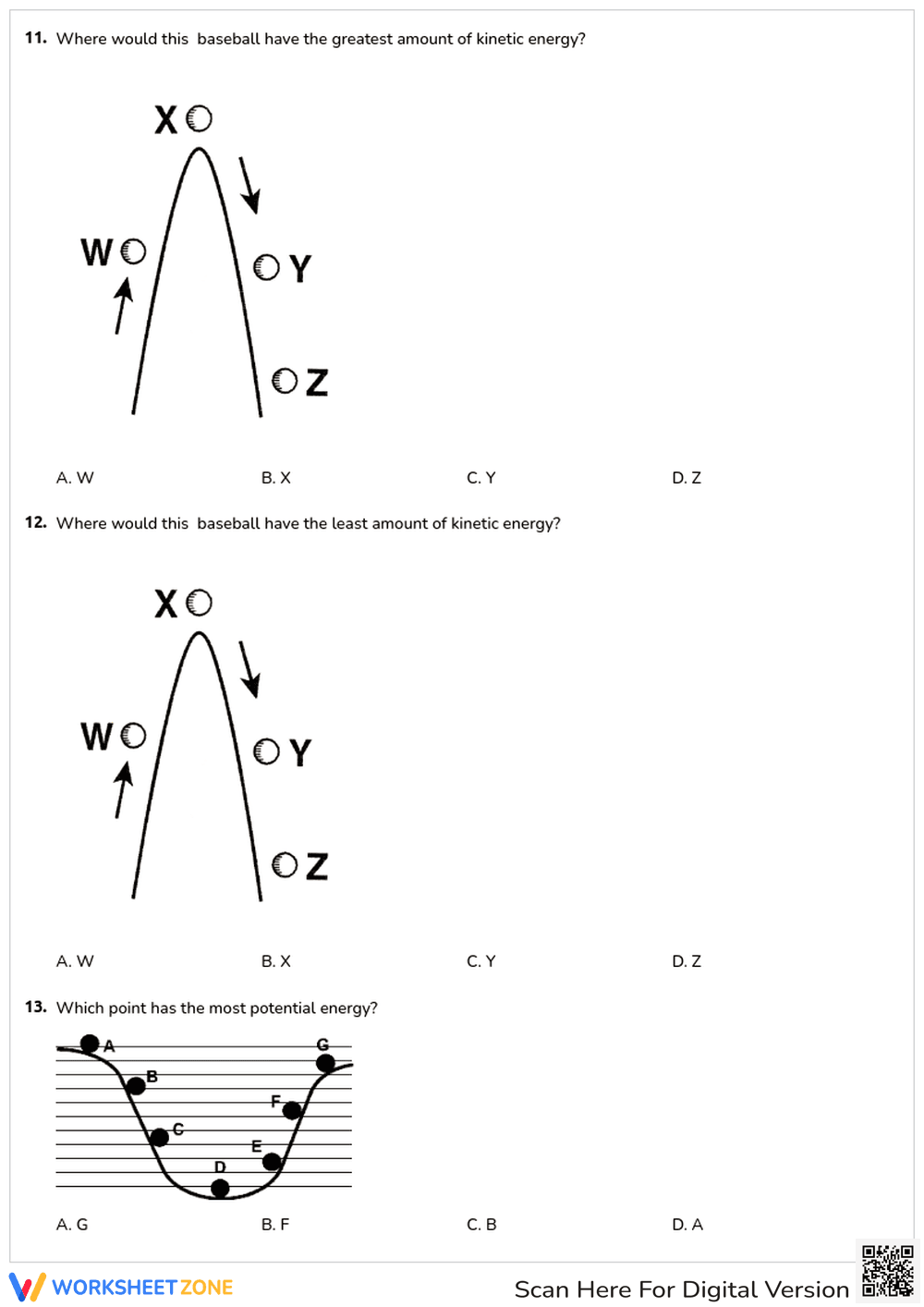
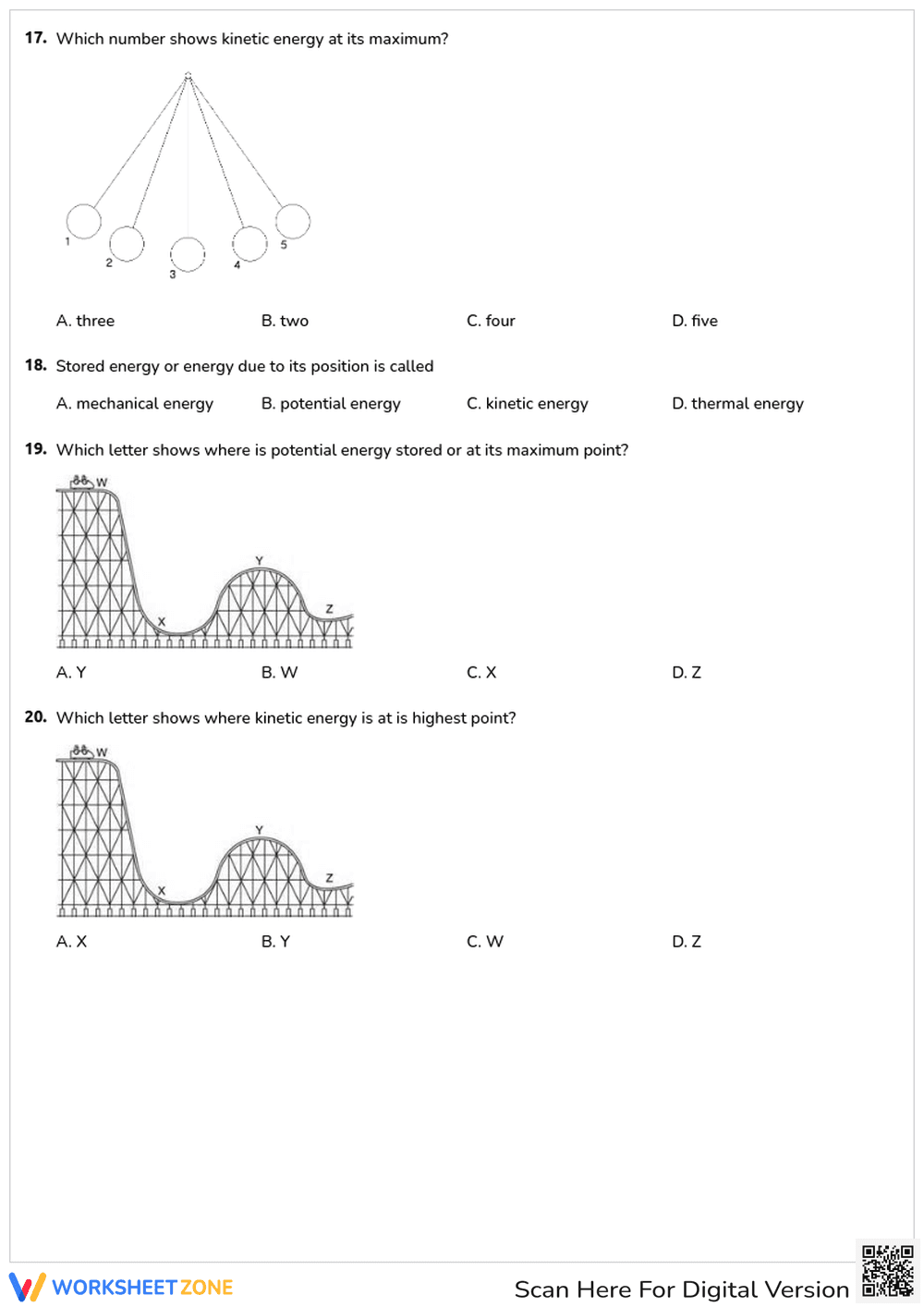
The packet contains 20 multiple-choice questions spread across 5 pages. It features diagrams including a slingshot, a rock on a hill, a roller coaster track, a baseball's trajectory, and a diver's descent. These visuals require students to apply theoretical knowledge to physical models, ensuring they can distinguish between stored energy and energy of motion in various contexts.
Zero-Prep Workflow
This resource is designed for a zero-prep classroom environment. Teachers can print the 5-page PDF in under 1 minute. Distribution takes seconds, and because the questions are structured as a clear quiz, students can begin working immediately with no additional instructions. Reviewing the 20 questions using the included answer key allows for a rapid feedback loop during the final 10 minutes of class.
Standards Alignment
Primary alignment is to `MS-PS3-2`, which focuses on developing models to describe the arrangement of objects and the potential energy stored in the system. The worksheet also supports MS-PS3-5 by asking students to explain what happens to energy as an object falls. Both standard codes can be copied directly into lesson plans, IEP goals, or district curriculum mapping tools.
How to Use It
Use this as a mid-unit check for understanding after introducing the formulas for PE and KE. It works well as a formative assessment; observe students as they analyze the roller coaster diagram to see if they confuse height with velocity. Completion typically takes 30 minutes, making it a perfect exit ticket style activity for a full block period.
Who It's For
This is ideal for Grade 5, 6, and 7 science students. It is particularly helpful for visual learners who benefit from seeing energy states represented graphically. Pair this with a PhET simulation on energy or a direct instruction lesson on mechanical energy to reinforce the concepts of mass and speed.
The MS-PS3-2 standard requires students to model energy changes within a system, a task this worksheet facilitates through 20 targeted visual problems. According to Fisher & Frey (2014), the use of non-linguistic representations—such as the roller coaster and pendulum diagrams included here—is a high-effect size strategy for improving student retention of complex physics concepts. By requiring students to identify the greatest kinetic energy or least potential energy across multiple contexts, the resource builds the cognitive flexibility needed for mastery of energy conservation laws. This structured approach ensures that learners move beyond rote memorization of definitions toward a functional understanding of how energy behaves in the physical world. The inclusion of an answer key and clear task count supports teacher efficiency while maintaining high academic rigor for middle school science curriculum requirements.


