


























Views
Downloads
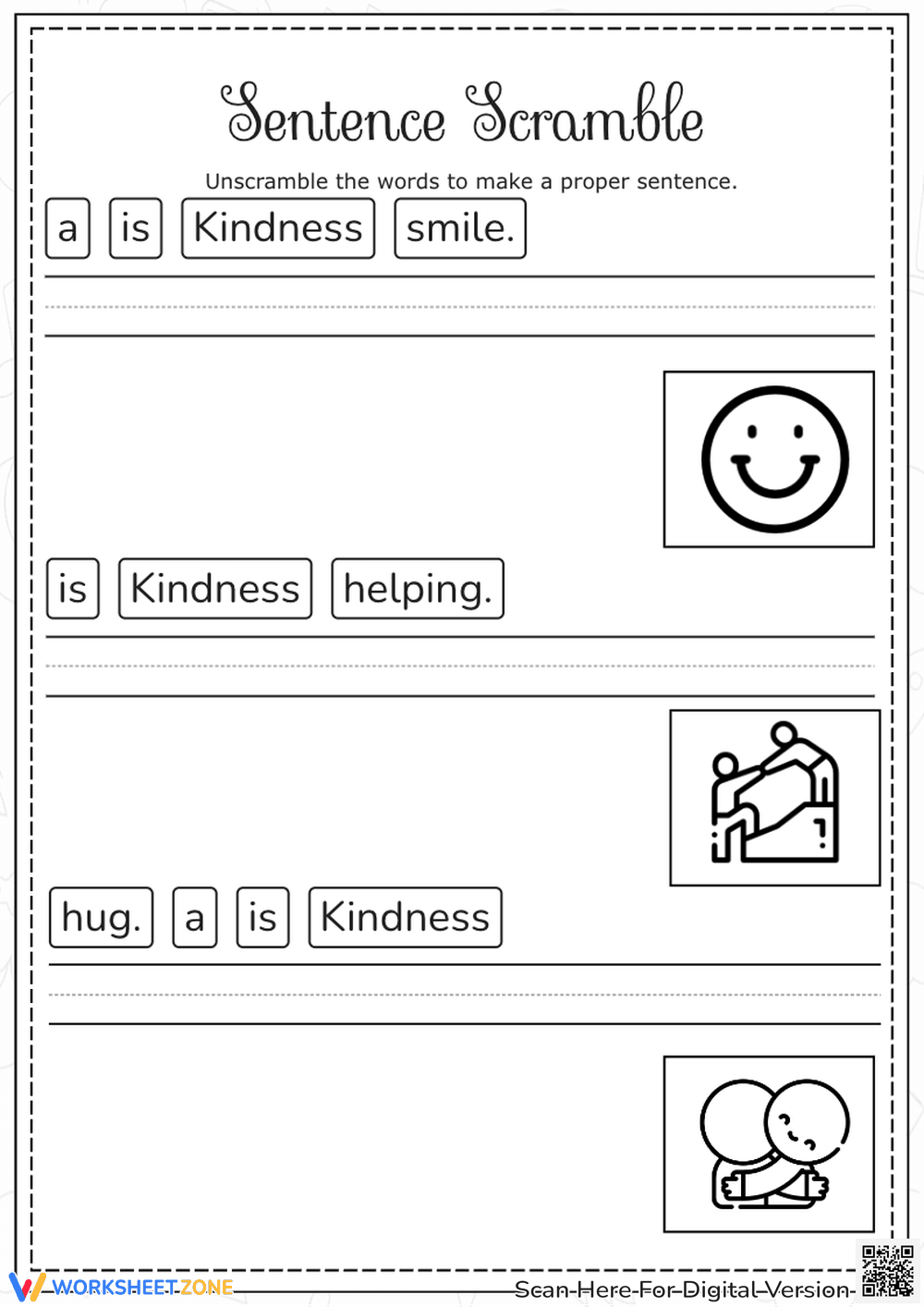

Kindness Sentence Scramble | Grade 1 Printable
Paste this activity's link or code into your existing LMS (Google Classroom, Canvas, Teams, Schoology, Moodle, etc.).
Students can open and work on the activity right away, with no student login required.
You'll still be able to track student progress and results from your teacher account.
This Grade 1 ELA worksheet helps students master basic syntax through engaging sentence scramble activities focused on the theme of kindness. By rearranging mixed-up words into logical statements, learners develop a foundational understanding of how subjects and predicates function together. This resource provides immediate practice in constructing clear, meaningful sentences while reinforcing positive social-emotional values.
At a Glance
- Grade: 1 · Subject: ELA
- Standard:
CCSS.ELA-LITERACY.L.1.1.J— Produce and expand complete simple declarative sentences in response to prompts- Skill Focus: Sentence structure and word order
- Format: 1 page · 3 problems · Answer key included · PDF
- Best For: Morning work or literacy centers
- Time: 10–15 minutes
Inside this single-page PDF, you will find 3 distinct sentence scramble tasks. Each task features a set of boxed words that must be reordered on primary-ruled lines. The worksheet includes visual cues and illustrations to support reading comprehension and context. A clear, easy-to-read font ensures that young learners can identify letters and punctuation marks without confusion.
The zero-prep workflow for this resource is designed for maximum efficiency. First, print the single-page PDF (30 seconds). Next, distribute the sheets to your students during your literacy block or as a transition activity (1 minute). Finally, review the completed sentences as a whole group to reinforce correct capitalization and punctuation (5 minutes). Total teacher preparation time is under 2 minutes, making it an ideal sub plan addition.
This resource aligns with `CCSS.ELA-LITERACY.L.1.1.J`, which requires students to produce and expand complete simple sentences. It also supports L.1.2.A by requiring the use of capitalization for the first word in a sentence. Both standard codes can be copied directly into lesson plans, IEP goals, or district curriculum mapping tools to ensure compliance with state and federal educational frameworks.
Use this worksheet as a formative assessment after a lesson on sentence parts. Observe if students recognize that the capitalized word starts the sentence and the word with the period ends it. It also works well as a quiet "fast finisher" activity or as part of a social-emotional learning (SEL) rotation. Expect students to complete the three tasks in approximately 12 minutes.
This worksheet is ideal for first-grade students or kindergarteners ready for advanced writing. It provides excellent support for English Language Learners (ELLs) who need visual aids to understand sentence logic. Pair this with a read-aloud book about kindness or a classroom anchor chart showing "Parts of a Sentence" to provide a comprehensive learning experience.
Research from Fisher & Frey (2014) emphasizes the importance of the gradual release of responsibility, particularly when teaching foundational writing skills like sentence construction. This worksheet facilitates that process by providing a constrained set of words, reducing the cognitive load on Grade 1 learners while they focus on syntax and word order. By engaging with the CCSS.ELA-LITERACY.L.1.1.J standard through a themed lens like kindness, students are more likely to retain the structural rules of the English language. Studies in the RAND AIRS 2024 report suggest that targeted, short-form practice sessions are more effective for early elementary retention than long-form writing prompts without scaffolding. This 3-task layout ensures that students achieve mastery of the specific skill without experiencing fatigue. The inclusion of visual icons further bridges the gap between decoding and comprehension, making it a robust tool for diverse classroom environments.


