


























Views
Downloads



Reading Comprehension Worksheet | Grade K Printable
Paste this activity's link or code into your existing LMS (Google Classroom, Canvas, Teams, Schoology, Moodle, etc.).
Students can open and work on the activity right away, with no student login required.
You'll still be able to track student progress and results from your teacher account.
This engaging reading comprehension worksheet helps Kindergarten students practice inferencing and decoding skills by solving fun animal riddles. By reading simple clues and matching them to the correct animal picture, early readers build confidence in identifying key details while developing essential fine motor skills through a hands-on cut-and-paste activity.
At a Glance
- Grade: K · Subject: ELA
- Standard:
CCSS.ELA-LITERACY.RI.K.1— Ask and answer questions about key details- Skill Focus: Reading comprehension and inferencing
- Format: 3 pages · 5 problems · PDF
- Best For: Independent practice or centers
- Time: 15–20 minutes
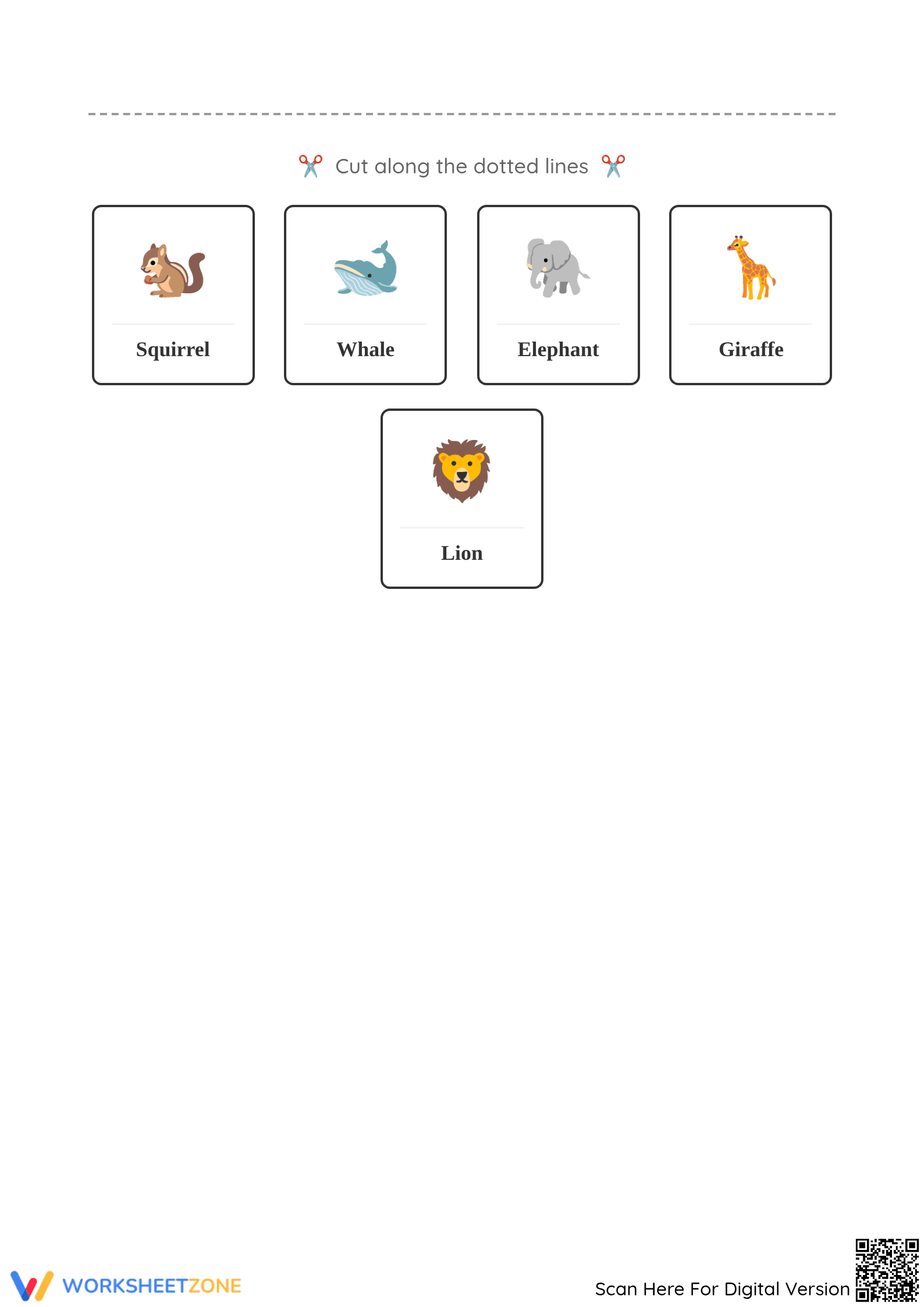
This resource includes three pages designed specifically for early learners. The first two pages feature five distinct "Who Am I?" animal riddles with simple, decodable sentences describing characteristics like size, habitat, and diet. The final page provides a set of five clearly labeled animal illustrations (squirrel, whale, elephant, giraffe, lion) surrounded by dotted lines, ready for students to cut out and paste into the corresponding riddle boxes.
- Guided practice: Read the first riddle aloud together, modeling how to identify clue words like "trunk" or "heavy" to select the elephant.
- Supported practice: Have students work in pairs to decode the next two riddles, discussing the clues before cutting and pasting the matching animals.
- Independent practice: Students complete the final riddles on their own, demonstrating their ability to read simple text and infer the correct answer.
This gradual-release approach ensures students feel supported before applying their reading comprehension skills independently.
Aligned to CCSS.ELA-LITERACY.RI.K.1: With prompting and support, ask and answer questions about key details in a text. It also supports foundational reading skills by encouraging students to decode high-frequency words and use context clues. Both standard codes can be copied directly into lesson plans, IEP goals, or district curriculum mapping tools.
This worksheet is highly effective as a literacy center activity during guided reading rotations. Teachers can place the printed pages, scissors, and glue sticks at a station for students to complete after a mini-lesson on animal habitats. Alternatively, use it as a whole-class Friday activity to assess reading comprehension formatively. While students work, observe whether they are relying on initial consonant sounds or reading the full sentences to make their inferences. Expect this activity to take 15 to 20 minutes.
This resource is ideal for Kindergarten students developing early reading and inferencing skills. The visual supports and hands-on cutting task make it highly accessible for English Language Learners (ELLs) and students needing extra fine motor practice. It pairs perfectly with a read-aloud session featuring informational books about zoo or ocean animals.
Integrating hands-on tasks with reading comprehension significantly boosts early literacy outcomes. When students interact physically with their learning materials, such as matching text to images, they demonstrate higher retention of key details. According to Fisher & Frey (2014), providing structured, interactive tasks allows young learners to solidify their understanding of complex concepts like inferencing. By aligning with CCSS.ELA-LITERACY.RI.K.1, this activity ensures students actively ask and answer questions about key details. Combining tactile cut-and-paste mechanics with targeted reading practice creates a multimodal learning experience that supports diverse cognitive needs and reinforces foundational literacy skills in the early childhood classroom.


