




























Views
Plays


Karyotypes Quiz: Essential Grade 10 Science Worksheet

Paste this activity's link or code into your existing LMS (Google Classroom, Canvas, Teams, Schoology, Moodle, etc.).
Students can open and work on the activity right away, with no student login required.
You'll still be able to track student progress and results from your teacher account.
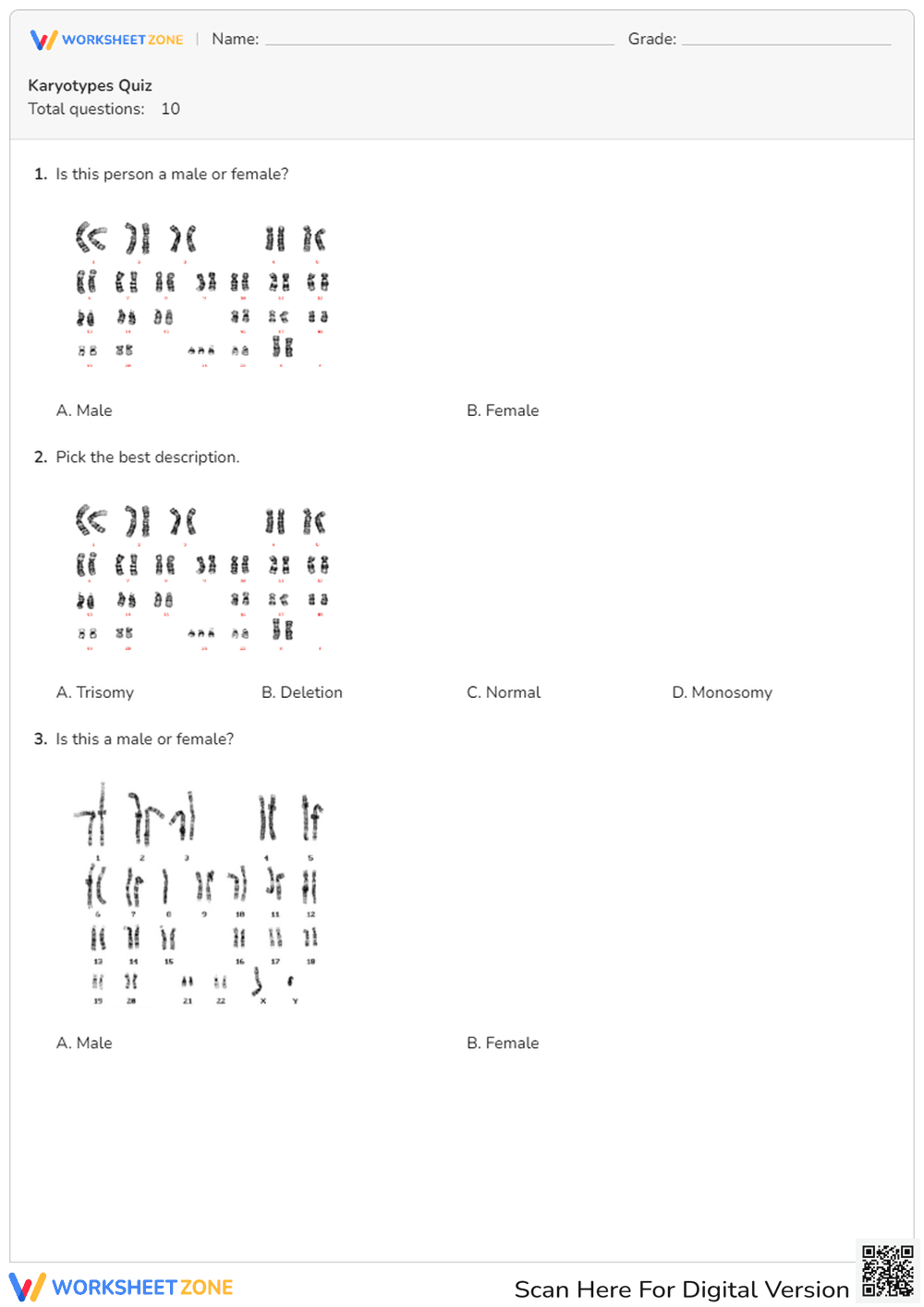
This Grade 10 karyotype analysis worksheet provides students with 10 high-quality visual problems to identify biological sex and chromosomal conditions. Students examine real-world chromosomal maps to distinguish between normal arrangements and abnormalities such as trisomy or monosomy. It serves as a rigorous assessment tool for genetics units.
At a Glance
- Grade: 10 · Subject: Science
- Standard:
HS-LS3-1— Clarify relationships about the role of DNA and chromosomes in trait inheritance- Skill Focus: Karyotype analysis and abnormality identification
- Format: 4 pages · 10 problems · Answer key included · PDF
- Best For: Formative assessment or genetics unit quiz
- Time: 15–20 minutes
What's Inside: This comprehensive 4-page PDF contains 10 multiple-choice questions, each paired with a clear, detailed karyotype image. The tasks require students to observe the 23rd pair to determine sex and scan the entire set for numerical mutations. The layout is clean, providing ample white space for student focus, and includes a full answer key for rapid grading.
Zero-Prep Workflow: This resource is designed for immediate classroom implementation. 1. Print: Select the 4-page document and print enough copies for your roster (1 minute). 2. Distribute: Hand out the quiz as a bell-ringer or exit ticket (30 seconds). 3. Review: Use the provided answer key to grade or conduct a peer-review session (5 minutes). It is an ideal emergency sub plan.
Standards Alignment: The primary focus is HS-LS3-1, which requires students to ask questions and clarify relationships regarding the role of chromosomes in coding traits. By identifying abnormalities, students demonstrate an understanding of how chromosomal structure impacts phenotypic expression. This standard code can be copied directly into lesson plans, IEP goals, or district curriculum mapping tools.
How to Use It: Assign this worksheet during the middle of a genetics unit after students have learned about meiosis and non-disjunction. It works effectively as a formative assessment to check for misconceptions before moving into complex pedigree analysis. Teachers should observe if students are correctly identifying the sex chromosomes versus autosomal pairs during the first three problems.
Who It's For: This resource is tailored for Grade 10 Biology or Life Science students. It provides necessary visual scaffolding for English Language Learners and students with IEPs through clear imagery. It pairs naturally with a lecture on Down Syndrome, Turner Syndrome, or Klinefelter Syndrome.
According to EdReports 2024, high-quality visual aids in science education significantly improve student retention of complex genetic concepts. This worksheet aligns with those findings by utilizing clear karyotype maps to reinforce the HS-LS3-1 standard. By requiring students to perform the plain-English skill of identifying chromosomal patterns and sex-linked traits, the resource bridges the gap between theoretical genetics and practical observation. Research indicates that multiple-choice assessments paired with visual data help students build the cognitive frameworks necessary for higher-order biological analysis. This 10-question set provides the repetition needed for mastery without overwhelming the learner. The inclusion of both normal and abnormal karyotypes ensures a comprehensive check of student understanding regarding chromosomal distribution and its role in human development and inherited characteristics.


