


























Views
Downloads

Essential Journeys Lesson 18 Vocab Worksheet | Grade 5-6
Paste this activity's link or code into your existing LMS (Google Classroom, Canvas, Teams, Schoology, Moodle, etc.).
Students can open and work on the activity right away, with no student login required.
You'll still be able to track student progress and results from your teacher account.
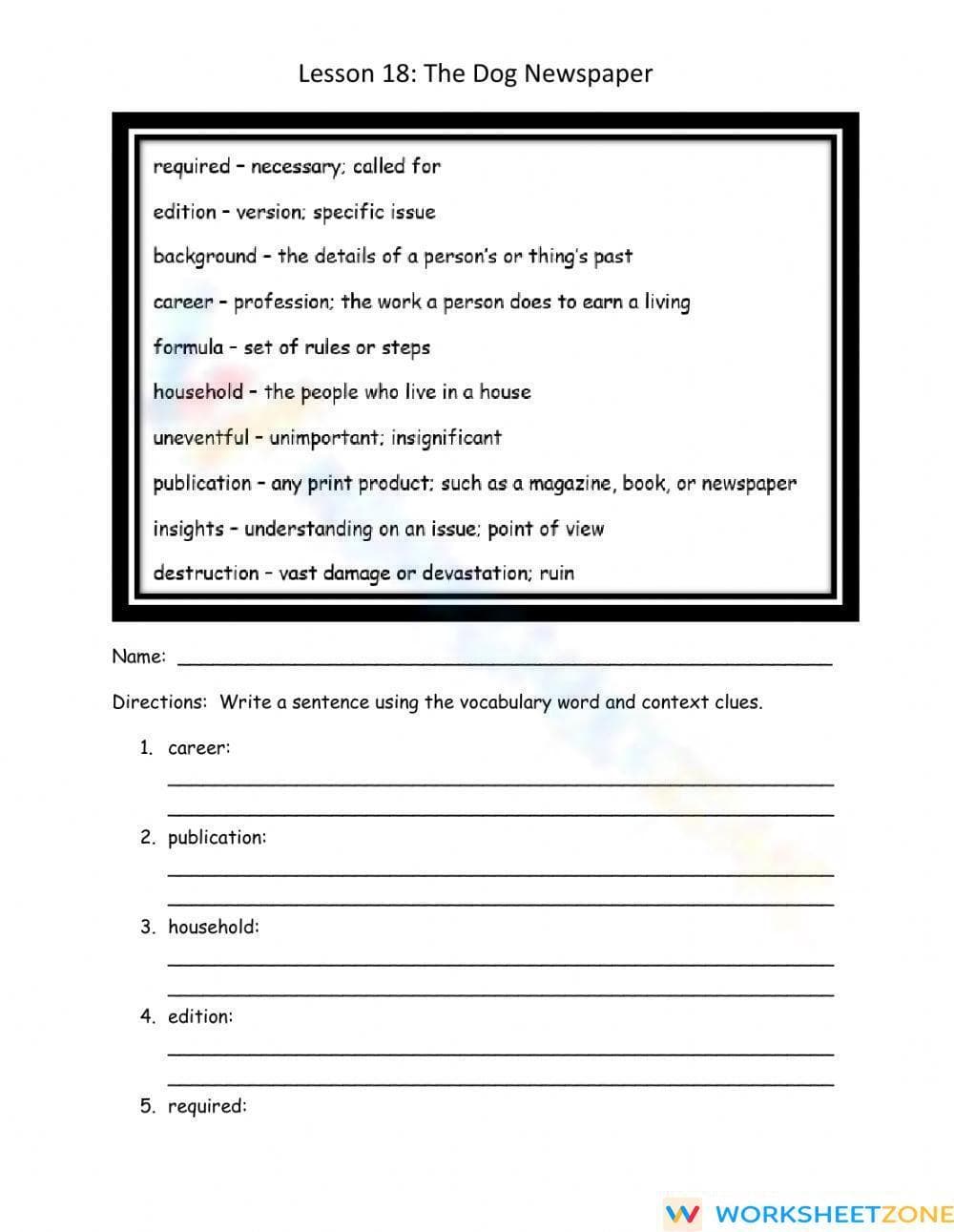
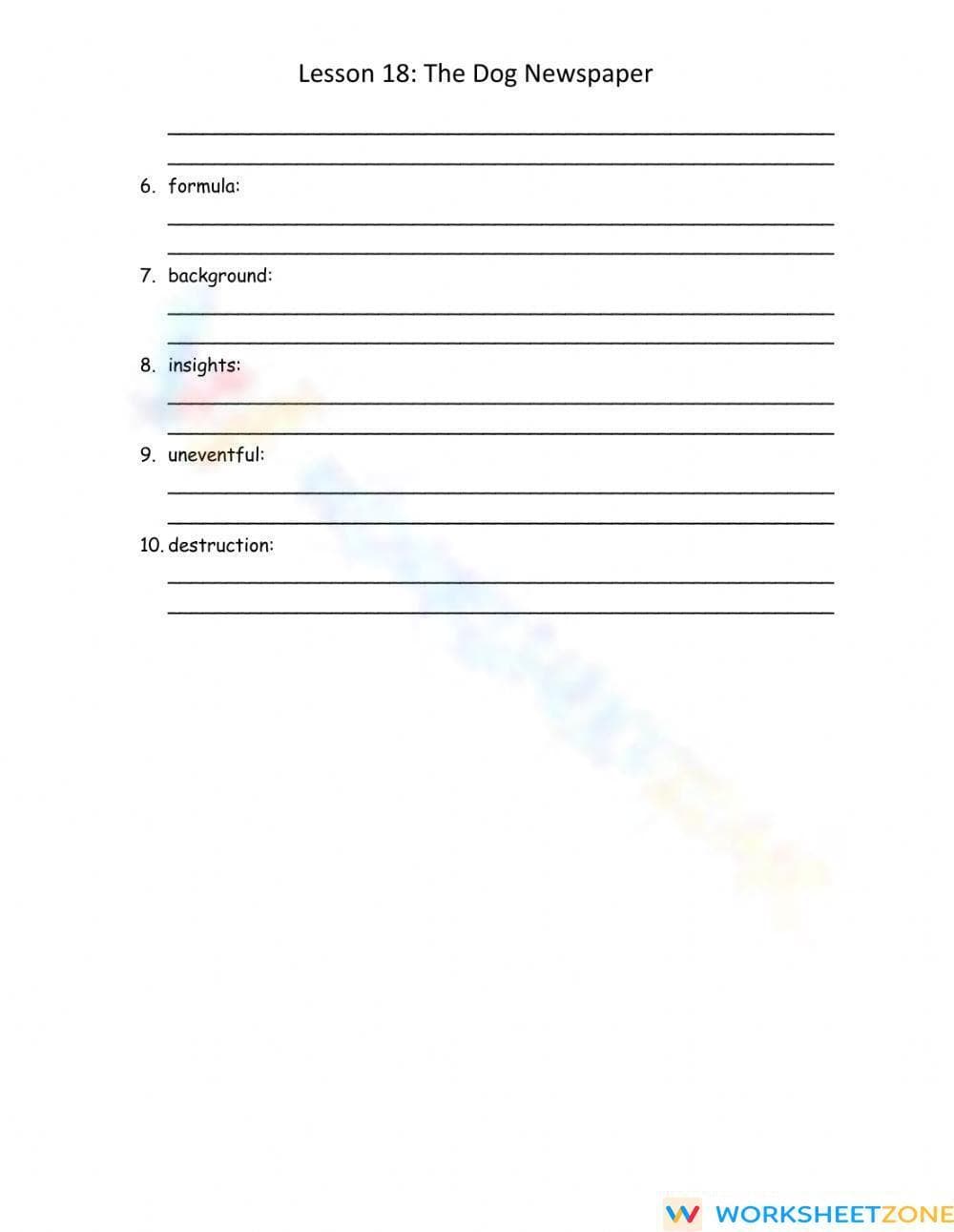
This printable Grade 5 English Language Arts worksheet focuses on mastering vocabulary from Journeys Lesson 18, "The Dog Newspaper." By providing clear definitions and requiring students to construct original sentences, this resource ensures deep comprehension of academic terms. Students transition from passive recognition to active usage, building the linguistic precision necessary for advanced literacy and vocabulary development.
At a Glance
- Grade: 5 · Subject: English Language Arts
- Standard:
CCSS.ELA-LITERACY.L.5.4.A— Use context clues to determine the meaning of unknown or multiple-meaning words- Skill Focus: Context Clue Application
- Format: 2 pages · 10 problems · Answer key included · PDF
- Best For: Independent practice and vocabulary reinforcement
- Time: 20–30 minutes
What's Inside
This two-page PDF resource features ten target vocabulary words specifically selected from the Journeys curriculum. The first page includes a dedicated reference box containing definitions for words such as required, career, and publication. Students are tasked with writing original, meaningful sentences for each term, applying their understanding of context clues. The layout is clean and spacious, providing ample room for student handwriting and sentence expansion without visual clutter.
Zero-Prep Workflow
This resource streamlines your classroom routine with a three-step workflow that requires under two minutes of total teacher preparation. First, print your student copies (30 seconds). Second, distribute the materials during your vocabulary block or as a transition activity (30 seconds). Finally, review the completed sentences using the provided answer key (1 minute). Its clear structure and self-explanatory definitions also make it an ideal selection for emergency sub plans or quiet independent work sessions.
Standards Alignment
The primary alignment is CCSS.ELA-LITERACY.L.5.4.A, which requires students to use context (e.g., cause/effect relationships and comparisons in text) as a clue to the meaning of a word or phrase. By crafting their own context clues within original sentences, students demonstrate mastery of word nuances and syntactic variety. This standard code can be copied directly into lesson plans, IEP goals, or district curriculum mapping tools to track student progress toward grade-level mastery.
How to Use It
Assign this worksheet as a follow-up activity after the first reading of "The Dog Newspaper" to solidify student understanding of the text's key terms. It also serves as an effective formative assessment tool; observe whether students are merely copying the provided definitions or if they are successfully integrating the words into complex sentence structures with relevant context. The expected completion time for most students is approximately 25 minutes, making it perfect for a standard class period.
Who It's For
This worksheet is primarily designed for Grade 5 and 6 students working with the Journeys reading curriculum. It is highly effective for English Language Learners (ELL) who benefit from the explicit definitions provided in the reference box at the top of the page. Pair this resource with a vocabulary anchor chart or a digital word wall to provide additional visual support during the independent writing process for struggling learners.
Integrating vocabulary instruction with authentic writing tasks is a critical component of the gradual release of responsibility model. This Grade 5 worksheet aligns with evidence-based practices by moving students from definition recall to independent sentence generation. By focusing on CCSS.ELA-LITERACY.L.5.4.A, the resource addresses the word gap often found in intermediate grades, where academic vocabulary becomes increasingly abstract. The task structure ensures students learn to manipulate word meanings within varying linguistic contexts, supporting long-term retention and reading comprehension gains. This focused practice provides a scalable way for educators to track lexical development effectively during core instruction or intervention blocks.


