


























Views
Downloads

Essential Journeys Lafff Vocabulary Worksheet | Grade 5
Paste this activity's link or code into your existing LMS (Google Classroom, Canvas, Teams, Schoology, Moodle, etc.).
Students can open and work on the activity right away, with no student login required.
You'll still be able to track student progress and results from your teacher account.
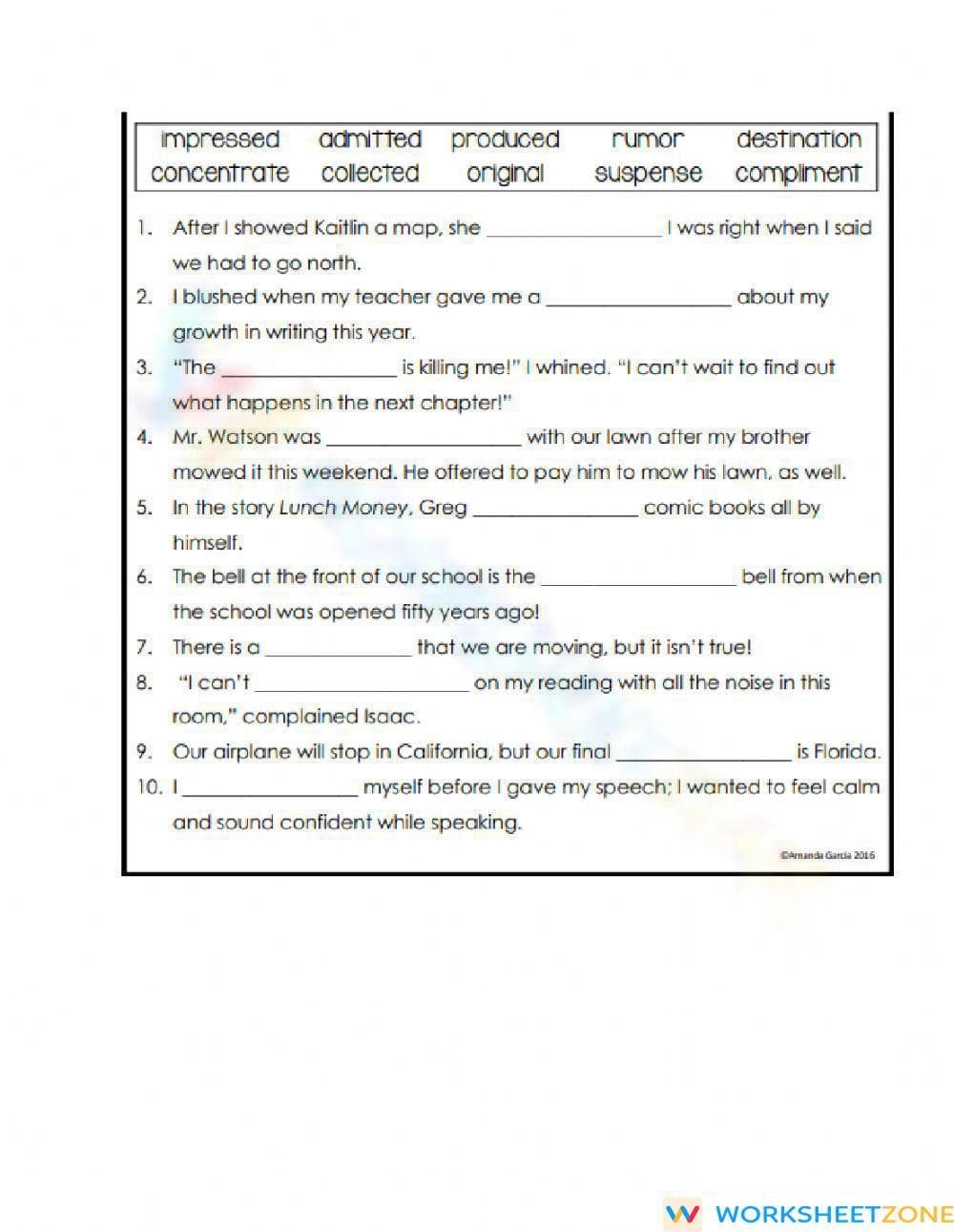
This Grade 5 Journeys Lafff vocabulary worksheet empowers students to master academic terminology through contextual application. By completing 10 targeted fill-in-the-blank sentences, learners transition from rote memorization to active usage of Lesson 17's core word list. It is an ideal resource for reinforcing reading comprehension and linguistic precision in upper elementary classrooms.
At a Glance
- Grade: 5 · Subject: ELA
- Standard:
CCSS.ELA-LITERACY.L.5.6— Use grade-appropriate academic words and phrases in context- Skill Focus: Vocabulary Acquisition & Context Clues
- Format: 1 page · 10 problems · Answer key included · PDF
- Best For: Vocabulary reinforcement and homework
- Time: 15–20 minutes
The worksheet features a clear word bank containing ten essential terms from the "Lafff" unit: impressed, admitted, produced, rumor, destination, concentrate, collected, original, suspense, and compliment. Students must evaluate ten unique sentence scenarios to determine which word fits best based on context clues. The layout is clean, providing ample space for handwriting, and includes a full answer key for efficient grading or self-correction.
This resource is designed for a smooth classroom experience. Total teacher preparation time is less than two minutes: simply print the single-page PDF, distribute to the class, and review the answers using the provided key. The self-explanatory format makes it an excellent choice for substitute plans, morning work, or independent centers where students require minimal teacher intervention to succeed.
Aligned to CCSS.ELA-LITERACY.L.5.6, this worksheet ensures students can acquire and use accurately grade-appropriate general academic and domain-specific words and phrases. By focusing on words that appear in the Journeys curriculum, the task directly supports the development of academic language proficiency required for complex text analysis. Both standard codes can be copied directly into lesson plans, IEP goals, or district curriculum mapping tools.
Assign this worksheet after the initial reading of "Lafff" to gauge understanding of unit vocabulary. Teachers can use these sentences as a formative assessment to observe how students apply logic to word bank choices. It serves as a perfect homework assignment to reinforce usage, typically taking students 15 to 20 minutes to complete.
This resource is tailored for 5th-grade students following the Journeys curriculum, and suitable for older students needing intervention. The word bank provides scaffolding for English Language Learners and students with IEPs who benefit from constrained choice. Pair this with the original text or an anchor chart for maximum instructional impact.
Standardized vocabulary instruction, such as the contextual application used in this CCSS.ELA-LITERACY.L.5.6 worksheet, is a proven driver of reading comprehension gains. Research from Fisher & Frey (2014) emphasizes that students must encounter and use new words in diverse contexts multiple times to move them into permanent memory. This worksheet facilitates that transition by requiring students to match ten academic terms—including words like "suspense" and "destination"—to specific narrative scenarios. By grounding vocabulary practice in sentence-level context rather than isolated definitions, the resource aligns with the "Vocabulary in Context" mandates of the RAND AIRS 2024 report on ELA pedagogy. Educators can utilize this structured practice to bridge the gap between word recognition and fluent expression, ensuring students possess the linguistic tools necessary for the NAEP-aligned demands of middle school reading and writing tasks.


