


























Views
Downloads



Essential Josh Gibson Reading Worksheet | Grades 6-9 ELA
Paste this activity's link or code into your existing LMS (Google Classroom, Canvas, Teams, Schoology, Moodle, etc.).
Students can open and work on the activity right away, with no student login required.
You'll still be able to track student progress and results from your teacher account.
This comprehensive informational text worksheet focuses on the legendary Negro League baseball player Josh Gibson. Students read a detailed biographical narrative and then engage with high-level comprehension tasks that require them to synthesize information, identify irony, and substantiate claims with direct evidence. It is a complete resource for Black History Month or sports history units.
At a Glance
- Grade: 6–9 · Subject: English Language Arts
- Standard:
CCSS.ELA-LITERACY.RI.8.1— Cite strong textual evidence to support analysis of what the text says explicitly- Skill Focus: Evidence-based analysis and critical reflection
- Format: 5 pages · 6 problems · Answer key included · PDF
- Best For: Close reading and informational text analysis
- Time: 40–50 minutes
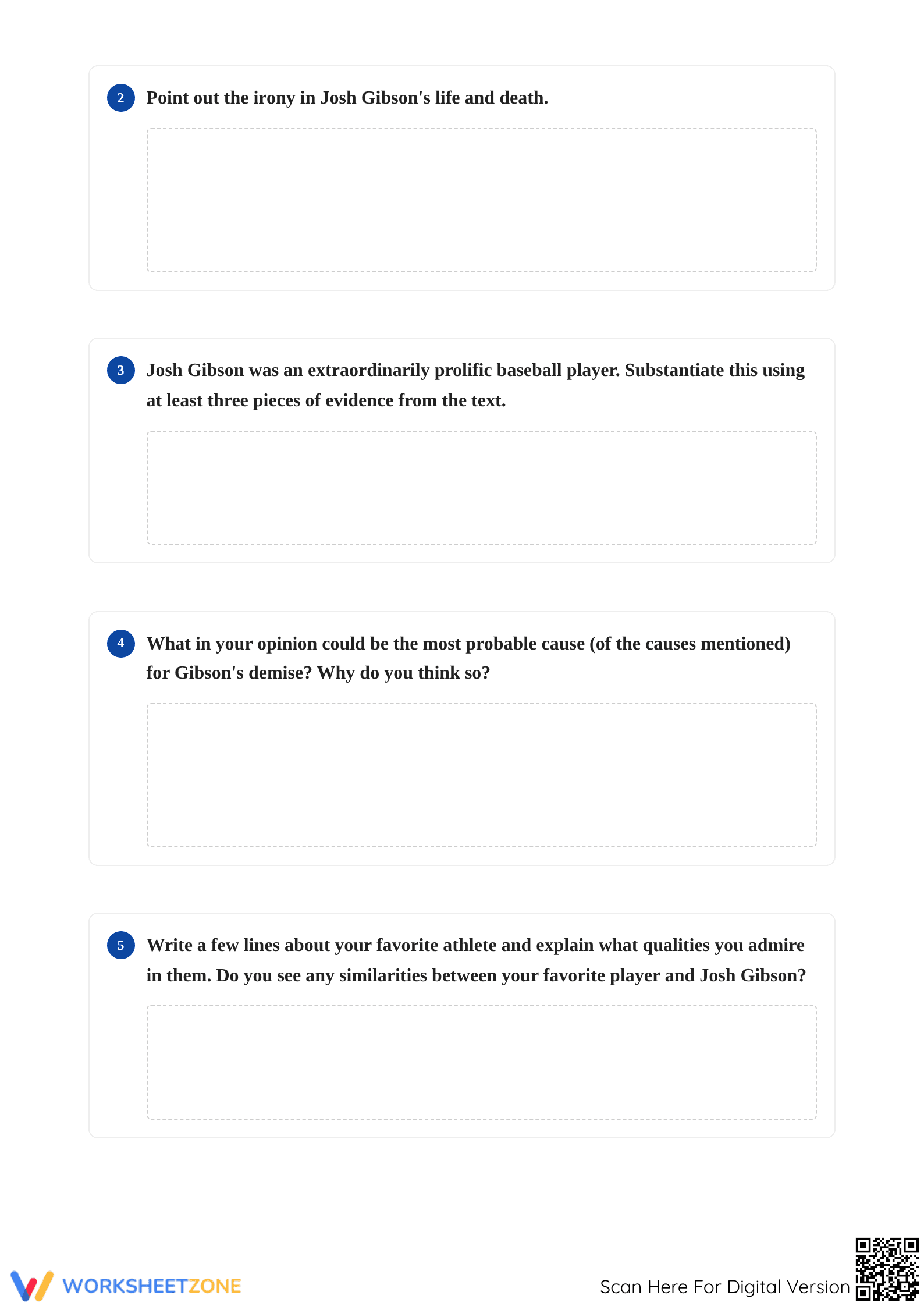
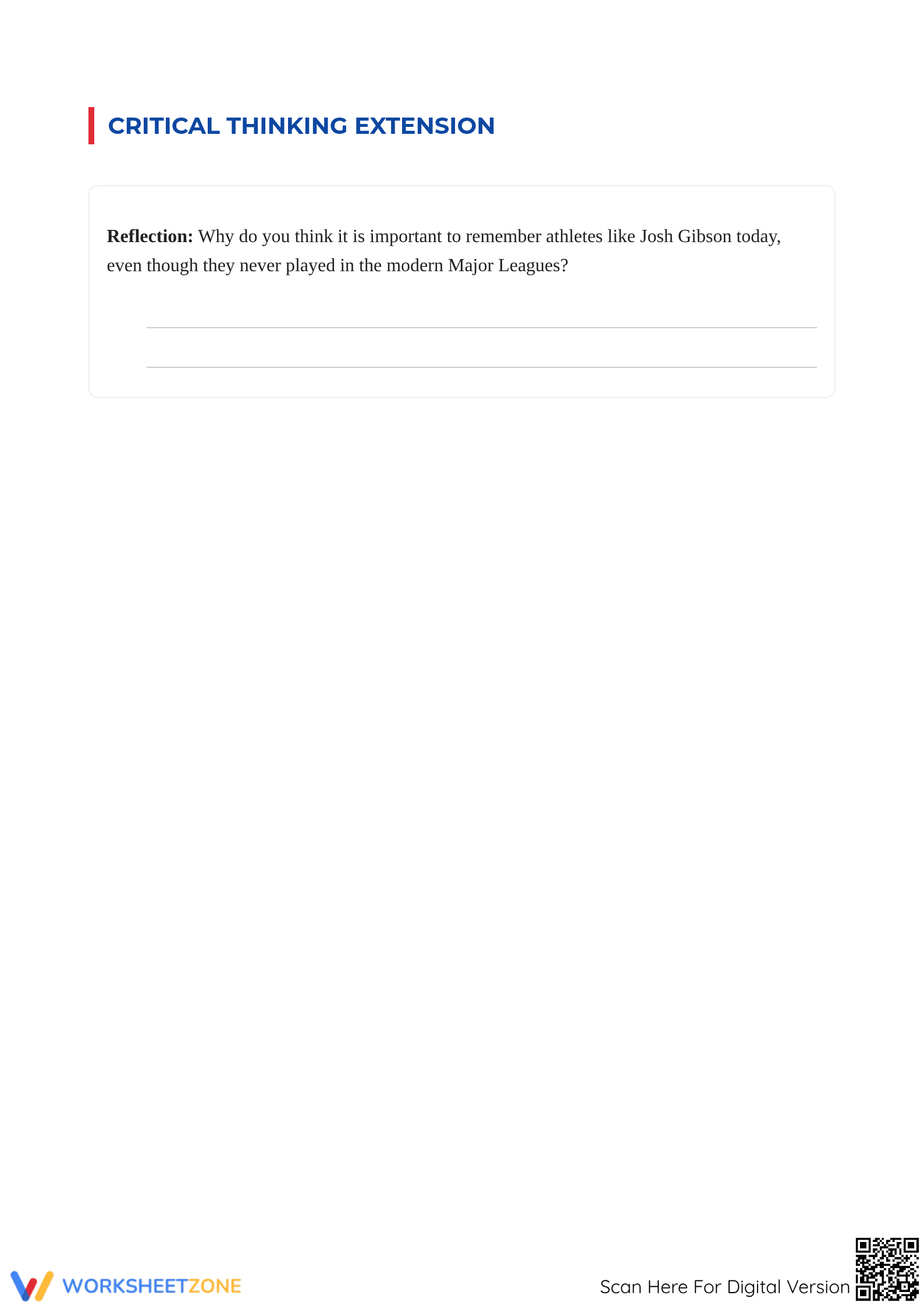
The package contains five high-quality pages. The first two pages provide a rich, narrative-driven biography of Josh Gibson, covering his athletic prowess, the color line barrier, and his tragic legacy. The subsequent pages feature structured comprehension questions, including a multiple-choice item, four short-answer evidence-based questions, and a critical thinking reflection prompt. A full answer key is provided.
- Guided Practice: Students begin by identifying the author's underlying purpose in a multiple-choice task that focuses on the broader historical context of the color line.
- Supported Practice: Three structured short-answer questions require students to point out ironies and substantiate Gibson's prolific career using exactly three pieces of textual evidence.
- Independent Practice: The final reflection task challenges students to articulate the modern significance of remembering athletes who were excluded from Major League Baseball.
This sequence follows a gradual-release model, moving from identifying explicit meanings to constructing complex inferences with minimal teacher intervention.
The primary alignment is CCSS.ELA-LITERACY.RI.8.1, which requires students to cite the textual evidence that most strongly supports an analysis. The reflection extension also supports secondary standards by determining central themes and analyzing their development. These standard codes can be copied directly into lesson plans, IEP goals, or district curriculum mapping tools.
Use this during a unit on social justice or American sports legends. After a silent reading period, have students work in pairs to find the three pieces of evidence for task three. Observe how students bridge the gap between Gibson's statistics and his historical exclusion to assess their inferential reasoning skills.
This resource is designed for middle and early high school students (Grades 6–9). It serves as an excellent resource for Black History Month or as a standalone literacy lesson. Pair this with a video clip of Negro League history or a biographical passage on Jackie Robinson for a comparative study of the era.
Instructional materials focusing on historical biographies, such as this Josh Gibson resource, play a vital role in developing secondary literacy skills. According to the RAND AIRS 2024 report on literacy interventions, engaging with complex informational texts that require evidence-based substantiation directly correlates with higher proficiency in argumentative writing and critical reasoning. This worksheet aligns with CCSS.ELA-LITERACY.RI.8.1 by requiring students to cite specific textual evidence to support their analysis of a historical figure’s impact and the systemic barriers they faced. By moving beyond simple recall to tasks involving irony and reflection, students build the cognitive stamina necessary for college and career readiness. The inclusion of a structured “three pieces of evidence” prompt ensures that students practice the specific skill of selecting the most salient details from a text. This approach is recognized by educational researchers as an effective method for closing the gap in reading comprehension for diverse student populations.


