


























Views
Downloads
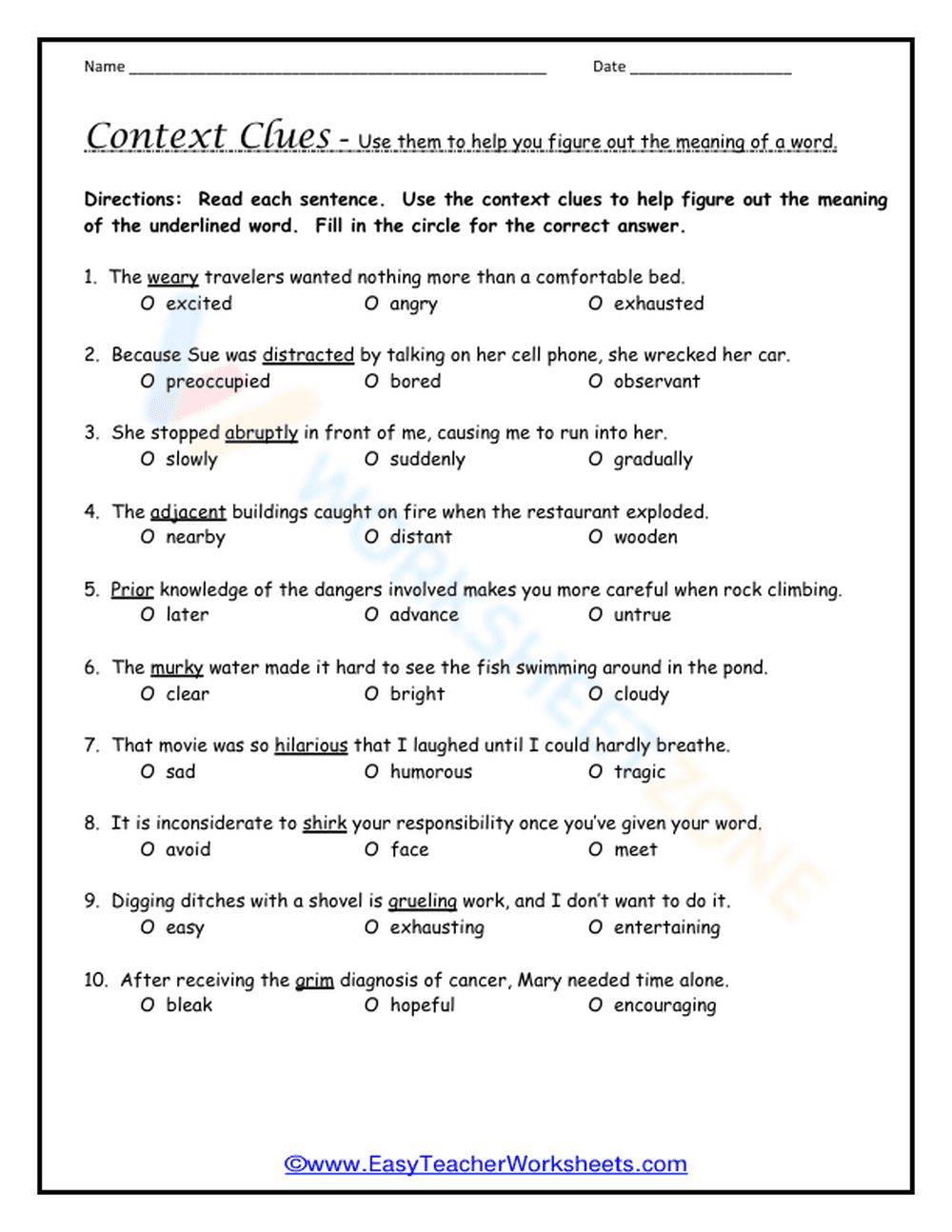

Context Clues Worksheet | Essential Grade 4-6 ELA Practice
Paste this activity's link or code into your existing LMS (Google Classroom, Canvas, Teams, Schoology, Moodle, etc.).
Students can open and work on the activity right away, with no student login required.
You'll still be able to track student progress and results from your teacher account.
This context clues worksheet helps Grade 4-6 students master vocabulary acquisition by identifying meanings through sentence-level evidence. By analyzing ten distinct sentences, learners determine the definition of academic words like "adjacent" and "grueling." This resource provides focused practice that builds reading comprehension and linguistic confidence across various literary and informational contexts.
At a Glance
- Grade: 4–6 · Subject: ELA
- Standard:
CCSS.ELA-LITERACY.L.4.4.A— Use context clues to determine meanings of unknown words- Skill Focus: Contextual Vocabulary Analysis
- Format: 1 page · 10 problems · Answer key included · PDF
- Best For: Independent practice or bell-ringer activity
- Time: 10–15 minutes
What's Inside: The PDF includes one page of high-quality ELA practice featuring ten multiple-choice questions. Each problem presents a sentence with a bolded vocabulary word, followed by three options that challenge students to select the most appropriate synonym based on surrounding text evidence. A full answer key is provided to ensure quick grading and immediate student feedback.
The zero-prep workflow is designed for busy educators. First, print the single-page document (30 seconds). Second, distribute to students for individual or partner work (30 seconds). Third, review the answers using the included key for a whole-class check (1 minute). Total teacher preparation time is under two minutes, making this an ideal choice for emergency sub plans or last-minute literacy centers.
Standards Alignment: This activity is directly aligned with CCSS.ELA-LITERACY.L.4.4.A, which requires students to "use context as a clue to the meaning of a word or phrase." It also supports CCSS.ELA-LITERACY.L.5.4.A by encouraging learners to verify preliminary determinations of word meanings. Both standard codes can be copied directly into lesson plans, IEP goals, or district curriculum mapping tools.
How to Use It: Use this worksheet as a formative assessment after a direct instruction lesson on vocabulary strategies to observe how well students apply their skills to new words. Alternatively, assign it as a morning work activity to settle the class and activate prior knowledge. Educators should look for students who struggle to articulate why a specific option fits the sentence logic.
Who It's For: This resource is perfect for general education students in intermediate grades, as well as ELL learners who benefit from sentence-level scaffolds. It pairs naturally with a vocabulary anchor chart or a short reading passage that requires students to apply these strategies in a broader narrative or informational context.
Extensive research from the RAND AIRS 2024 report highlights the critical role of morphological and contextual analysis in closing the achievement gap for literacy. This worksheet addresses CCSS.ELA-LITERACY.L.4.4.A by providing structured opportunities for students to engage in "plain-English" problem-solving: identifying a word's meaning by looking at the information surrounding it. By focusing on ten specific academic terms, students develop the stamina needed for complex text analysis. The multiple-choice format reduces cognitive load during initial skill acquisition, allowing learners to focus entirely on the linguistic logic required for successful inference. Implementing such targeted practice within a comprehensive literacy block ensures that students move beyond rote memorization toward a functional mastery of academic language. This approach is proven to support long-term retention of Tier 2 vocabulary across diverse student populations and instructional settings.


