


























Views
Downloads

Printable Irregular Plural Nouns Worksheet | Grade 4-5
Paste this activity's link or code into your existing LMS (Google Classroom, Canvas, Teams, Schoology, Moodle, etc.).
Students can open and work on the activity right away, with no student login required.
You'll still be able to track student progress and results from your teacher account.
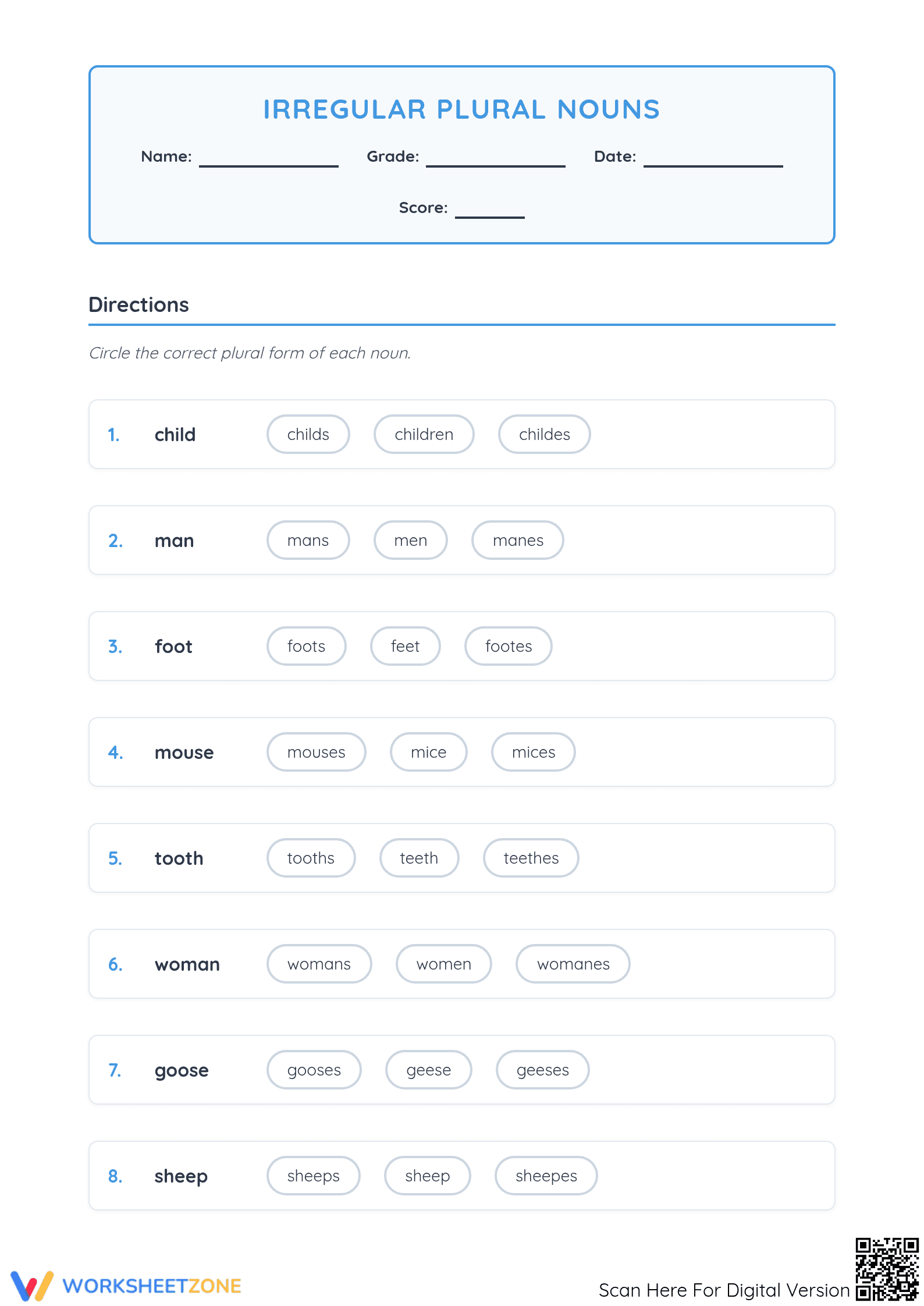
Mastering irregular plural nouns is a foundational step in developing advanced literacy and writing skills. This worksheet provides students with targeted practice in identifying correct plural forms for words that do not follow the standard "add -s" rule. By isolating these challenging nouns, students build the morphological awareness necessary for clear and accurate communication.
At a Glance
- Grade: 4–5 · Subject: ELA Grammar
- Standard:
CCSS.ELA-LITERACY.L.3.1.B— Form and use irregular plural nouns correctly in speech and writing- Skill Focus: Irregular Plural Noun Identification
- Format: 2 pages · 12 problems · Answer key included · PDF
- Best For: Independent grammar practice and review
- Time: 10–15 minutes
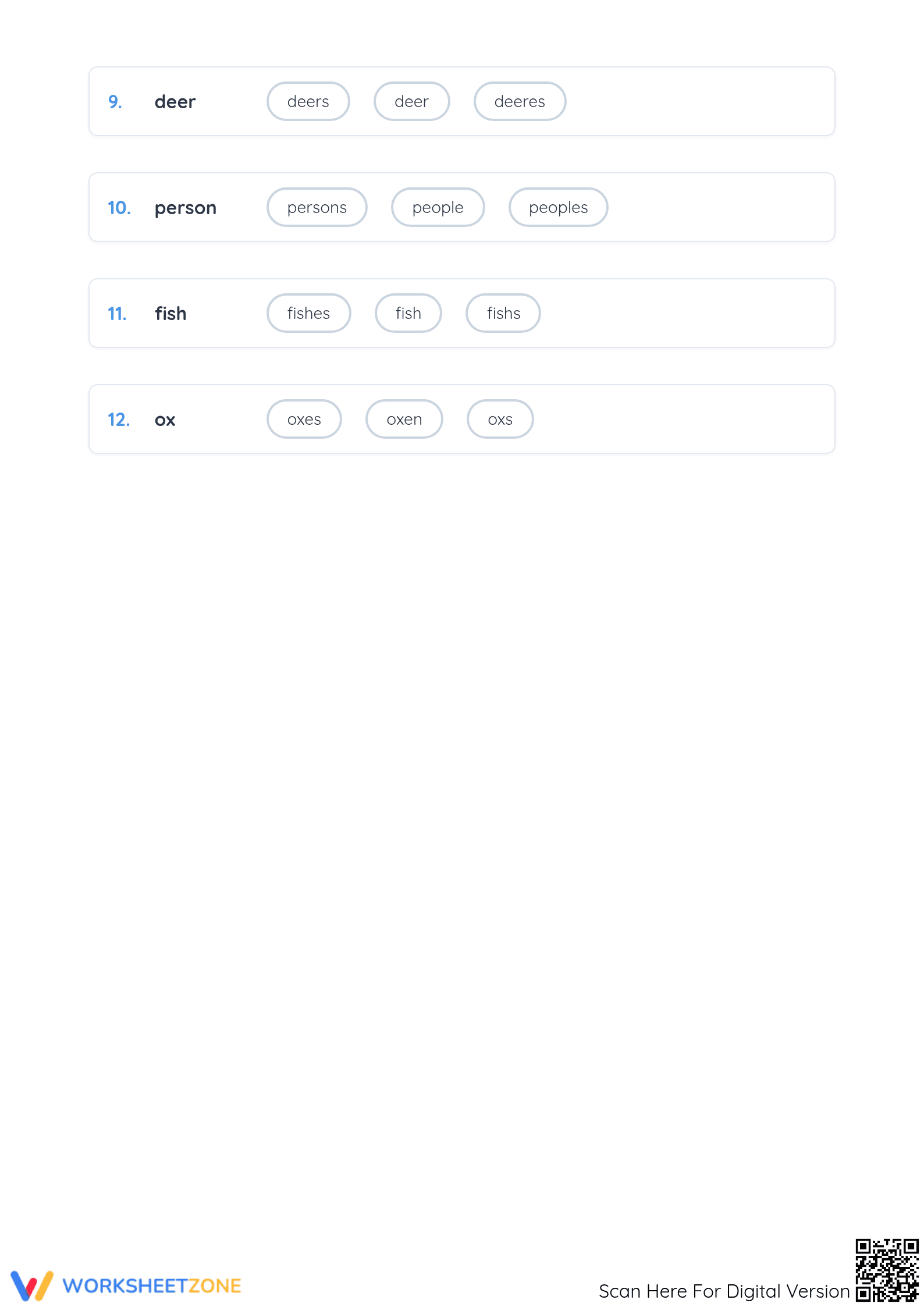
This two-page resource features twelve distinct exercises designed to challenge and reinforce pluralization rules. Each item presents a singular noun, such as "mouse" or "goose," alongside three potential plural options. Students must evaluate the choices and circle the linguistically accurate form. The clean, distraction-free layout ensures students remain focused on the task, while the included answer key allows for immediate feedback and grading.
The worksheet follows a structured skill progression. Guided practice begins with common irregulars students encounter daily, like "children." Supported practice moves to less frequent forms like "oxen," requiring closer attention to spelling patterns. Independent practice concludes the set, asking students to differentiate nouns that change completely from those that stay the same, like "sheep." This mirrors the I Do, We Do, You Do model of instruction.
This activity is primarily aligned to `CCSS.ELA-LITERACY.L.3.1.B`, which focuses on the formation and usage of irregular plural nouns. It also supports `CCSS.ELA-LITERACY.L.4.1` by helping students demonstrate command of the conventions of standard English grammar. Both standard codes can be copied directly into lesson plans, IEP goals, or district curriculum mapping tools to ensure instructional consistency across the grade level.
Use this worksheet as a quick check for understanding immediately after a direct instruction lesson on grammar mechanics. It also serves as an excellent formative assessment tool; teachers can observe whether students are over-applying regular rules (e.g., choosing "mouses" instead of "mice") to identify specific areas for remediation. The twelve-task format makes it an ideal warm-up or "exit ticket" to gauge class-wide mastery of these specific irregular forms.
Designed for Grade 4 and 5 students, this resource is particularly effective for English Language Learners (ELLs) who often struggle with the non-intuitive nature of irregular English plurals. It is a natural pairing for an anchor chart displaying common irregulars or a reading passage containing diverse plural forms. The visual circling task provides a low-stakes way for students to demonstrate their morphological knowledge.
The mastery of irregular pluralization is more than a spelling exercise; it is a critical component of syntactic development. According to Fisher & Frey (2014), targeted practice in morphological awareness, such as identifying irregular plural nouns, significantly improves overall reading comprehension and writing clarity. This Grade 4 and 5 worksheet addresses `CCSS.ELA-LITERACY.L.3.1.B` by providing twelve specific circling tasks that force students to distinguish between correct and incorrect irregular forms. By moving beyond the rote memorization of rules, this resource helps students internalize the exceptions that define standard English. Research from NAEP indicates that students who demonstrate a strong grasp of these conventions perform significantly better on standardized writing assessments. Providing students with structured, focused practice on these 12 high-frequency irregulars ensures they build a durable foundation for more complex linguistic tasks as they progress into middle school.


