


























Views
Downloads
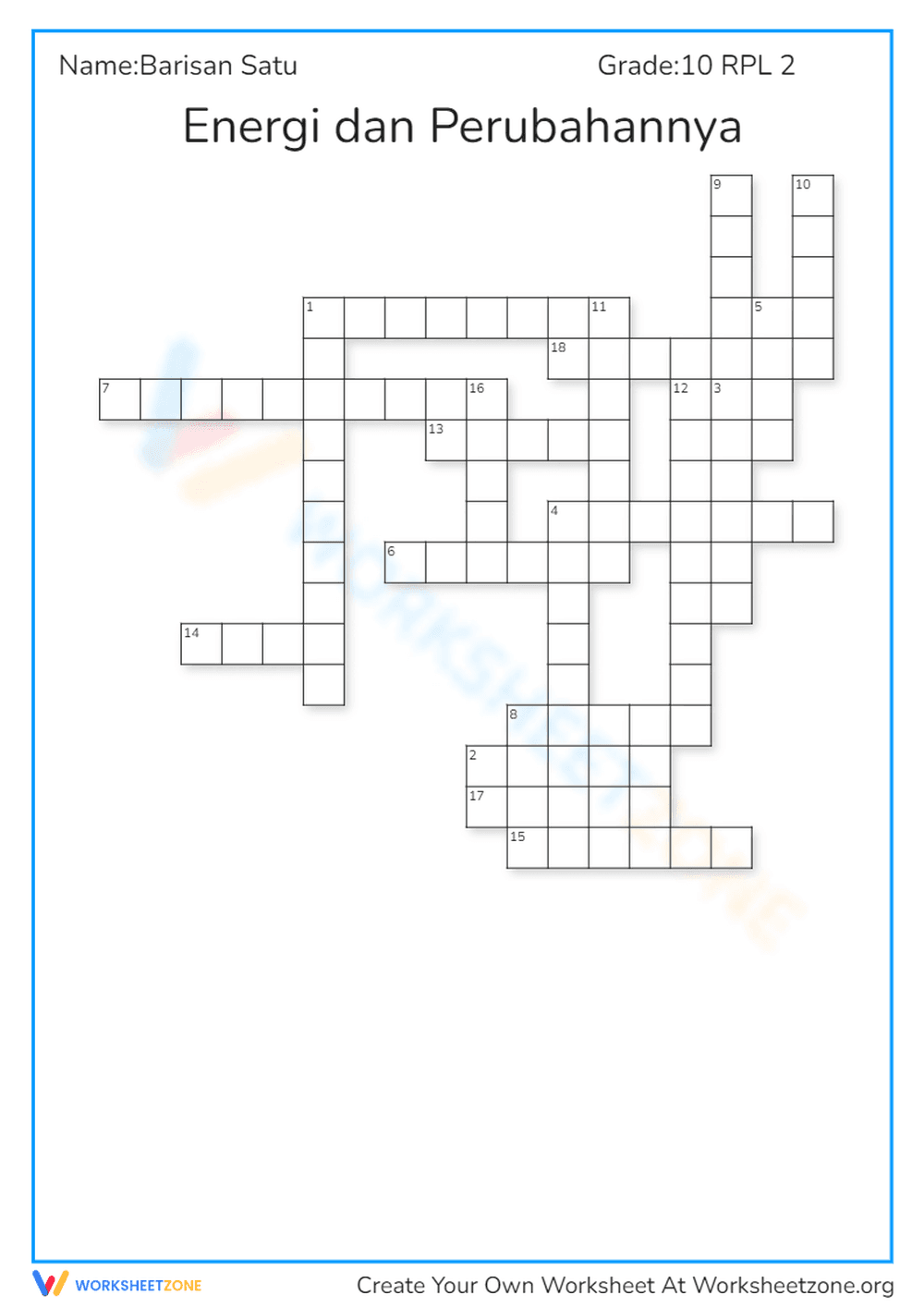


Printable Energy Vocabulary Worksheet | Grade 10 Science
Paste this activity's link or code into your existing LMS (Google Classroom, Canvas, Teams, Schoology, Moodle, etc.).
Students can open and work on the activity right away, with no student login required.
You'll still be able to track student progress and results from your teacher account.
This Grade 10 Science worksheet helps students master essential physics vocabulary related to energy, forces, and motion. By completing this engaging crossword puzzle, learners will reinforce their understanding of key terms like kinetic energy, potential energy, and standard units of measurement, building a strong foundation for advanced physical science concepts.
At a Glance
- Grade: 10 · Subject: Science
- Standard:
HS-PS3-2— Model macroscopic energy as motion and position- Skill Focus: Physics Vocabulary & Energy Concepts
- Format: 2 pages · 20 problems · PDF
- Best For: Vocabulary review and sub plans
- Time: 20–30 minutes
What's Inside
Inside this resource, educators will find a two-page activity featuring a comprehensive crossword puzzle and a dedicated clues sheet. The worksheet includes 20 distinct vocabulary tasks covering fundamental physics terminology, including units of measurement, types of energy, and principles of force and motion. The clear, structured layout ensures students can easily navigate between the clues and the puzzle grid.
Zero-Prep Workflow
- Print (1 minute): Simply download the PDF and print the two-page puzzle for your class.
- Distribute (1 minute): Hand out the worksheets at the beginning of the lesson or leave them on desks for immediate engagement.
- Review (5 minutes): Go over the completed puzzle together as a class to clarify any challenging terms.
With under two minutes of total teacher prep time, this activity is an ideal, self-explanatory resource for busy educators or emergency substitute plans.
Standards Alignment
Aligned to primary standard HS-PS3-2: Develop and use models to illustrate that energy at the macroscopic scale can be accounted for as a combination of energy associated with the motions of particles (objects) and energy associated with the relative position of particles (objects). This vocabulary foundation supports students in accurately describing these energy models. Both standard codes can be copied directly into lesson plans, IEP goals, or district curriculum mapping tools.
How to Use It
This worksheet is highly versatile for various instructional moments. Use it as a bell-ringer activity before diving into direct instruction on the conservation of energy to activate prior knowledge. Alternatively, assign it as a quiet, independent review task after a unit on forces and motion. As a formative assessment tip, observe which clues students struggle to answer without their textbooks; this will highlight specific vocabulary gaps that require reteaching. Expected completion time is 20 to 30 minutes.
Who It's For
This resource is designed for Grade 10 high school science students studying physical science or introductory physics. It serves as an excellent tool for general education students needing vocabulary reinforcement, as well as English Language Learners who benefit from structured word-association tasks. Pair this worksheet with a foundational anchor chart on the laws of thermodynamics or a direct instruction lesson on kinetic and potential energy equations.
Integrating structured vocabulary practice into high school science curricula is essential for developing scientific literacy. According to Fisher & Frey (2014), explicit vocabulary instruction in the content areas significantly improves students' ability to comprehend complex informational texts and articulate scientific reasoning. This worksheet supports that pedagogical approach by requiring students to actively recall and apply physics terminology. Aligned with standard HS-PS3-2, the activity ensures students can accurately model macroscopic energy as motion and position using the correct scientific lexicon. By engaging with these 20 targeted vocabulary prompts, learners transition from passive reading to active retrieval, a process proven to enhance long-term retention of core physical science concepts.


