


























Views
Plays

Invisible Hand Quiz: Essential Grade 10-12 Economics
Paste this activity's link or code into your existing LMS (Google Classroom, Canvas, Teams, Schoology, Moodle, etc.).
Students can open and work on the activity right away, with no student login required.
You'll still be able to track student progress and results from your teacher account.
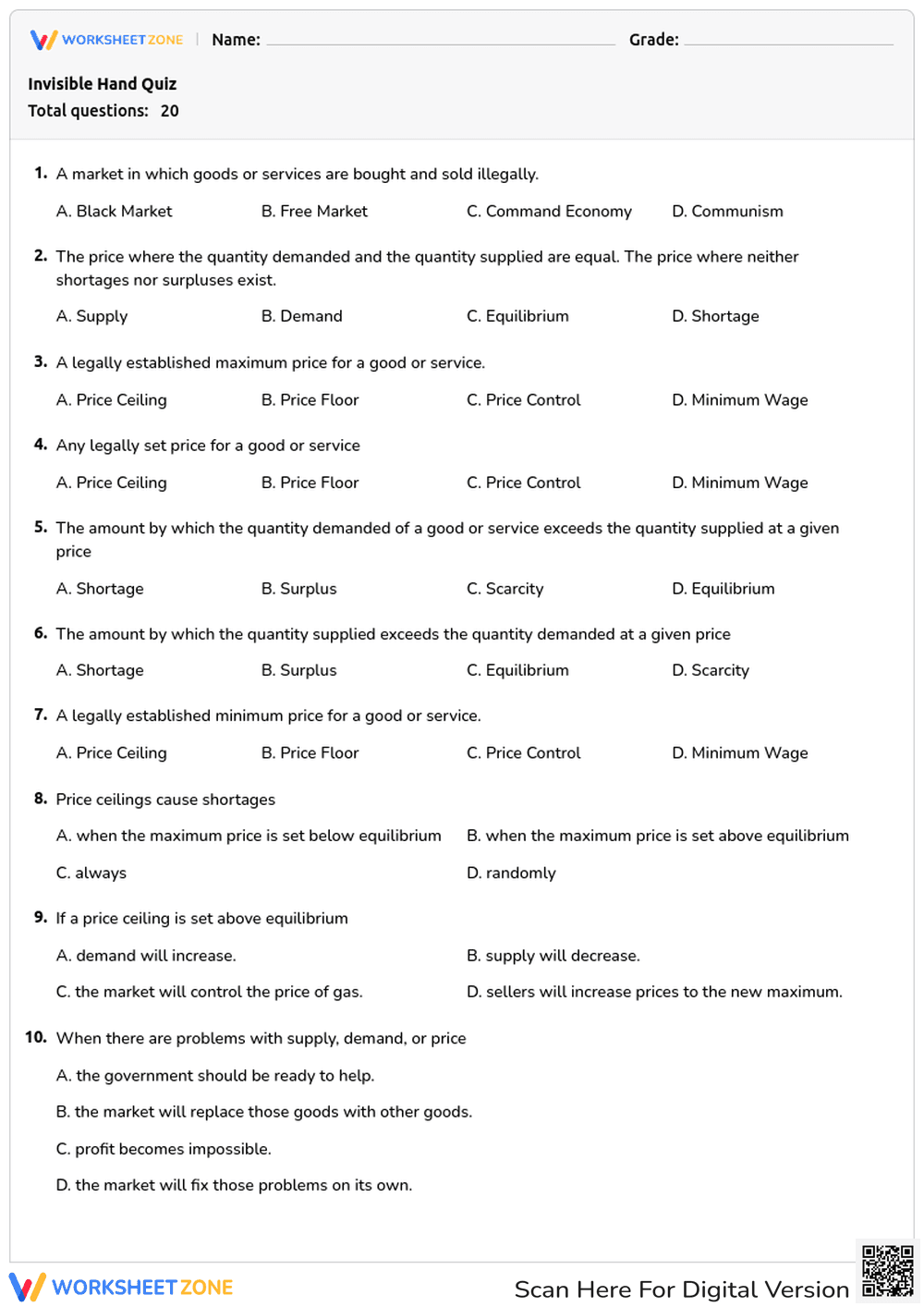
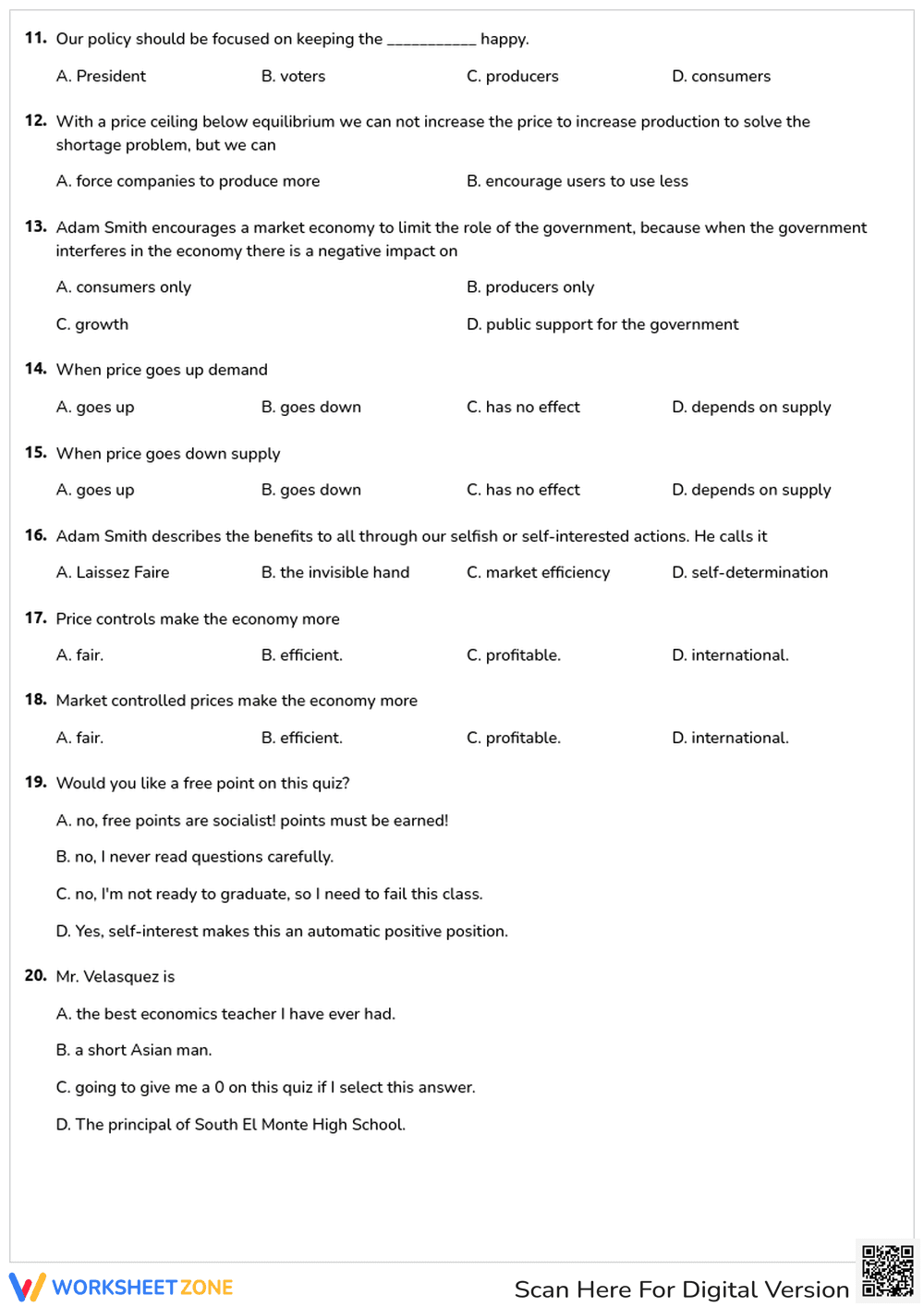
This Grade 10-12 Economics worksheet provides a comprehensive assessment of market mechanics, focusing on Adam Smith's "Invisible Hand" theory. Students demonstrate mastery of supply and demand interactions, price controls, and market equilibrium through 20 targeted multiple-choice questions. It is designed to evaluate conceptual understanding and practical application of economic principles.
At a Glance
- Grade: 10-12 · Subject: Economics
- Standard:
HS.E.1.3— Analyze how supply and demand determine equilibrium price and quantity in markets- Skill Focus: Market Equilibrium & Price Controls
- Format: 2 pages · 20 problems · Answer key included · PDF
- Best For: Formative assessment or unit review
- Time: 20–30 minutes
What's Inside
This 2-page assessment features 20 multiple-choice questions. The first half focuses on vocabulary and definitions, including black markets, equilibrium, and price ceilings. The second half challenges students to apply these concepts to real-world scenarios, such as the impact of government interference on economic growth and the self-correcting nature of free markets. A full answer key is provided for rapid grading.
Zero-Prep Workflow
- Print: Generate the 2-page PDF in under 1 minute for your entire class.
- Distribute: Hand out the quiz for a focused 20-minute individual assessment.
- Review: Use the included answer key for a 5-minute peer-review or teacher-led grading session.
Its self-contained nature makes it an ideal emergency sub plan for high school social studies teachers needing a high-quality, relevant activity.
Standards Alignment
The primary focus is `HS.E.1.3`, which requires students to "Analyze how supply and demand determine equilibrium price and quantity in the market." It also supports standards related to the role of government in the economy and the impact of price controls. Both standard codes can be copied directly into lesson plans, IEP goals, or district curriculum mapping tools.
How to Use It
Use this quiz as a summative exit ticket after a unit on market structures or as a diagnostic tool before introducing macroeconomics. For formative assessment, observe student responses to questions 8 and 9 regarding price ceilings; difficulty here indicates a need for further visual modeling of supply and demand curves. Completion typically takes 25 minutes.
Who It's For
This worksheet is tailored for high school students in Economics or Civics courses. It provides clear, accessible language for general education students while maintaining the rigor required for honors-level learners. It pairs naturally with an anchor chart on supply and demand curves or a primary source reading of Adam Smith’s "The Wealth of Nations."
According to the RAND AIRS 2024 report, structured assessments that isolate specific economic variables, such as price controls and equilibrium, significantly improve student retention of complex market theories. This worksheet aligns with these findings by utilizing 20 targeted questions to reinforce the "Invisible Hand" concept (HS.E.1.3). By requiring students to distinguish between shortages and surpluses within the context of price ceilings and floors, the resource builds the analytical framework necessary for high school economic literacy. Research from Fisher & Frey (2014) emphasizes that frequent, low-stakes testing of vocabulary and conceptual application, as seen in this 2-page quiz, bridges the gap between direct instruction and independent mastery. This assessment provides the data points needed for educators to adjust instruction based on real-time student performance in social studies classrooms.


