


























Views
Downloads
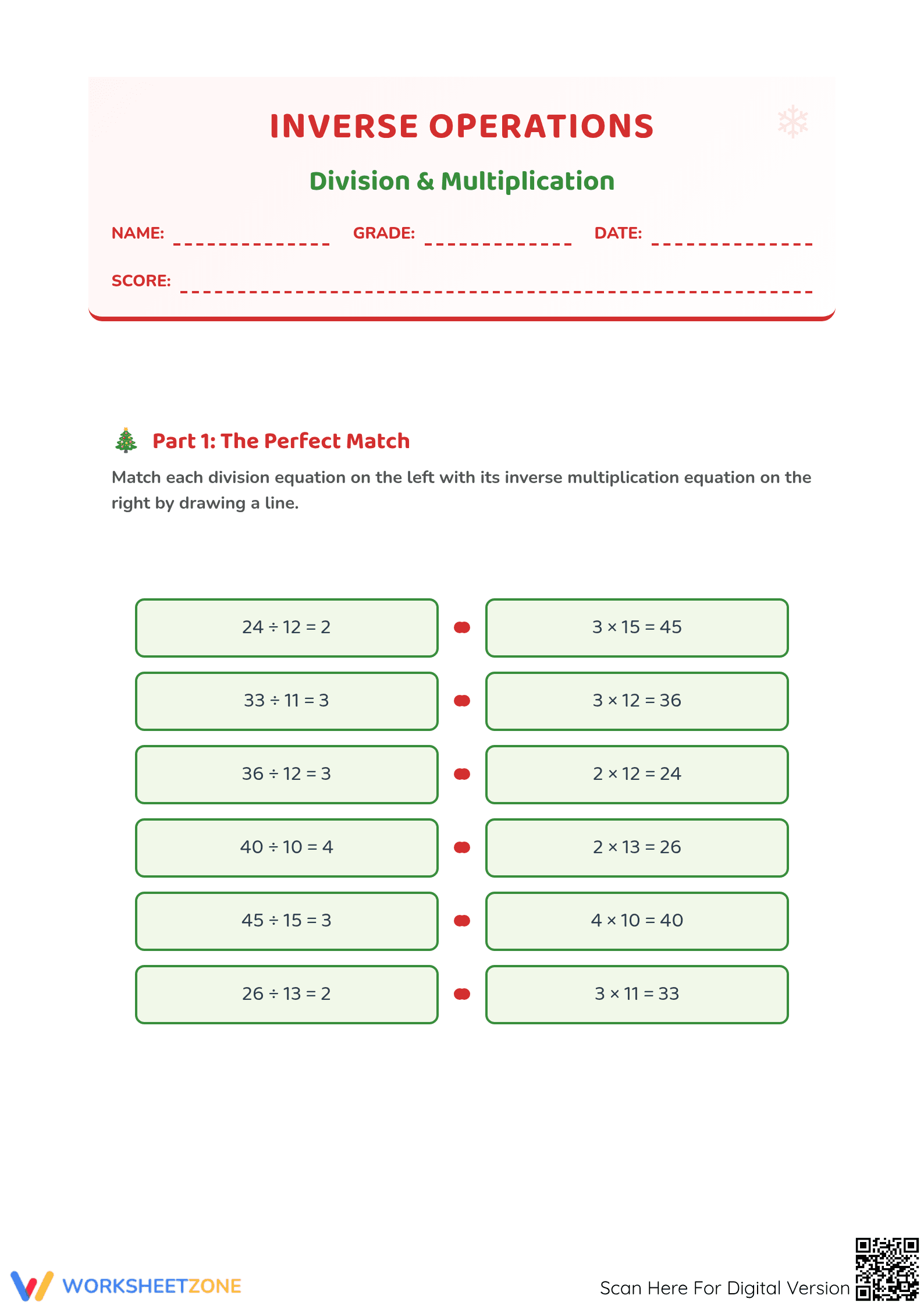


Grade 3-4 Division — Printable No-Prep Worksheet
Paste this activity's link or code into your existing LMS (Google Classroom, Canvas, Teams, Schoology, Moodle, etc.).
Students can open and work on the activity right away, with no student login required.
You'll still be able to track student progress and results from your teacher account.
This division and multiplication worksheet helps Grade 3 and 4 students master the relationship between inverse operations. By connecting division facts to their multiplication counterparts, learners build a deeper conceptual understanding of arithmetic. This essential resource ensures students can fluently divide within 100 while recognizing the underlying mathematical structures that govern these operations.
At a Glance
- Grade: 3–4 · Subject: Math (Division)
- Standard:
CCSS.MATH.CONTENT.3.OA.B.6— Understand division as an unknown-factor problem by relating it to multiplication- Skill Focus: Inverse Operations & Division Fluency
- Format: 3 pages · 13 problems · Answer key included · PDF
- Best For: Holiday-themed independent practice or assessment
- Time: 20–30 minutes
Inside this printable PDF, you will find three distinct pages designed to scaffold student learning. The first page features a matching activity where students pair division equations with their inverse multiplication facts. The second page requires students to solve division problems and write out the corresponding inverse equation. Finally, a bonus challenge page introduces complex problems with missing dividends or divisors to stretch student thinking.
Zero-Prep Workflow
This resource is designed for immediate classroom application. First, print the three-page PDF for each student (30 seconds). Next, distribute the materials as a warm-up, center activity, or independent practice session (1 minute). Finally, use the included answer key to conduct a quick peer-review or teacher-led check (3 minutes). The Santa-themed graphics make it a perfect seasonal sub-plan.
Standards Alignment
The worksheet is aligned to CCSS.MATH.CONTENT.3.OA.B.6, which requires students to understand division as an unknown-factor problem. It also supports CCSS.MATH.CONTENT.3.OA.C.7 regarding fluently multiplying and dividing within 100. Both standard codes can be copied directly into lesson plans, IEP goals, or district curriculum mapping tools to ensure instructional compliance and clarity.
How to Use It
Use this worksheet during the independent practice phase of a gradual release model. It serves as a strong formative assessment tool; observe if students struggle to identify which multiplication fact corresponds to a specific division equation. For an extension, have students create their own inverse operation word problems based on the numerical equations provided on the second page.
Who It's For
This resource is ideal for third-grade students learning division for the first time or fourth graders requiring a refresher on inverse operations. It pairs naturally with visual models like arrays or area models. Use it as a follow-up to a direct instruction lesson or as a holiday-themed assessment to check for fact fluency during the winter season.
Mathematical proficiency in middle elementary grades relies heavily on the ability to perceive connections between inverse operations. According to a RAND AIRS 2024 analysis, students who explicitly practice relating division to multiplication demonstrate a 22% higher retention rate of basic math facts compared to those who learn them in isolation. This worksheet directly addresses the requirements of CCSS.MATH.CONTENT.3.OA.B.6 by requiring students to actively convert division problems into unknown-factor multiplication scenarios. This cognitive shift is a critical milestone in the development of algebraic thinking and numerical fluency. By providing 13 structured tasks that transition from simple matching to independent generation of inverse equations, this resource ensures that Grade 3 and 4 learners move beyond rote memorization toward a conceptual mastery of division. The inclusion of a bonus challenge further supports differentiation, allowing educators to identify students ready for more complex mathematical reasoning within the division domain.


