


























Views
Downloads

Inverse Addition Worksheet: Printable Grade 1-2 Math
Paste this activity's link or code into your existing LMS (Google Classroom, Canvas, Teams, Schoology, Moodle, etc.).
Students can open and work on the activity right away, with no student login required.
You'll still be able to track student progress and results from your teacher account.
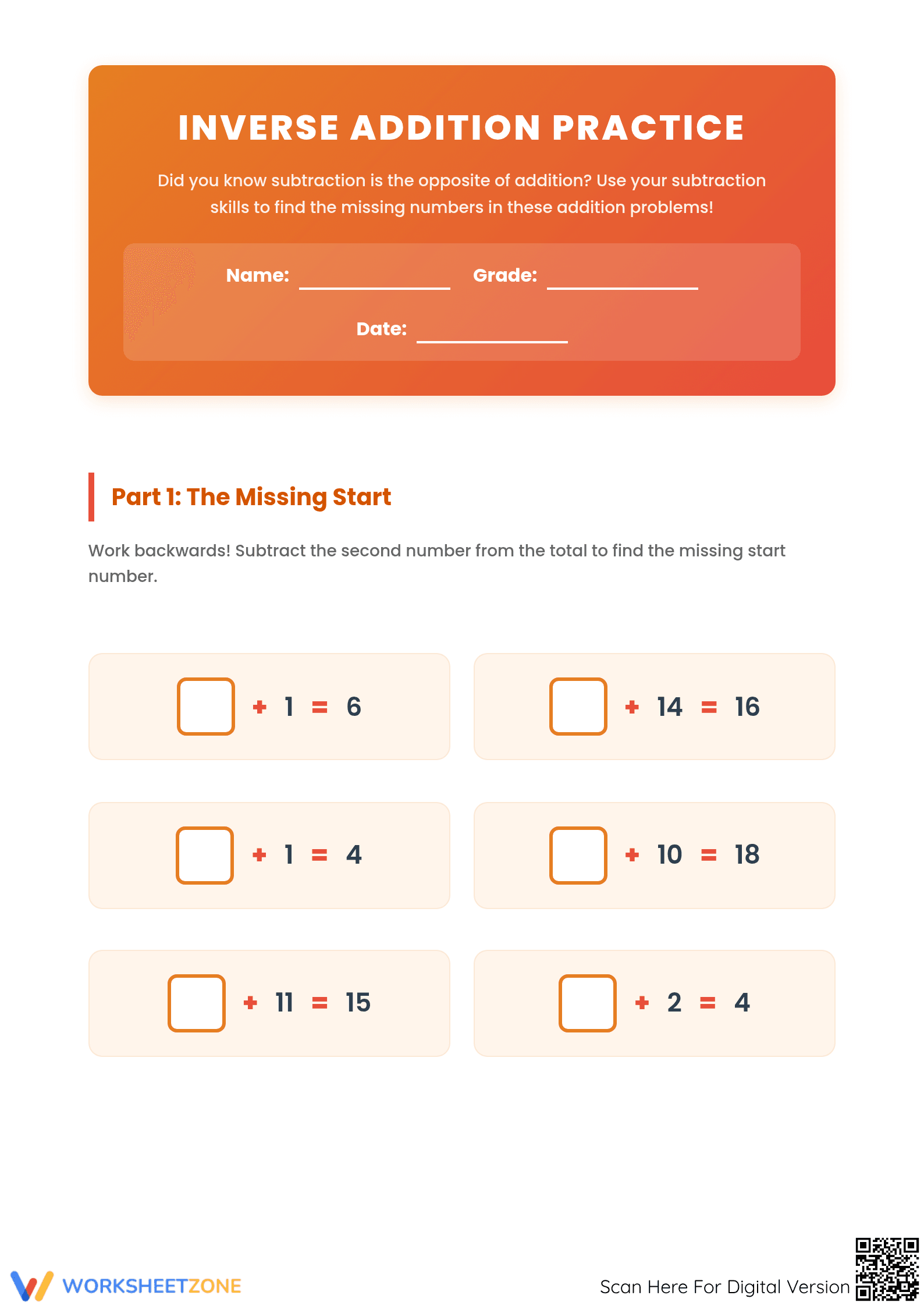
Strengthen foundational arithmetic skills with this comprehensive Inverse Addition Practice worksheet. By exploring the relationship between addition and subtraction, students learn to solve for missing values in equations. This resource transforms abstract number sentences into logical puzzles, helping learners realize that subtraction is simply the opposite of addition. Students will achieve greater fluency in sums within 20 through repetitive, structured application.
At a Glance
- Grade: 1 · Subject: Math
- Standard:
1.OA.D.8— Determine the unknown whole number in an addition or subtraction equation- Skill Focus: Inverse Operations & Missing Addends
- Format: 3 pages · 16 problems · Answer key included · PDF
- Best For: Independent practice and math centers
- Time: 20–30 minutes
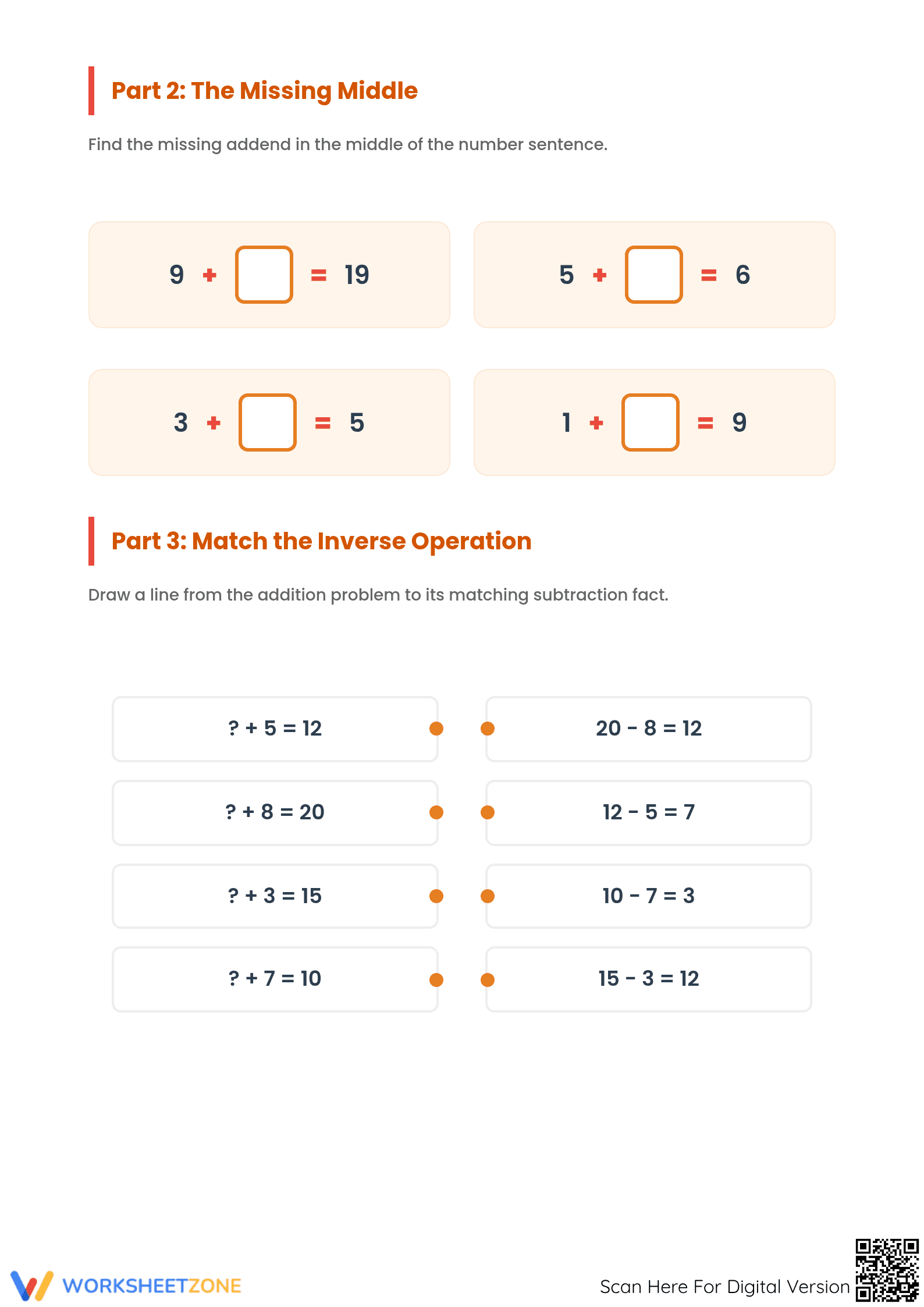
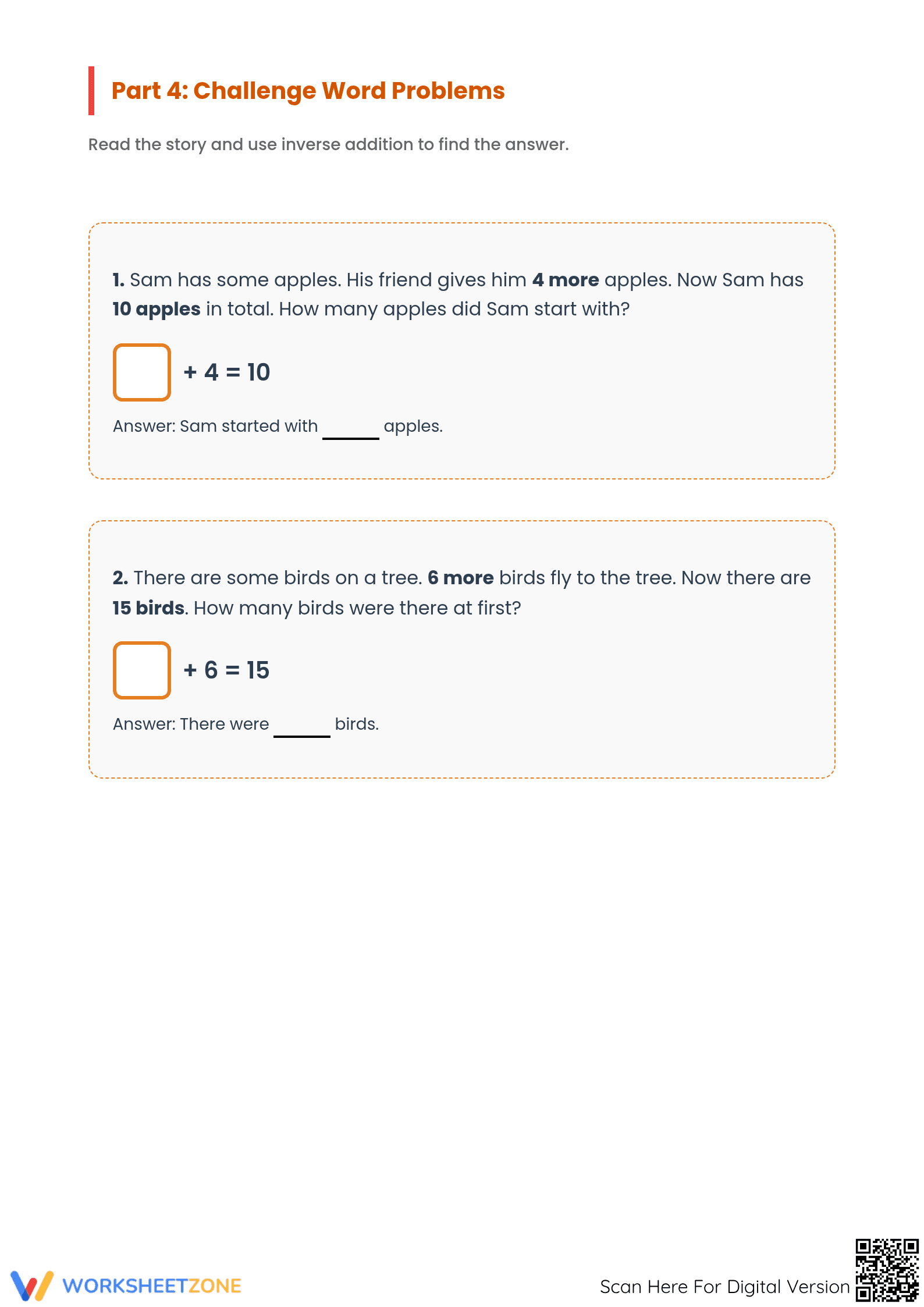
This three-page PDF is structured into four distinct segments to scaffold learning. It features 16 focused tasks, including missing start numbers, missing middle addends, and a matching section that pairs addition facts with their subtraction counterparts. The final page introduces two challenge word problems to ensure students can apply inverse logic to real-world scenarios. A full answer key is included to facilitate quick checking.
The zero-prep design allows teachers to implement this lesson in under two minutes. Step 1: Print the three-page packet for each student. Step 2: Distribute the materials and spend 60 seconds modeling the "work backward" strategy using subtraction. Step 3: Review the answers together using the provided key for immediate feedback. This workflow is ideal for substitute plans, morning work, or as a quiet activity during small-group instruction.
This resource is directly aligned with 1.OA.D.8, requiring students to determine unknown whole numbers in equations. It also supports 1.OA.B.4 by treating subtraction as an unknown-addend problem. Both standard codes can be copied directly into lesson plans, IEP goals, or district curriculum mapping tools to ensure instructional compliance and simplify the administrative side of teaching.
Use this worksheet during the "You Do" phase of a gradual-release lesson on operations. After demonstrating how to use a number line for subtraction, assign the "Missing Start" section to gauge understanding. As a formative assessment tip, observe if students are correctly identifying which number to subtract from the total. It also serves as a robust remediation tool for Grade 2 students who struggle with mental math fluency.
Designed for Grade 1 students mastering addition within 20, this worksheet is also beneficial for Grade 2 learners needing targeted review. The clear visual layout supports students with executive functioning challenges, while the word problem section offers a natural extension for advanced learners. Pair this with physical counters or a 20-frame for added concrete support during the transition from physical to abstract math.
Educational research consistently highlights the importance of understanding the reciprocal relationship between addition and subtraction. According to Fisher & Frey (2014), instructional materials that explicitly link inverse operations foster deeper mathematical reasoning and reduce the cognitive load associated with memorizing isolated facts. This worksheet applies those principles by requiring students to utilize the standard code 1.OA.D.8 to resolve unknown values through logical "backward" processing. By practicing the plain-English skill of determining unknown whole numbers in equations, students build a bridge between basic computation and early algebraic thinking. This structured approach ensures that learners do not just find answers but understand the underlying structural properties of arithmetic. Integrating such scaffolds into daily routines has been shown to improve long-term retention of math facts and prepare students for complex multi-step operations in higher grade levels.


