


























Views
Downloads
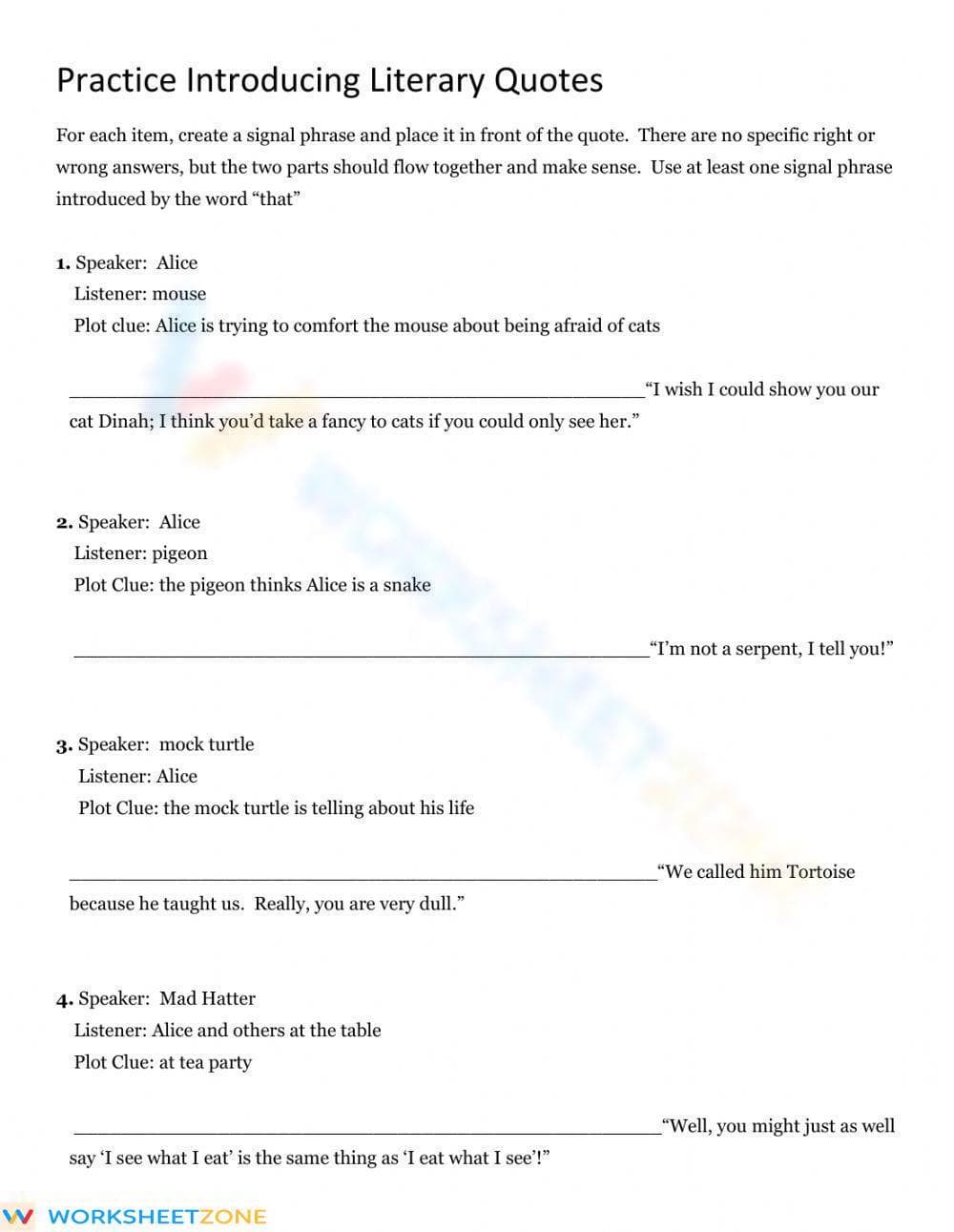


Grade 11/12 Literary Quotes — Printable No-Prep Worksheet
Paste this activity's link or code into your existing LMS (Google Classroom, Canvas, Teams, Schoology, Moodle, etc.).
Students can open and work on the activity right away, with no student login required.
You'll still be able to track student progress and results from your teacher account.
This worksheet provides targeted practice for high schoolers on introducing literary quotations. Students learn to integrate textual evidence into their writing by crafting appropriate signal phrases for four distinct quotes, strengthening their analytical and compositional abilities. An answer key is included for easy review.
At a Glance
- Grade: 10–12 · Subject: English Language Arts (ELA)
- Standard:
CCSS.ELA-LITERACY.RL.11-12.1— Cite strong textual evidence to support analysis.- Skill Focus: Introducing literary quotations
- Format: 2 pages · 4 problems · Answer key included · PDF
- Best For: Bell-ringer, exit ticket, or homework assignment
- Time: 10–15 minutes
This two-page PDF includes a primary worksheet and a full answer key. The worksheet presents four problems, each with a literary quote, speaker, and plot clue. Students are tasked with writing an introductory signal phrase for each one. The answer key provides examples for simple grading or self-assessment.
Zero-Prep Workflow
This resource uses a simple, zero-prep workflow. First, print the PDF. Second, distribute the worksheet to students for a short, focused activity. Finally, review answers using the provided key. The teacher prep process takes under two minutes, making this ideal for substitute plans, writing drills, or a bell-ringer. It is a true print-and-go solution for busy classrooms.
Standards Alignment
This worksheet aligns with Common Core standard CCSS.ELA-LITERACY.RL.11-12.1, which requires students to cite strong textual evidence to support their analysis. Practicing signal phrases is a foundational component of meeting this expectation. The standard code can be copied directly into lesson plans, IEP goals, or curriculum maps for easy documentation.
How to Use It
Use this as a formative assessment after a lesson on integrating evidence. It serves well as a 10-minute bell-ringer or an exit ticket to check understanding. While students work, observe their signal verb choices; a lack of variety suggests a topic for a quick follow-up lesson. Completion time is 10-15 minutes.
Who It's For
This resource is ideal for students in Grades 10-12 ELA courses developing their analytical writing skills. It is especially helpful for students who need structured practice with sophisticated phrasing. To support learners, pair this worksheet with an anchor chart of common signal verbs (e.g., "argues," "observes," "notes") as a reference during the activity.
Integrating textual evidence is a core academic skill measured by standards like CCSS.ELA-LITERACY.RL.11-12.1. This worksheet gives focused practice on the mechanics of this skill by requiring students to create signal phrases. Research from Fisher & Frey (2014) highlights that structured practice with evidence is critical for developing the "close reading" abilities required for college and careers. This resource moves students beyond simply dropping quotes into writing, guiding them to frame evidence with context. By mastering signal phrases, students control their analysis, making arguments more fluid and persuasive. It provides a direct, practical application of principles essential for demonstrating analytical acumen.


