


























1 / 4
0
Views
0
Downloads

0.0
0
Save
0 Likes
Share
Lab on Intermolecular Forces Worksheet
0 Views
0 Downloads
Paste this activity's link or code into your existing LMS (Google Classroom, Canvas, Teams, Schoology, Moodle, etc.).
Students can open and work on the activity right away, with no student login required.
You'll still be able to track student progress and results from your teacher account.
Information
Description
What It Is:
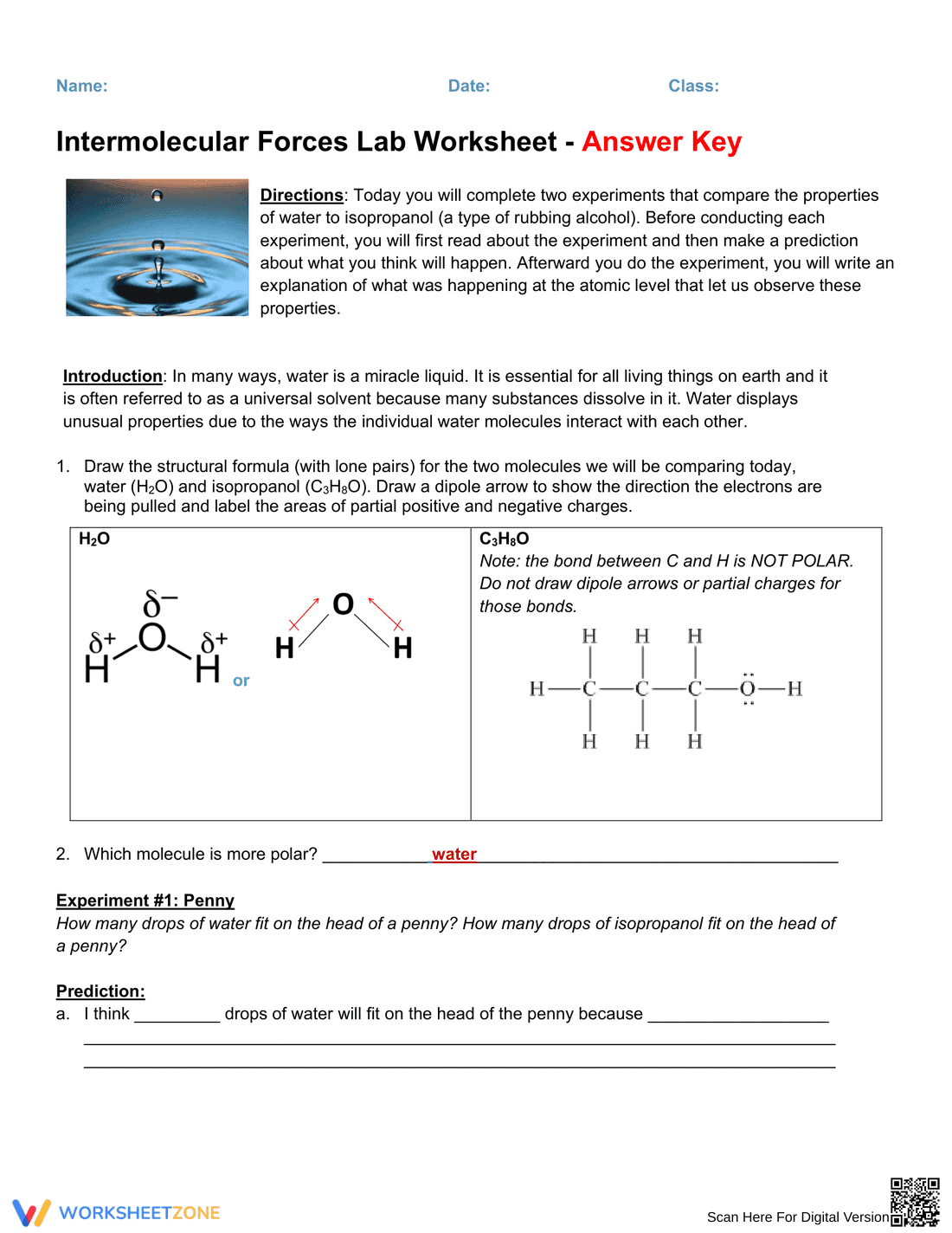
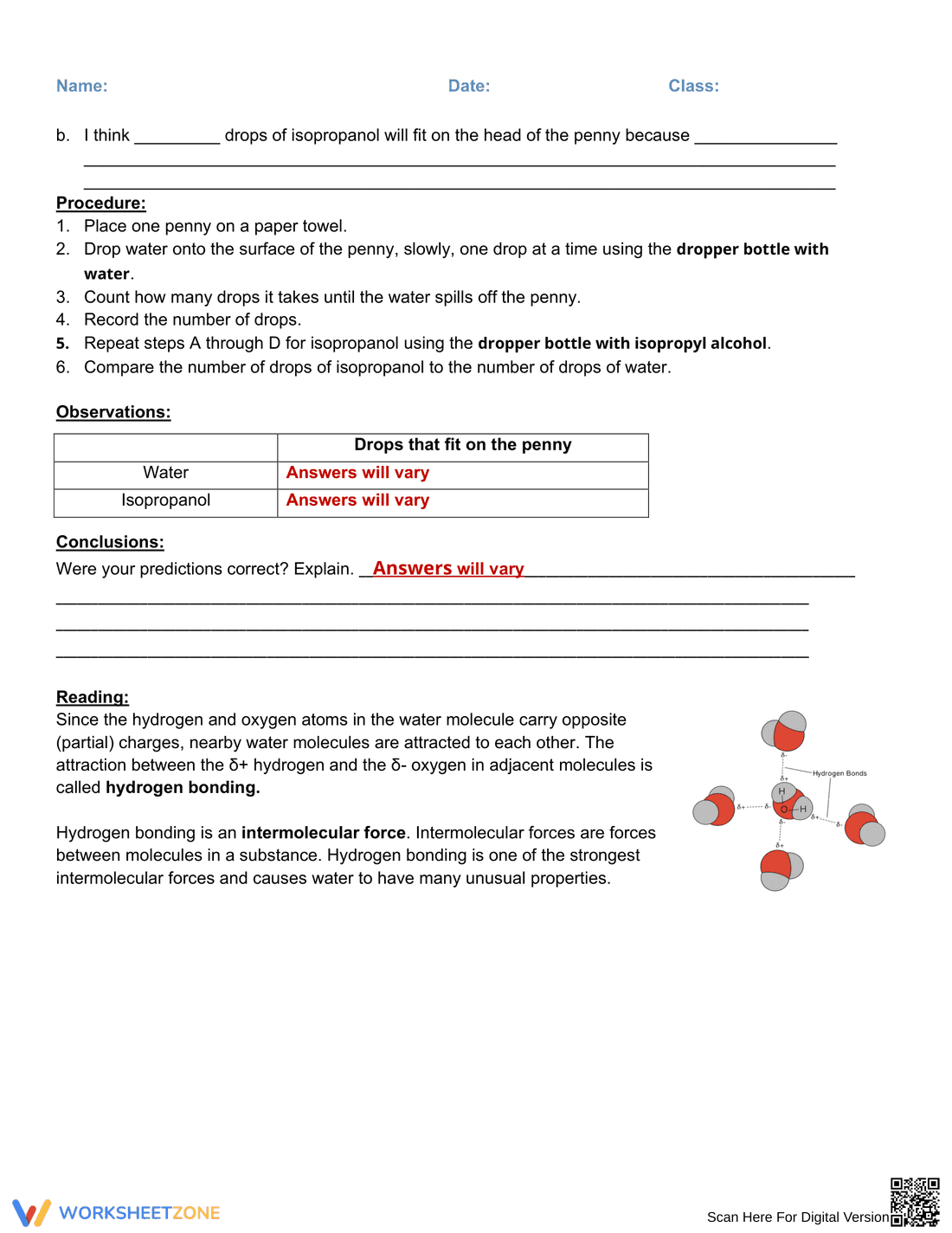
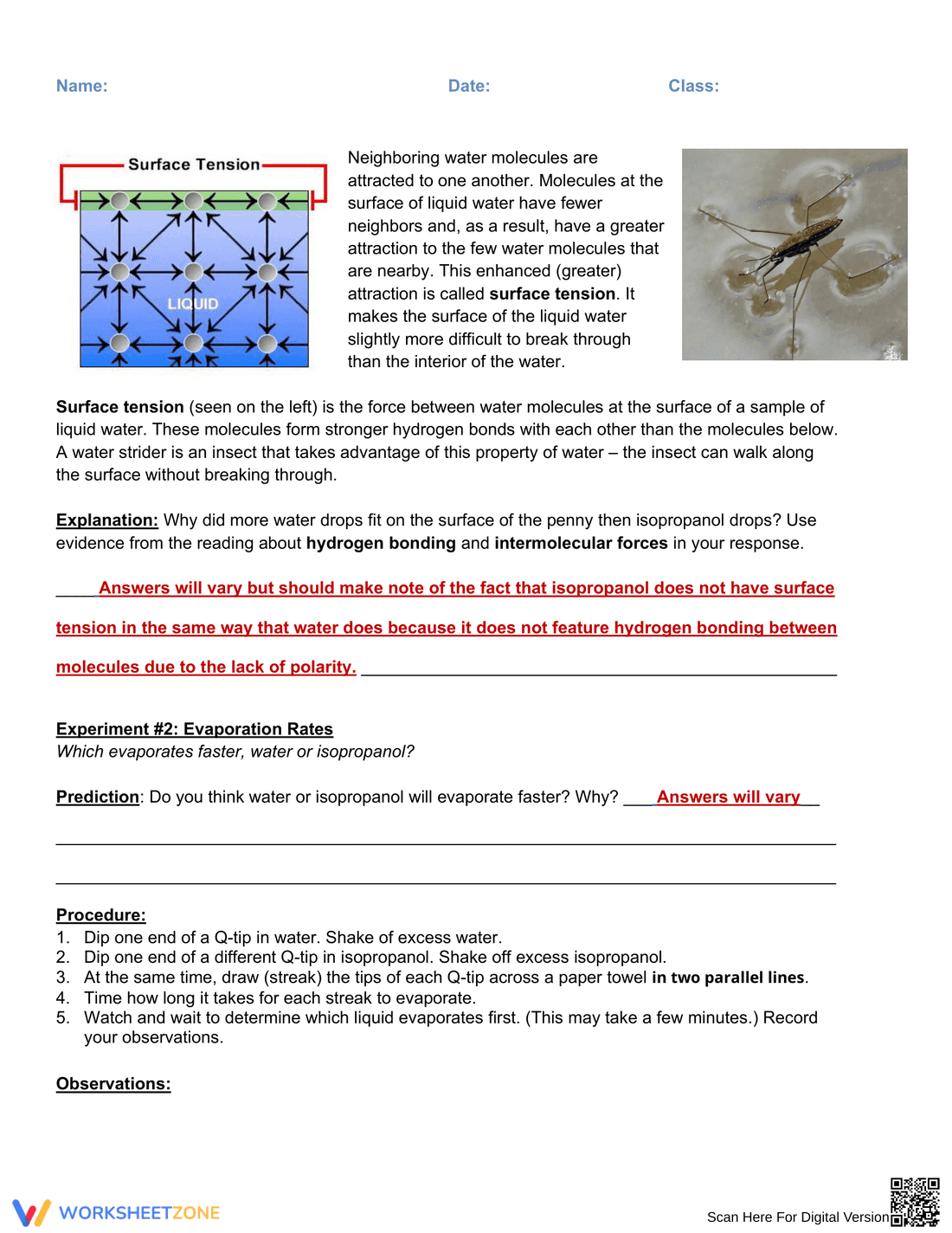
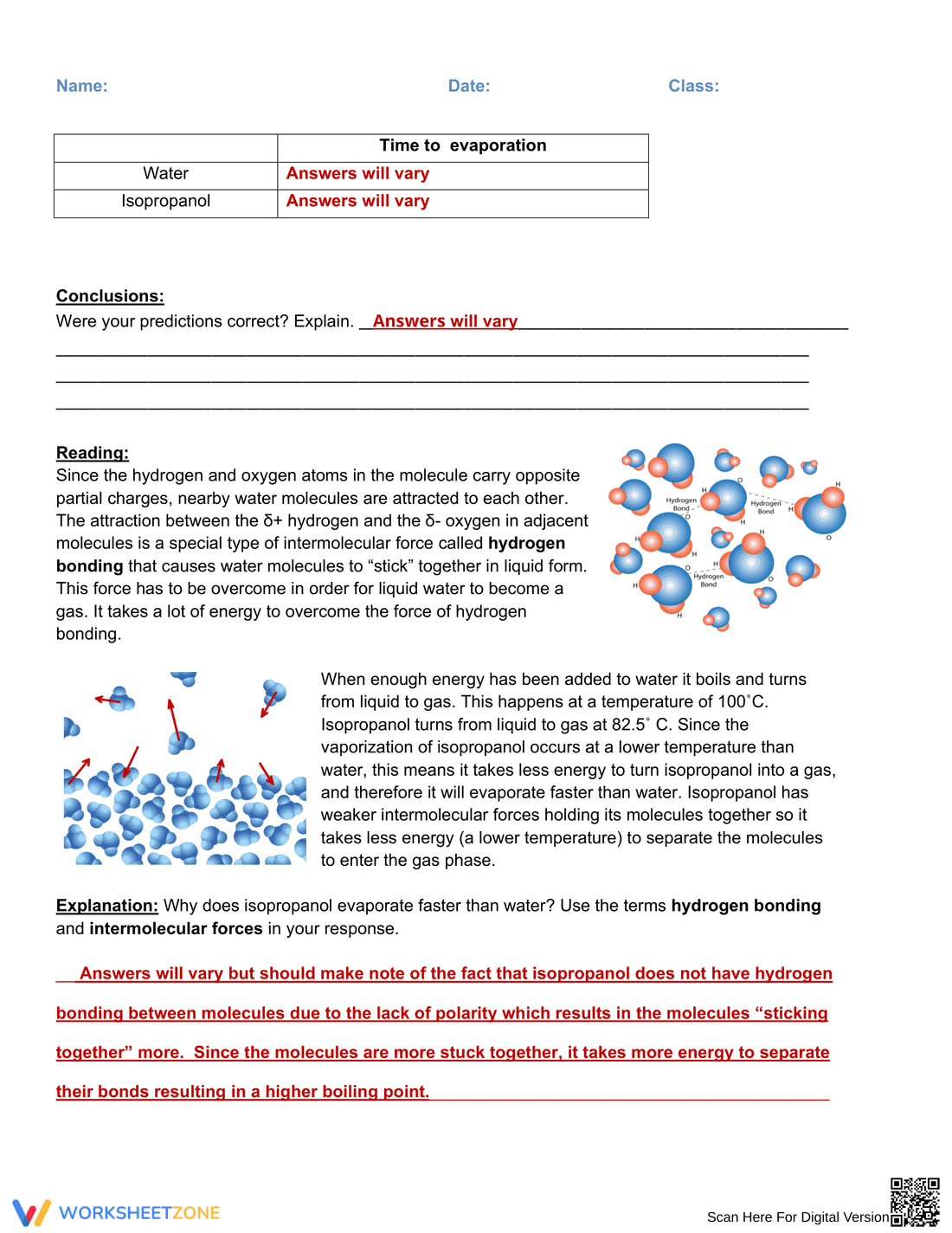
This is an intermolecular forces lab worksheet designed as an answer key. The worksheet begins with directions for completing two experiments comparing the properties of water and isopropanol. It includes an introduction explaining water's properties as a universal solvent. Students are instructed to draw the structural formulas of water (H2O) and isopropanol (C3H8O), including dipole arrows and partial charges. It then poses the question of which molecule is more polar. The worksheet then sets up an experiment where students are asked to predict how many drops of water and isopropanol will fit on a penny.
Grade Level Suitability:
This worksheet is suitable for high school chemistry or introductory college chemistry courses (grades 9-13). The content requires an understanding of molecular structure, polarity, and intermolecular forces, typically covered at these levels.
Why Use It:
This worksheet helps students visualize and understand intermolecular forces by comparing water and isopropanol. It reinforces the concepts of molecular polarity, structural formulas, and the relationship between molecular properties and macroscopic observations. The hands-on experiment encourages scientific inquiry and prediction skills.
How to Use It:
Students should first read the introduction and directions. They should then draw the structural formulas of water and isopropanol, indicating dipole arrows and partial charges as instructed. Next, they should answer the polarity question. Finally, they should conduct the penny experiment, recording their predictions and observations.
Target Users:
The target users are high school and introductory college students studying chemistry, as well as their teachers. It's also helpful for homeschoolers covering chemistry concepts.
This is an intermolecular forces lab worksheet designed as an answer key. The worksheet begins with directions for completing two experiments comparing the properties of water and isopropanol. It includes an introduction explaining water's properties as a universal solvent. Students are instructed to draw the structural formulas of water (H2O) and isopropanol (C3H8O), including dipole arrows and partial charges. It then poses the question of which molecule is more polar. The worksheet then sets up an experiment where students are asked to predict how many drops of water and isopropanol will fit on a penny.
Grade Level Suitability:
This worksheet is suitable for high school chemistry or introductory college chemistry courses (grades 9-13). The content requires an understanding of molecular structure, polarity, and intermolecular forces, typically covered at these levels.
Why Use It:
This worksheet helps students visualize and understand intermolecular forces by comparing water and isopropanol. It reinforces the concepts of molecular polarity, structural formulas, and the relationship between molecular properties and macroscopic observations. The hands-on experiment encourages scientific inquiry and prediction skills.
How to Use It:
Students should first read the introduction and directions. They should then draw the structural formulas of water and isopropanol, indicating dipole arrows and partial charges as instructed. Next, they should answer the polarity question. Finally, they should conduct the penny experiment, recording their predictions and observations.
Target Users:
The target users are high school and introductory college students studying chemistry, as well as their teachers. It's also helpful for homeschoolers covering chemistry concepts.


