


























Views
Downloads

Essential Integumentary System Worksheet | Grade 7 Science
Paste this activity's link or code into your existing LMS (Google Classroom, Canvas, Teams, Schoology, Moodle, etc.).
Students can open and work on the activity right away, with no student login required.
You'll still be able to track student progress and results from your teacher account.
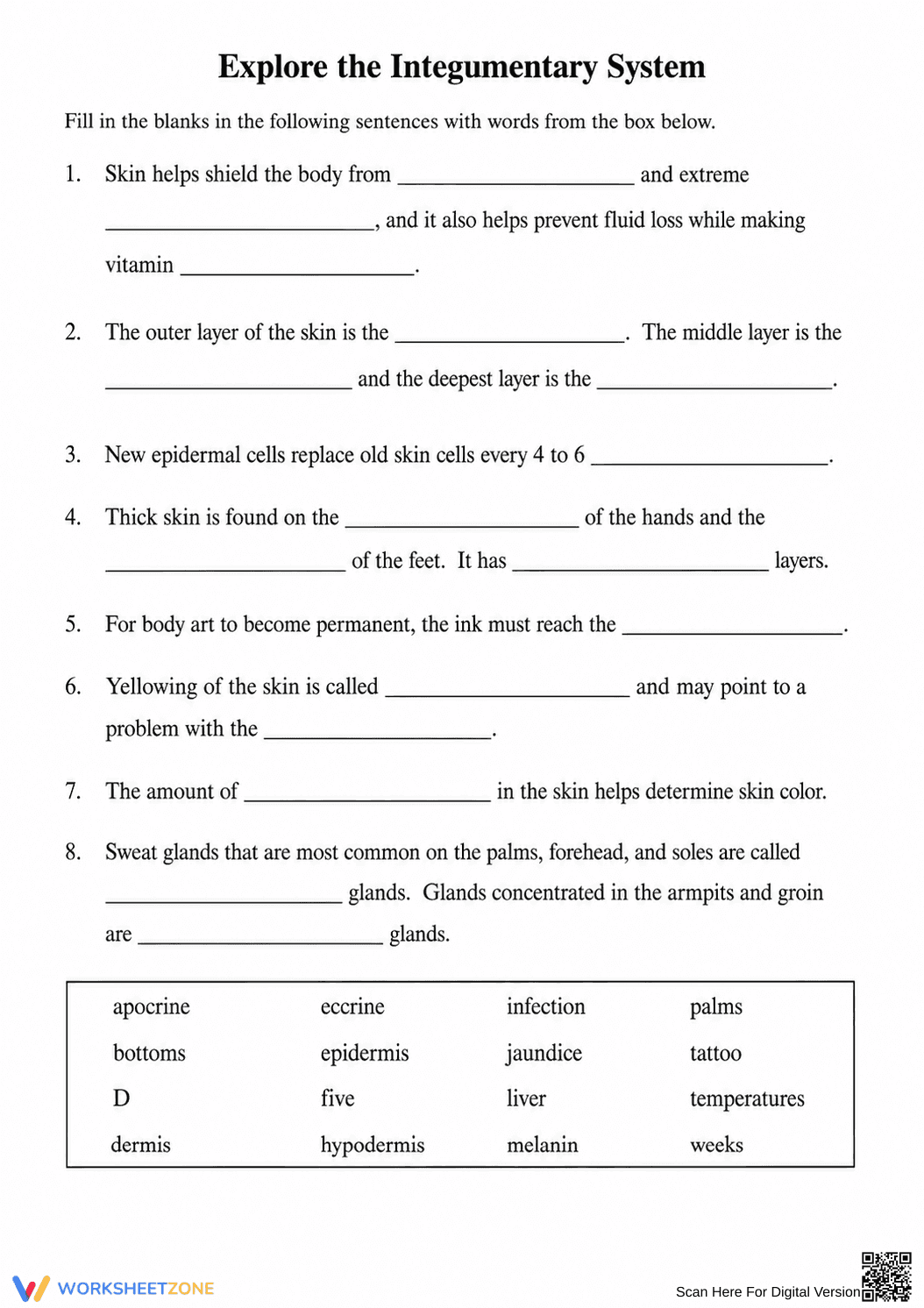
This Grade 7 Integumentary System worksheet provides a structured approach for students to master the anatomy and physiology of the human skin. By completing 8 multi-part sentences, learners demonstrate their understanding of how the epidermis, dermis, and hypodermis function together to protect the body and maintain internal balance.
At a Glance
- Grade: 7 · Subject: Science
- Standard:
MS-LS1-3— Use evidence to explain how body systems interact to maintain homeostasis- Skill Focus: Skin anatomy and physiology
- Format: 1 page · 8 problems · Word bank included · PDF
- Best For: Quick assessment or sub plans
- Time: 15–20 minutes
What's Inside
This single-page PDF features a comprehensive review of the integumentary system. It includes 8 complex fill-in-the-blank questions that require students to synthesize information about skin layers, cell replacement cycles, and glandular functions. A 16-term word bank is provided at the bottom, featuring technical vocabulary such as melanin, jaundice, eccrine, and apocrine.
Zero-Prep Workflow
- Print: Generate the required number of copies for your class in under 30 seconds.
- Distribute: Hand out the worksheets as a quiet bell-ringer or independent practice activity (1 minute).
- Review: Go over the answers as a whole-class check to identify common misconceptions about skin anatomy (10 minutes).
Standards Alignment
This resource is aligned with `MS-LS1-3`, which requires students to use evidence for how the body is a system of interacting subsystems. By identifying specific layers and gland types, students build the foundational knowledge necessary to explain how the skin interacts with other systems. This standard code can be copied directly into lesson plans or IEP goals.
How to Use It
Use this worksheet as a formative assessment immediately following a direct instruction session on the human body. As students work, circulate the room to observe if they can distinguish between the eccrine and apocrine glands; this provides instant data on student mastery. The expected completion time is 15 to 20 minutes, making it a perfect transition activity.
Who It's For
This activity is tailored for middle school science students and early high school biology learners. It provides necessary scaffolding for students who benefit from vocabulary support while maintaining high cognitive demand through technical terminology. It pairs naturally with a labeled anatomical diagram or a microscope lab observing skin tissue slides.
This worksheet supports the `MS-LS1-3` standard by focusing on the structural organization of the integumentary system. According to Fisher & Frey (2014), the use of scaffolded fill-in-the-blank tasks with technical word banks helps bridge the gap between receptive and productive scientific vocabulary. By requiring students to place terms like "hypodermis" and "melanin" into context, the resource reinforces the conceptual framework of how specialized cells form tissues that perform vital protective functions. Research from the NAEP indicates that mastery of body system interactions is a critical predictor of success in advanced life science courses. This resource provides the 8 specific tasks needed to verify that students can identify the components of the skin system before moving toward complex physiological arguments.


