




























Views
Downloads

Integumentary System Worksheet | Essential Grade 7 Science

Paste this activity's link or code into your existing LMS (Google Classroom, Canvas, Teams, Schoology, Moodle, etc.).
Students can open and work on the activity right away, with no student login required.
You'll still be able to track student progress and results from your teacher account.
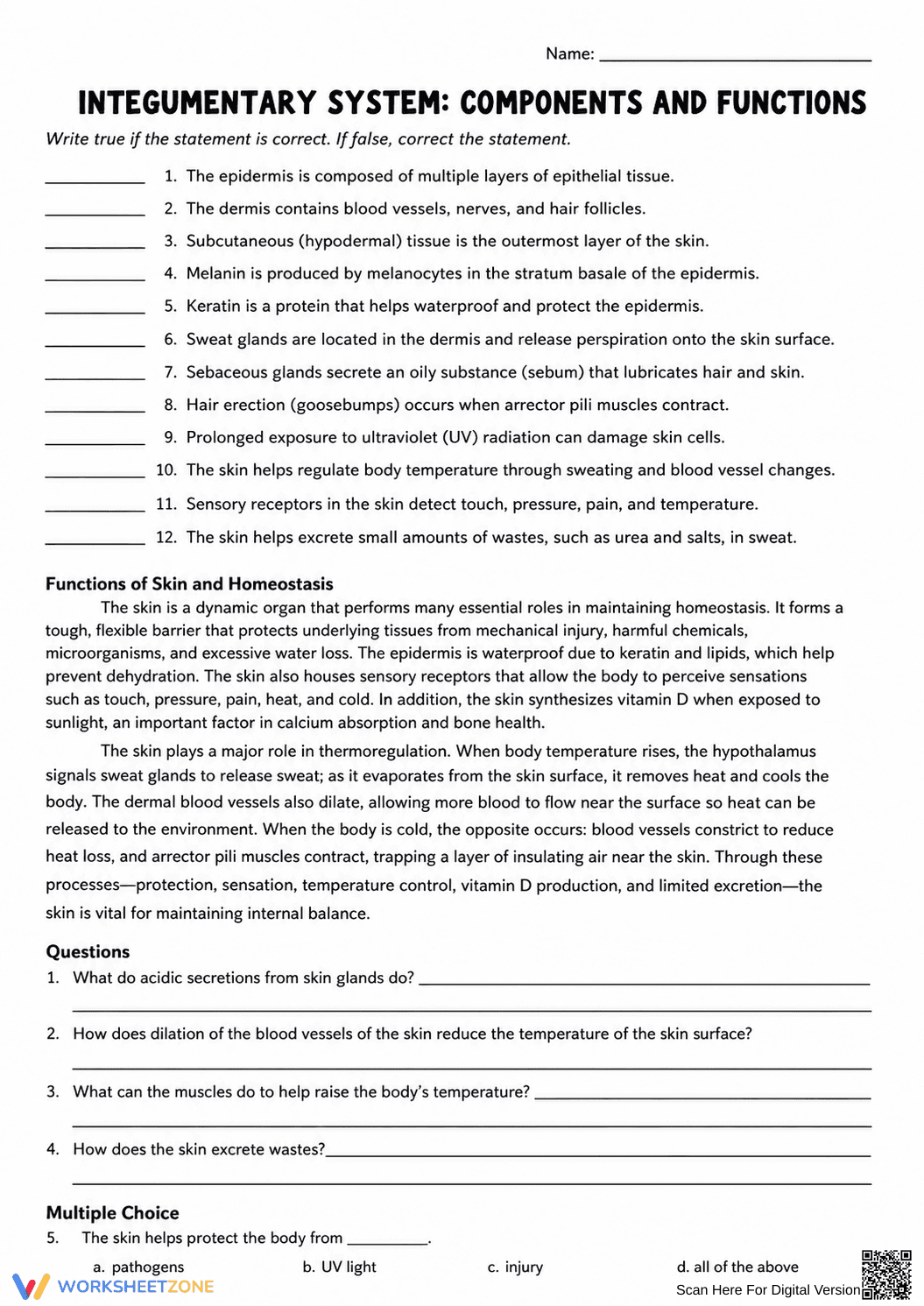
This comprehensive integumentary system worksheet provides students with a rigorous review of skin anatomy and physiological functions. By engaging with various question formats, learners identify specific layers of the epidermis and dermis while explaining how the body maintains homeostasis through thermoregulation and protection. It ensures students grasp the vital role of the skin as a dynamic organ.
At a Glance
- Grade: 7 · Subject: Science
- Standard:
MS-LS1-3— Use argument supported by evidence for how the body is a system of interacting subsystems- Skill Focus: Skin layers and homeostatic functions
- Format: 2 pages · 44 problems · Answer key included · PDF
- Best For: Mid-unit review or formative assessment
- Time: 35–45 minutes
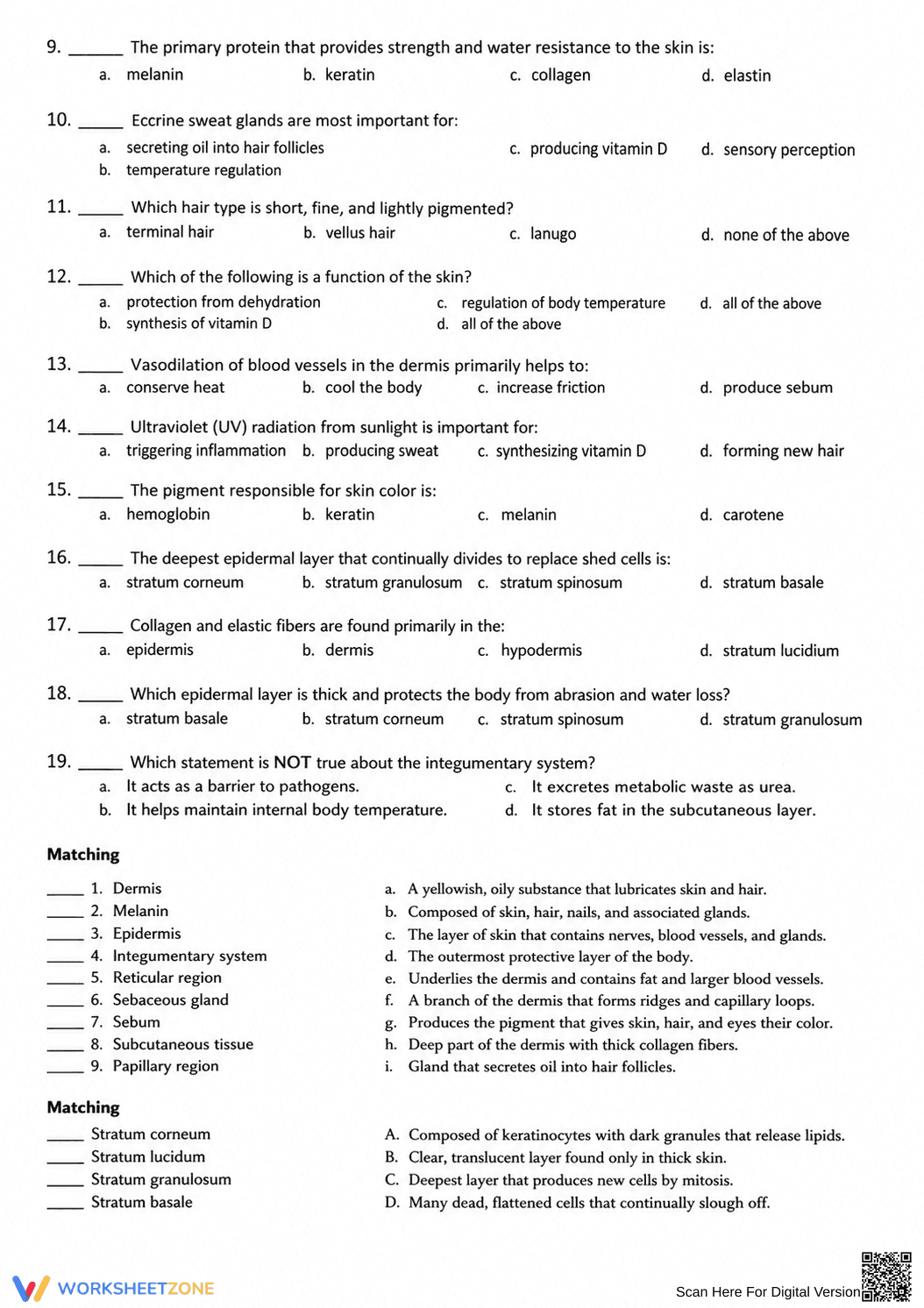
The resource contains two full pages of content-rich exercises. It begins with 12 true/false statements requiring students to correct false claims, followed by a detailed informational text on homeostasis. The second page expands into 15 multiple-choice questions and two matching sections covering the stratum layers and dermal regions. A clear layout ensures students can navigate between anatomical identification and functional analysis.
Skill Progression
- Guided Practice: 12 true/false statements prompt students to recall basic anatomical facts and correct common misconceptions about skin layers.
- Supported Practice: A focused reading passage followed by 4 short-answer questions requires synthesizing information about blood vessel dilation and waste excretion.
- Independent Practice: 15 multiple-choice questions and 13 matching tasks test mastery of specific tissue layers and cellular functions.
This gradual-release model ensures students build confidence before tackling higher-order classification and physiological processes.
Standards Alignment
This resource aligns with `MS-LS1-3`, focusing on how the integumentary system functions as a subsystem to support the body's overall internal balance. Students must explain how the skin interacts with the nervous and circulatory systems to regulate temperature. Both standard codes can be copied directly into lesson plans, IEP goals, or district curriculum mapping tools.
How to Use It
Use this worksheet as a summative review after a lecture on the human body systems. It works effectively as a partner activity where students discuss the "Functions of Skin and Homeostasis" text before answering the short-response questions. Teachers should observe students during the matching section to identify misconceptions regarding the specific layers of the epidermis, such as the stratum basale versus the stratum corneum. Completion typically takes 40 minutes.
Who It's For
This material is designed for middle school life science students but contains enough depth for introductory high school biology. It is particularly useful for visual learners who benefit from structured matching and for students requiring literacy support through the included informational text. Pair this with a skin model or a microscope lab observing epithelial tissue.
According to the RAND AIRS 2024 report on secondary science education, the use of multi-modal assessment tools—such as combining matching, true/false, and short-answer tasks—significantly improves long-term retention of complex anatomical terminology. This worksheet applies these findings by requiring students to not only identify the components of the integumentary system but also to explain the physiological mechanisms behind thermoregulation and protection. By aligning with MS-LS1-3, the resource ensures that students view the skin not merely as a covering, but as a critical subsystem interacting with the whole body to maintain homeostasis. Research from Fisher & Frey (2014) supports this scaffolded approach, noting that informational text integration within practice sets helps bridge the gap between vocabulary acquisition and conceptual application. This 44-task printable provides the rigorous, evidence-based practice necessary for students to achieve mastery in life science standards.


