




























Views
Downloads

Grade 6 Integumentary System — Printable No-Prep Worksheet

Paste this activity's link or code into your existing LMS (Google Classroom, Canvas, Teams, Schoology, Moodle, etc.).
Students can open and work on the activity right away, with no student login required.
You'll still be able to track student progress and results from your teacher account.
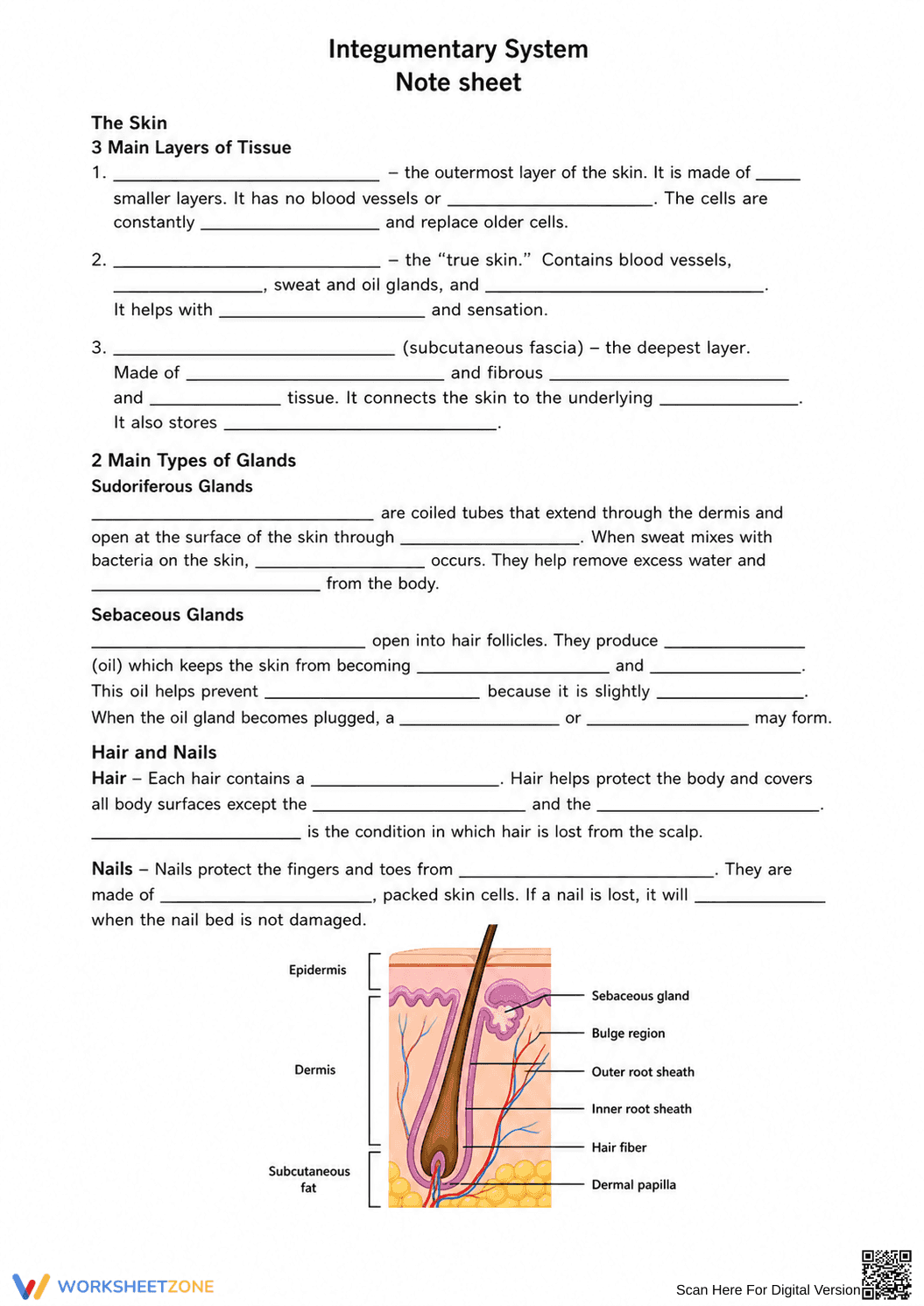
This comprehensive integumentary system note sheet helps students identify and describe the structures and functions of the skin, hair, and nails. By completing targeted fill-in-the-blank exercises and diagram labeling, learners build a strong foundational understanding of how this vital body system protects and regulates the human body.
At a Glance
- Grade: 6 · Subject: Science
- Standard:
MS-LS1-3— Describe how the body is a system of interacting subsystems- Skill Focus: Integumentary system anatomy
- Format: 2 pages · 42 problems · PDF
- Best For: Independent practice or sub plans
- Time: 20–30 minutes
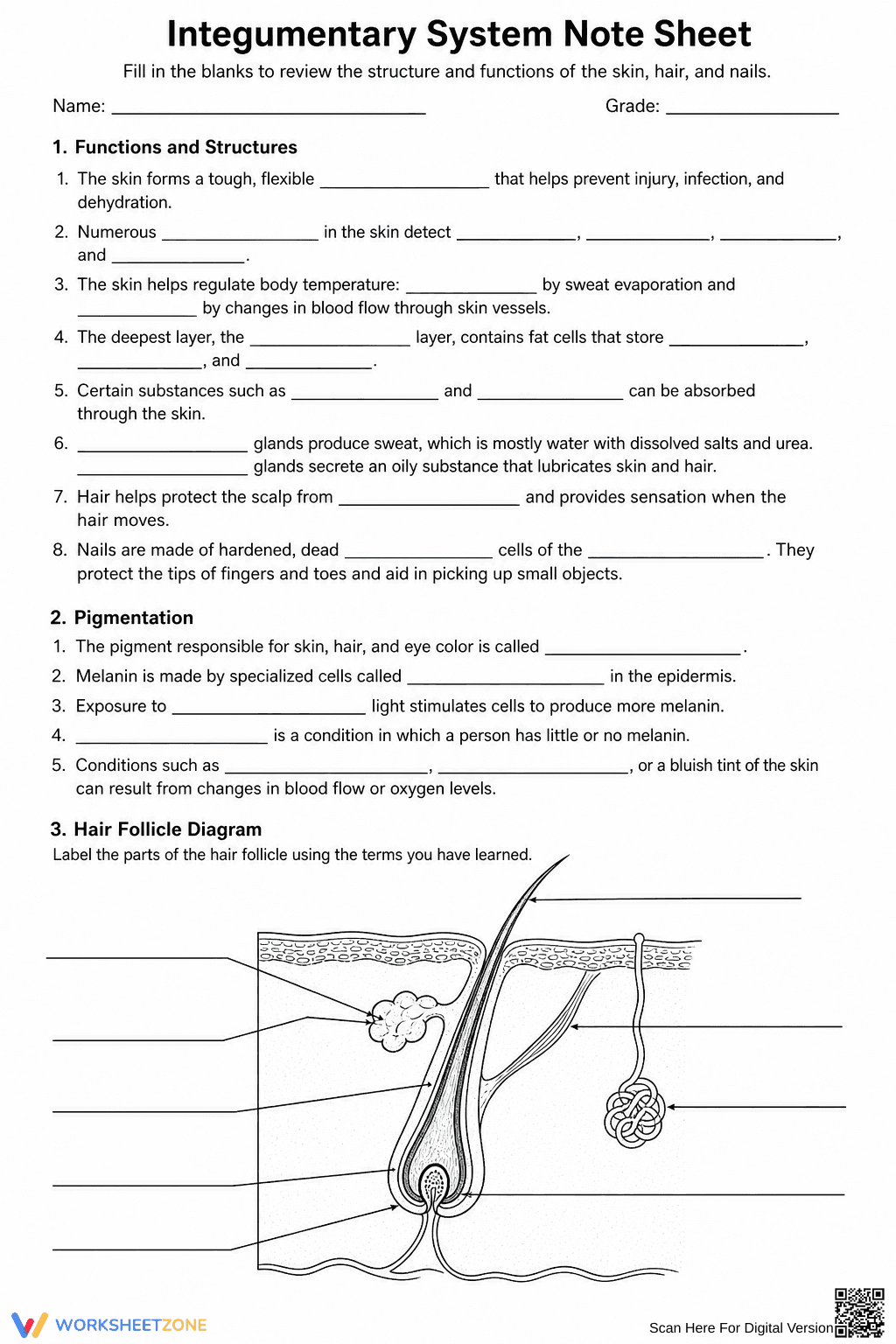
This two-page resource features over 40 fill-in-the-blank tasks and a detailed diagram labeling activity. Students will explore the three main layers of tissue—the epidermis, dermis, and subcutaneous layers—along with sudoriferous and sebaceous glands. The second page includes a comprehensive section on pigmentation and a clear, cross-sectional diagram of a hair follicle for students to label, reinforcing their anatomical vocabulary.
Designed for immediate classroom implementation, this resource requires under two minutes of teacher preparation:
- Print (1 minute): Simply print the two-page PDF double-sided to save paper.
- Distribute (1 minute): Hand out the note sheets at the beginning of the lesson or leave them in a sub folder.
- Review (Ongoing): Students can complete the blanks using their textbooks or digital resources, making it a highly autonomous task.
It serves as an excellent emergency sub plan.
This worksheet is aligned to MS-LS1-3, which requires students to use argument supported by evidence for how the body is a system of interacting subsystems composed of groups of cells. Detailing the roles of skin layers and glands helps students understand the integumentary system's broader role. Both standard codes can be copied directly into lesson plans, IEP goals, or district curriculum mapping tools.
This note sheet is highly versatile. Use it during direct instruction as a guided notes template. Alternatively, assign it after a lecture as an independent review or homework assignment to consolidate learning. As a formative assessment tip, walk around the room while students label the hair follicle diagram; checking their accuracy on the sebaceous gland and root sheath labels will quickly reveal if they grasp the spatial relationships of the skin's structures. Expect students to complete the entire packet in 20 to 30 minutes.
This resource is ideal for middle school life science and introductory high school biology students. The structured fill-in-the-blank format provides built-in scaffolding for learners who struggle with open-ended note-taking, ensuring they capture the most critical vocabulary. It pairs perfectly with a 3D skin model demonstration or an introductory reading passage on human body systems.
Aligning life science instruction with MS-LS1-3 ensures that students can accurately describe how the body is a system of interacting subsystems. According to a ScienceDirect TpT Analysis, providing students with structured visual note-taking tools significantly improves their long-term retention of complex anatomical vocabulary. When learners actively engage with detailed diagrams, such as labeling the hair follicle and various skin layers, they build stronger cognitive connections between physical structure and biological function. This targeted practice reduces cognitive overload, allowing students to focus on how the integumentary system protects the body and regulates temperature rather than struggling to organize their notes from scratch. By integrating clear visual aids with focused text completion, educators can foster a deeper, more enduring understanding of human biology and better prepare students for advanced scientific inquiry.


