


























Views
Downloads
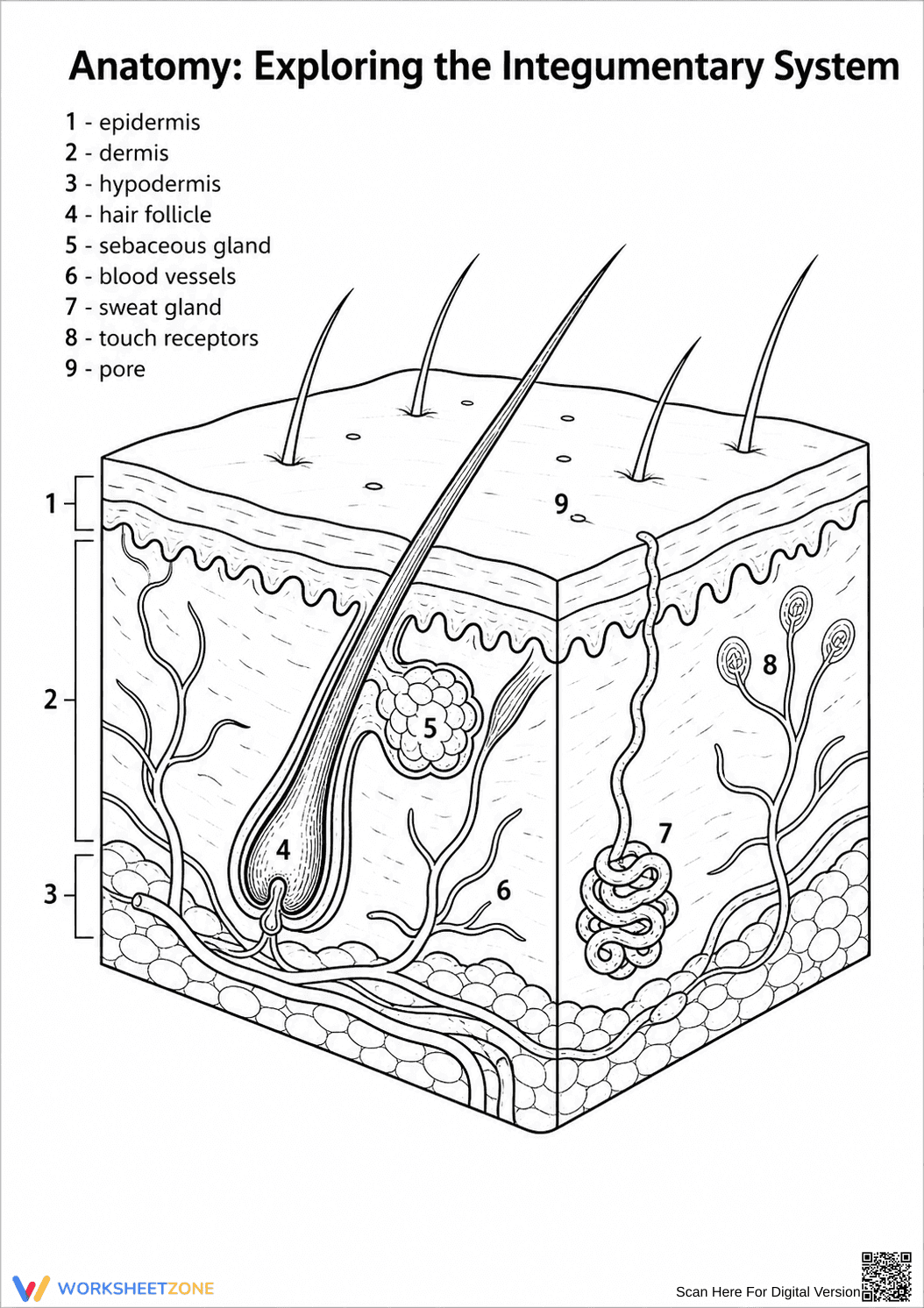

Printable Integumentary System Diagram | Grade 6
Paste this activity's link or code into your existing LMS (Google Classroom, Canvas, Teams, Schoology, Moodle, etc.).
Students can open and work on the activity right away, with no student login required.
You'll still be able to track student progress and results from your teacher account.
This printable Grade 6 science resource provides a detailed visual breakdown of the integumentary system. Students explore the anatomical structure of human skin by examining a cross-section diagram. By reviewing the specific layers and glands, learners build foundational biology vocabulary and understand how these subsystems interact.
At a Glance
- Grade: 6 · Subject: Science
- Standard:
MS-LS1-3— Understand how the body is a system of interacting subsystems- Skill Focus: Identifying skin anatomy structures
- Format: 1 page · 9 structures · No answer key needed · PDF
- Best For: Visual reference and vocabulary building
- Time: 10–15 minutes
This single-page reference worksheet features a high-quality, black-and-white cross-section diagram of human skin. It includes a numbered key identifying nine essential anatomical components, including the epidermis, dermis, hypodermis, hair follicles, sebaceous glands, and touch receptors. The clear line-art format makes it an excellent candidate for interactive notebook inserts or a guided coloring activity to reinforce anatomical terminology.
- Print (1 minute): Simply print the PDF. The black-and-white line art ensures crisp copies without draining printer ink.
- Distribute (1 minute): Hand out the diagram as a reference sheet or interactive notebook addition at the start of your human body systems unit.
- Review (5 minutes): Guide students through the nine labeled structures, discussing the function of each layer and gland.
Total teacher preparation requires under two minutes. This self-contained visual guide is also highly suitable for emergency sub plans, as it requires no specialized setup or prior background knowledge to distribute.
Aligned to primary standard MS-LS1-3: Use argument supported by evidence for how the body is a system of interacting subsystems composed of groups of cells. This diagram provides the foundational structural knowledge students need before they can argue how the integumentary system interacts with the nervous or circulatory systems. Both standard codes can be copied directly into lesson plans, IEP goals, or district curriculum mapping tools.
Introduce this diagram during direct instruction as a visual anchor for the integumentary system. Have students color-code the three primary skin layers (epidermis, dermis, hypodermis) and their corresponding glands to enhance memory retention. As a formative assessment observation tip, ask students to point to specific structures, like the sweat gland or hair follicle, and verbally explain its function to a peer. Expected completion time for a guided coloring and review session is 10 to 15 minutes.
This resource is designed for middle school science students studying human anatomy and biology. The clear, uncluttered visual layout provides excellent differentiation for English Language Learners (ELLs) and visual learners who benefit from seeing spatial relationships between vocabulary terms. It pairs perfectly with a direct instruction lesson on body systems or a hands-on lab examining skin models.
Mastering anatomical vocabulary through visual aids is a critical step in understanding complex biological systems. When students interact with clear diagrams aligned to MS-LS1-3, they are better equipped to understand how the body is a system of interacting subsystems. According to Fisher & Frey (2014), integrating structured visual references and guided vocabulary practice significantly improves student retention of domain-specific scientific concepts. By isolating the nine key structures of the integumentary system in a single, focused graphic, educators reduce cognitive overload and allow learners to build accurate mental models of human anatomy before moving on to functional interactions.


