


























Views
Downloads
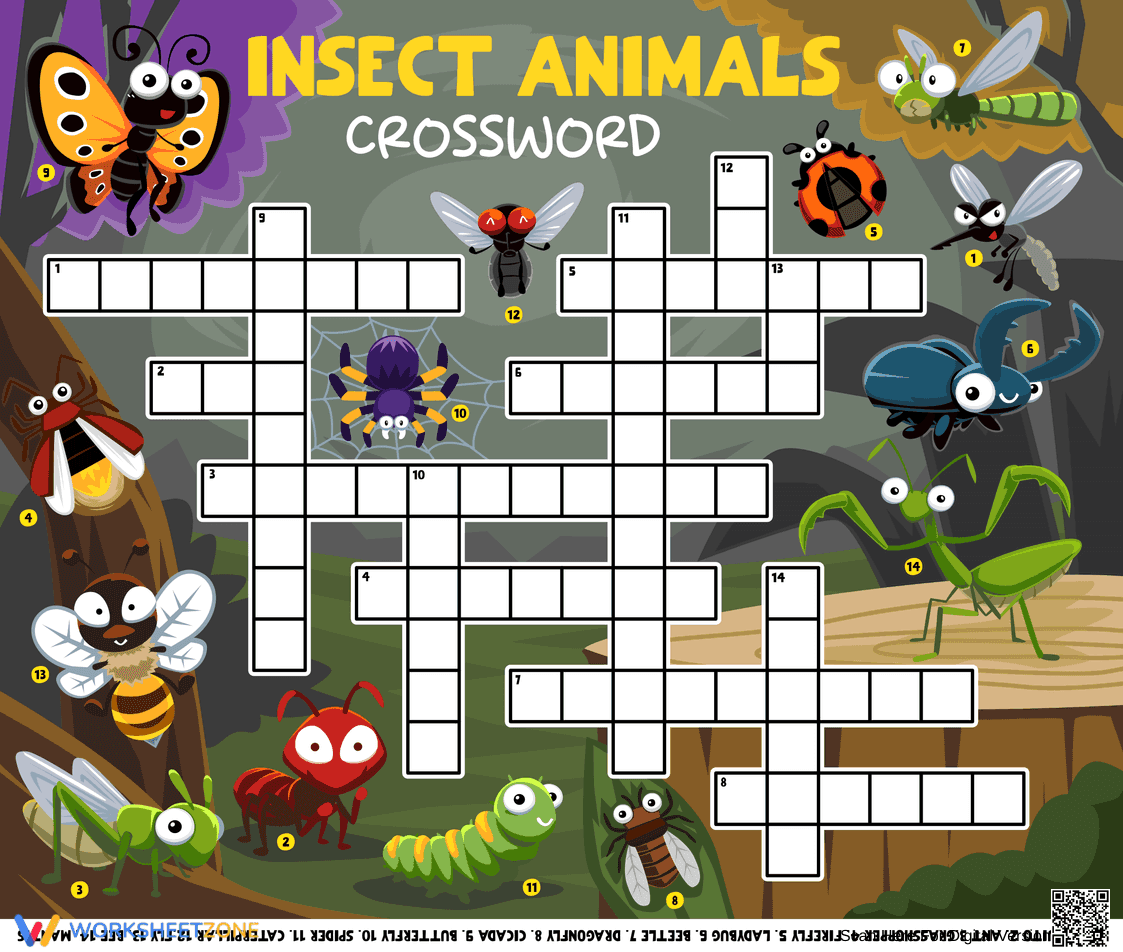

Grade K Insect Vocabulary — Printable No-Prep Worksheet
Paste this activity's link or code into your existing LMS (Google Classroom, Canvas, Teams, Schoology, Moodle, etc.).
Students can open and work on the activity right away, with no student login required.
You'll still be able to track student progress and results from your teacher account.
This engaging insect animals crossword puzzle helps kindergarten students build foundational vocabulary and spelling skills. By matching colorful picture clues to specific insect names, young learners reinforce letter recognition and word formation while exploring life science concepts in a fun, accessible format.
At a Glance
- Grade: K · Subject: ELA
- Standard:
CCSS.ELA-LITERACY.L.K.6— Use newly acquired words and phrases- Skill Focus: Vocabulary and spelling
- Format: 1 page · 14 problems · Answer key included · PDF
- Best For: Independent practice and centers
- Time: 15–20 minutes
This single-page printable features a vibrant crossword puzzle containing 14 insect terms. Instead of text clues, the worksheet utilizes numbered illustrations of insects like butterflies and beetles to guide students. A convenient word bank at the bottom supports early readers, which can be folded over to increase the spelling challenge. A complete answer key is provided.
Designed for immediate classroom implementation, this resource requires minimal teacher preparation:
- Print (1 minute): Download the PDF and print. The high-contrast images print beautifully in grayscale.
- Distribute (1 minute): Hand out during literacy centers or morning work. No extra materials needed.
- Review (3 minutes): Use the included key to quickly check student work or project it for self-correction.
With under two minutes of prep time, this worksheet is an excellent addition to any emergency sub plan.
This activity is aligned to CCSS.ELA-LITERACY.L.K.6, requiring students to use words and phrases acquired through conversations, reading and being read to, and responding to texts. It also supports cross-curricular connections to early life science standards by familiarizing students with common insect species. Both standard codes can be copied directly into lesson plans, IEP goals, or district curriculum mapping tools.
This crossword puzzle serves as an excellent literacy center activity during a thematic unit on insects. Teachers can introduce vocabulary during whole-group instruction, then assign this worksheet for independent reinforcement. Alternatively, it works perfectly as quiet morning work. While students work, teachers can conduct formative assessments by observing how well children match initial consonant sounds to the pictures. Most kindergarteners will complete this within 15 to 20 minutes.
This resource is designed for kindergarten students developing early literacy and spelling capabilities. The visual clues make it highly accessible for English Language Learners (ELLs) building foundational vocabulary. To differentiate, teachers can leave the word bank visible for support, or conceal it for phonetic spellers. It pairs wonderfully with a read-aloud of an insect-themed picture book.
Integrating thematic vocabulary exercises like this crossword puzzle directly supports early childhood literacy development and long-term reading comprehension. Aligned with CCSS.ELA-LITERACY.L.K.6, this resource prompts students to use newly acquired words and phrases in a structured, engaging context. According to a comprehensive EdReports 2024 analysis of early literacy curricula, students who engage with vocabulary through multimodal formats—such as pairing visual illustrations with text-based word banks—demonstrate significantly higher retention rates of new terminology compared to rote memorization. The puzzle format encourages problem-solving and spatial reasoning alongside traditional spelling practice. By requiring learners to map letters into specific grid spaces, the activity reinforces phonics and orthographic mapping principles essential for kindergarten reading success. This visually supportive approach ensures that foundational language acquisition remains both rigorous and developmentally appropriate for young learners building their academic lexicon.


