


























Views
Downloads

Gr 7-10 Figurative Language — Printable No-Prep Worksheet
Paste this activity's link or code into your existing LMS (Google Classroom, Canvas, Teams, Schoology, Moodle, etc.).
Students can open and work on the activity right away, with no student login required.
You'll still be able to track student progress and results from your teacher account.
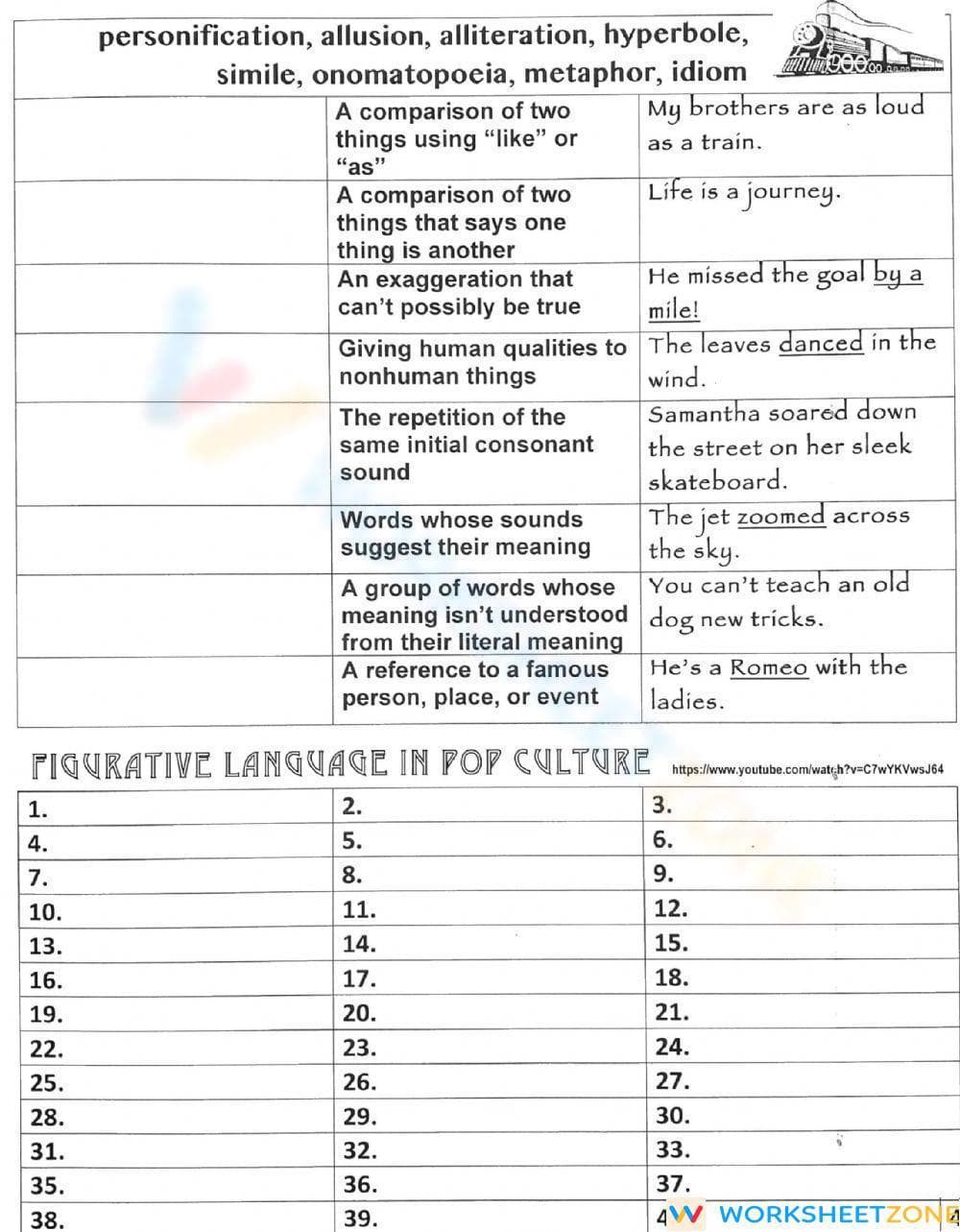
This ELA worksheet for grades 7-10 strengthens figurative language skills by asking students to identify literary devices in pop culture examples. The one-page activity includes 40 practice items and a reference guide, helping learners connect abstract concepts to familiar media and improve their reading comprehension. Answer key included.
At a Glance
- Grade: 7–10 · Subject: ELA
- Standard:
CCSS.ELA-LITERACY.L.7.5— Demonstrate understanding of figurative language and word meanings- Skill Focus: Figurative Language Identification
- Format: 1 page · 40 problems · Answer key included · PDF
- Best For: Engaging practice for middle & high school ELA
- Time: 30–45 minutes
What's Inside
This comprehensive one-page PDF features a clear reference table defining eight key literary devices: personification, allusion, alliteration, hyperbole, simile, onomatopoeia, metaphor, and idiom. Each definition is paired with a clear example. Below the guide, a 40-item grid provides ample space for students to categorize examples from pop culture media.
A Zero-Prep Workflow
This activity requires minimal teacher effort, with a total prep time under two minutes. Follow three simple steps:
- Print (1 min): Run one single-sided copy for each student. The PDF is designed for clean printing.
- Distribute (1 min): Hand out the worksheet. No complex instructions are needed, as the task is self-explanatory.
- Review (15 mins): Go over the answers as a class using the provided answer key or allow students to self-check.
This efficient process makes the resource a perfect, high-rigor fit for substitute plans, bell-ringers, or a low-stress Friday lesson.
Standards Alignment
This worksheet is primarily aligned to CCSS.ELA-LITERACY.L.7.5, which requires students to "demonstrate understanding of figurative language, word relationships, and nuances in word meanings." It also supports CCSS.ELA-LITERACY.RL.8.4 by helping students determine the meaning of words and phrases as they are used in a text. Both standard codes can be copied directly into lesson plans, IEP goals, or district curriculum mapping tools.
How to Use It
Use this worksheet as a fun summative check after a unit on literary devices, or turn it into a collaborative "scavenger hunt" where student teams listen to songs to find examples. For a quick formative assessment, observe students as they complete the first ten items; if they confuse metaphors and similes, pause for a rapid re-teach. Expected completion time is 30–45 minutes.
Who It's For
This resource is designed for middle and high school students who benefit from seeing academic concepts in real-world contexts. It is particularly effective for reluctant readers or students needing the scaffold of a definition table. Pair this with an analysis of a popular song's lyrics to deepen the connection between literature and the music students love, providing a natural bridge from direct instruction to application.
Connecting academic tasks to student interests, such as pop culture, significantly increases engagement and content retention, a finding supported by the RAND AIRS 2024 study on effective educational practices. This worksheet directly applies that principle to the study of figurative language. By asking students to identify literary devices in familiar contexts, it builds a durable bridge between abstract concepts and concrete examples. The design provides immediate definition scaffolding for eight key terms before requiring students to complete 40 practice problems. This approach ensures that learners not only meet the requirements of standard CCSS.ELA-LITERACY.L.7.5—demonstrating understanding of figurative language—but also develop a more intuitive and lasting grasp of the skill, crucial for analyzing complex texts throughout their academic careers.


