




























Views
Downloads
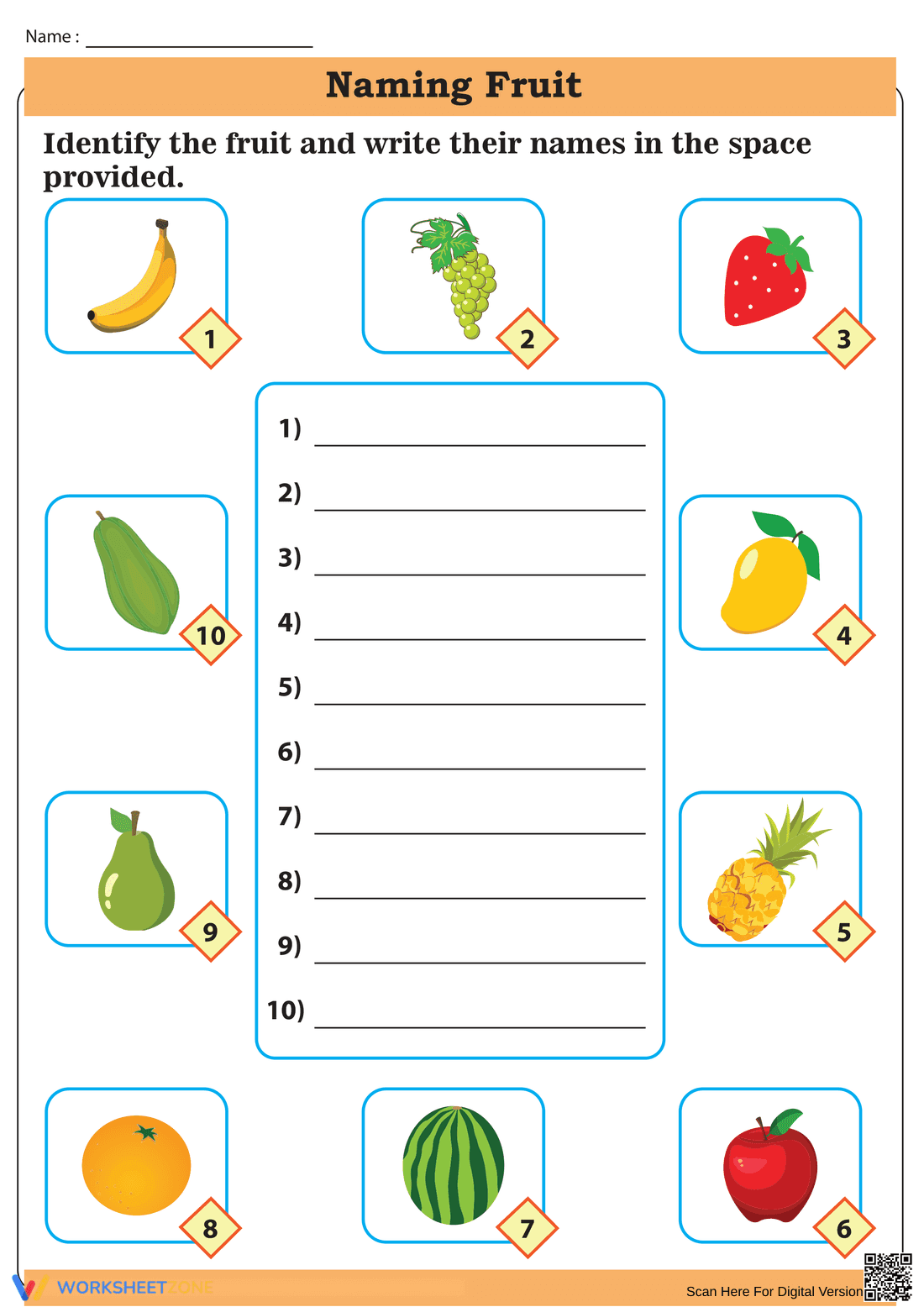

Essential Naming Fruit Worksheet | Grade 1 Printable

Paste this activity's link or code into your existing LMS (Google Classroom, Canvas, Teams, Schoology, Moodle, etc.).
Students can open and work on the activity right away, with no student login required.
You'll still be able to track student progress and results from your teacher account.
Help early learners master basic vocabulary with this engaging labeling activity. Students identify ten vibrant fruit illustrations and write the corresponding names in the designated spaces. This worksheet bridge the gap between visual recognition and written expression, ensuring students build confidence in their spelling and categorization skills while exploring healthy food groups.
At a Glance
- Grade: Grade 1 · Subject: ELA
- Standard:
CCSS.ELA-LITERACY.L.K.5.A— Students sort common objects into categories like food to understand concepts.- Skill Focus: Visual identification and spelling of fruit names
- Format: 1 page · 10 problems · Answer key included · PDF
- Best For: Independent morning work or vocabulary stations
- Time: 10–15 minutes
This comprehensive one-page document features ten distinct fruit images including bananas, grapes, strawberries, and papayas. Each image is paired with a numbered diamond that corresponds to a lined answer box in the center of the page. The clear layout and high-quality graphics ensure students can easily distinguish between similar items like pears and apples. A full-color answer key is included to facilitate quick grading or student self-correction.
This zero-prep resource is designed for a rapid classroom workflow. First, print the single PDF page (30 seconds). Second, distribute the sheets to students with no additional instruction required due to the intuitive design (1 minute). Third, review student responses using the provided key (30 seconds). Total teacher preparation time is under two minutes, making this an ideal choice for sub plans.
The primary standard for this resource is `CCSS.ELA-LITERACY.L.K.5.A`, which requires students to "Sort common objects into categories (e.g., shapes, foods) to gain a sense of the concepts the categories represent." By identifying and labeling specific fruits, students practice the critical sub-skill of attributes and categorization within the food domain. This standard code can be copied directly into lesson plans, IEP goals, or district curriculum mapping tools.
Use this worksheet as a formative assessment during a unit on healthy eating or as a literacy center activity. Instructors should observe whether students can identify the fruits independently or if they require the word bank often found in supporting anchor charts. A student who correctly labels 8 out of 10 fruits demonstrates proficient visual-to-verbal mapping. The expected completion time for most first-graders is approximately twelve minutes.
This activity is tailored for Kindergarten and Grade 1 students, particularly those developing fine motor skills and initial spelling proficiency. It is an excellent fit for English Language Learners (ELL) who need concrete visual supports to build their English vocabulary. This resource pairs naturally with a classroom anchor chart displaying fruit names or a reading passage about a trip to a local farmer's market.
According to research by Fisher & Frey (2014), the use of visual scaffolds in vocabulary acquisition is a critical component of the gradual release of responsibility model. This worksheet aligns with evidence-based practices by providing clear pictorial cues that reduce cognitive load while students focus on the orthographic task of writing names. The systematic labeling of ten distinct fruits supports the development of semantic networks, allowing students to anchor new words to existing mental schemas of familiar foods. By engaging in this structured practice, learners strengthen the neural pathways between visual recognition and lexical retrieval, a process essential for reading fluency. This approach ensures that standard CCSS.ELA-LITERACY.L.K.5.A is not merely a checkbox but a gateway to functional literacy. The inclusion of diverse fruits, from common apples to papayas, expands the student's linguistic repertoire within a manageable 15-minute instructional window.


