


























Views
Downloads
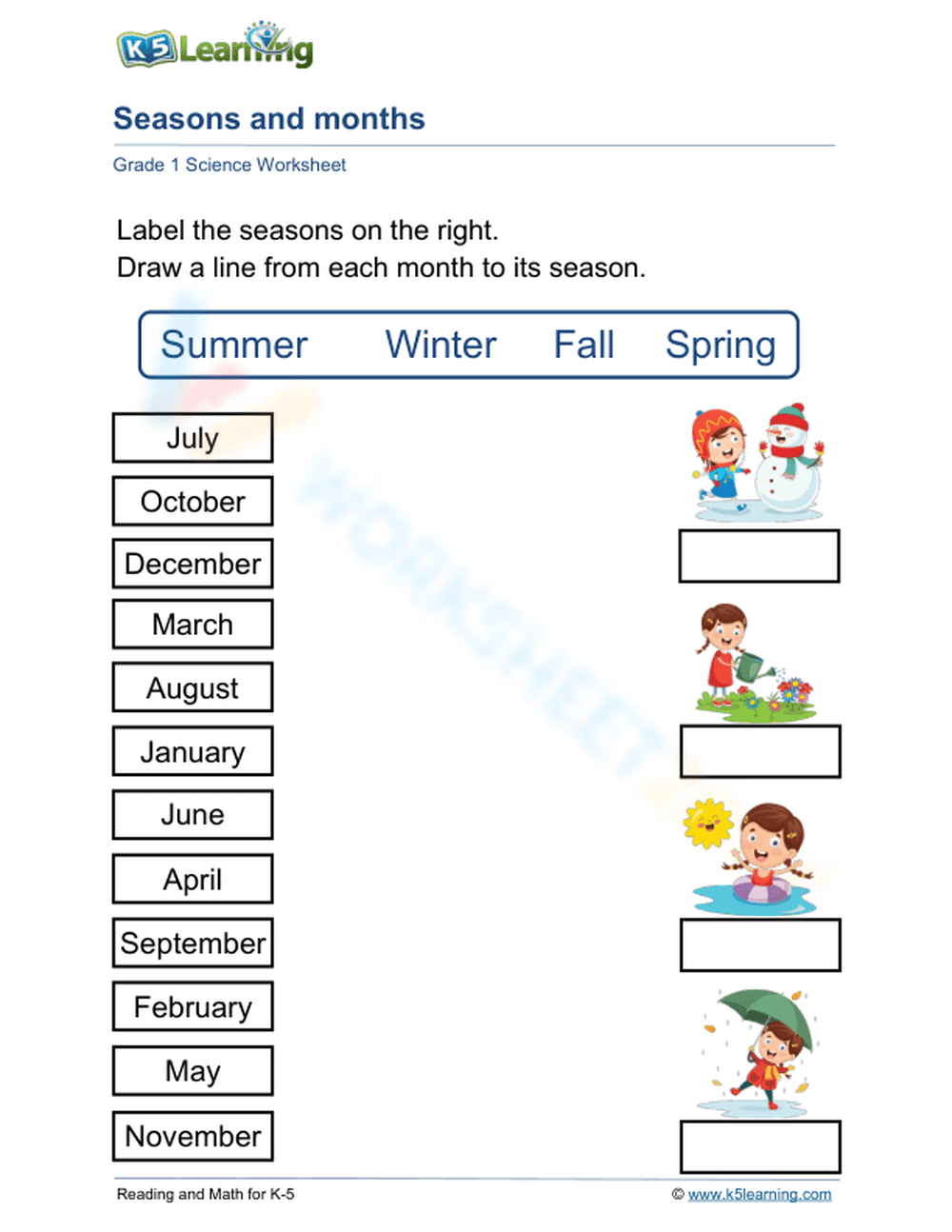

Grade 1 Seasons and Months — Printable No-Prep Worksheet
Paste this activity's link or code into your existing LMS (Google Classroom, Canvas, Teams, Schoology, Moodle, etc.).
Students can open and work on the activity right away, with no student login required.
You'll still be able to track student progress and results from your teacher account.
This Grade 1 seasons and months worksheet provides a structured way for students to identify the four seasons and associate each month with its corresponding time of year. By matching labels to visual cues and drawing connections between names and seasonal categories, learners build foundational Earth science knowledge and temporal awareness.
At a Glance
- Grade: 1 · Subject: Science
- Standard:
1-ESS1-2— Relate the amount of daylight and seasonal patterns to the time of year- Skill Focus: Seasonal identification and month categorization
- Format: 1 page · 16 tasks · Answer key included · PDF
- Best For: Individual practice or science center rotations
- Time: 10–15 minutes
This single-page PDF includes a two-part activity designed for early learners. Students first use a word bank to label four distinct seasonal illustrations (Spring, Summer, Fall, Winter). The second half features 12 monthly boxes in a randomized order, requiring students to draw lines connecting each month to the appropriate season. A full answer key is provided to ensure quick and accurate grading.
This classroom-ready resource follows a streamlined three-step workflow. First, print the single-page PDF (10 seconds). Second, distribute to students with zero prior setup or special materials required (20 seconds). Finally, review the completed matching and labeling tasks using the included answer key (60 seconds). The total teacher preparation time is under two minutes, making it an ideal choice for substitute plans or transition periods.
Primary standard 1-ESS1-2 focuses on Earth’s Place in the Universe, specifically requiring students to make observations at different times of the year to relate seasonal patterns to the calendar. This worksheet reinforces that connection by forcing students to categorize months within the larger seasonal cycle. This standard code can be copied directly into lesson plans, IEP goals, or district curriculum mapping tools.
This resource is best used during the apply phase of a science lesson on Earth’s cycles. After discussing the visual characteristics of each season, assign the worksheet as an independent check for understanding. Teachers should observe students as they match months like December and June, noting if they rely on the illustrations or prior calendar knowledge. Completion typically takes 12 minutes.
The worksheet is designed for first-grade students but serves as an effective review for second graders or as a modified activity for older students with special education needs. It pairs naturally with a classroom weather chart, a read-aloud about the changing seasons, or an anchor chart listing the months in chronological order.
According to the NAEP Science Framework, understanding Earth’s systems begins with identifying observable patterns in weather and time. This 1-ESS1-2 aligned worksheet supports this cognitive development by requiring students to classify 12 months into four distinct seasonal categories. Fisher & Frey (2014) emphasize that such categorization tasks are essential for building domain-specific vocabulary and conceptual frameworks in early science education. By moving from visual identification (labeling illustrations) to abstract association (matching month names), students participate in a scaffolded cognitive process that solidifies their understanding of cyclical time. Research from ScienceDirect TpT Analysis suggests that high-utility, single-page worksheets improve student engagement by providing clear, achievable goals within a standard class period. This resource ensures that learners can demonstrate mastery of calendar-season relationships while minimizing cognitive load through clear formatting and inclusive design principles.


