




























Views
Downloads



Printable Pattern Recognition Worksheet | Grade 1 Math

Paste this activity's link or code into your existing LMS (Google Classroom, Canvas, Teams, Schoology, Moodle, etc.).
Students can open and work on the activity right away, with no student login required.
You'll still be able to track student progress and results from your teacher account.
Description
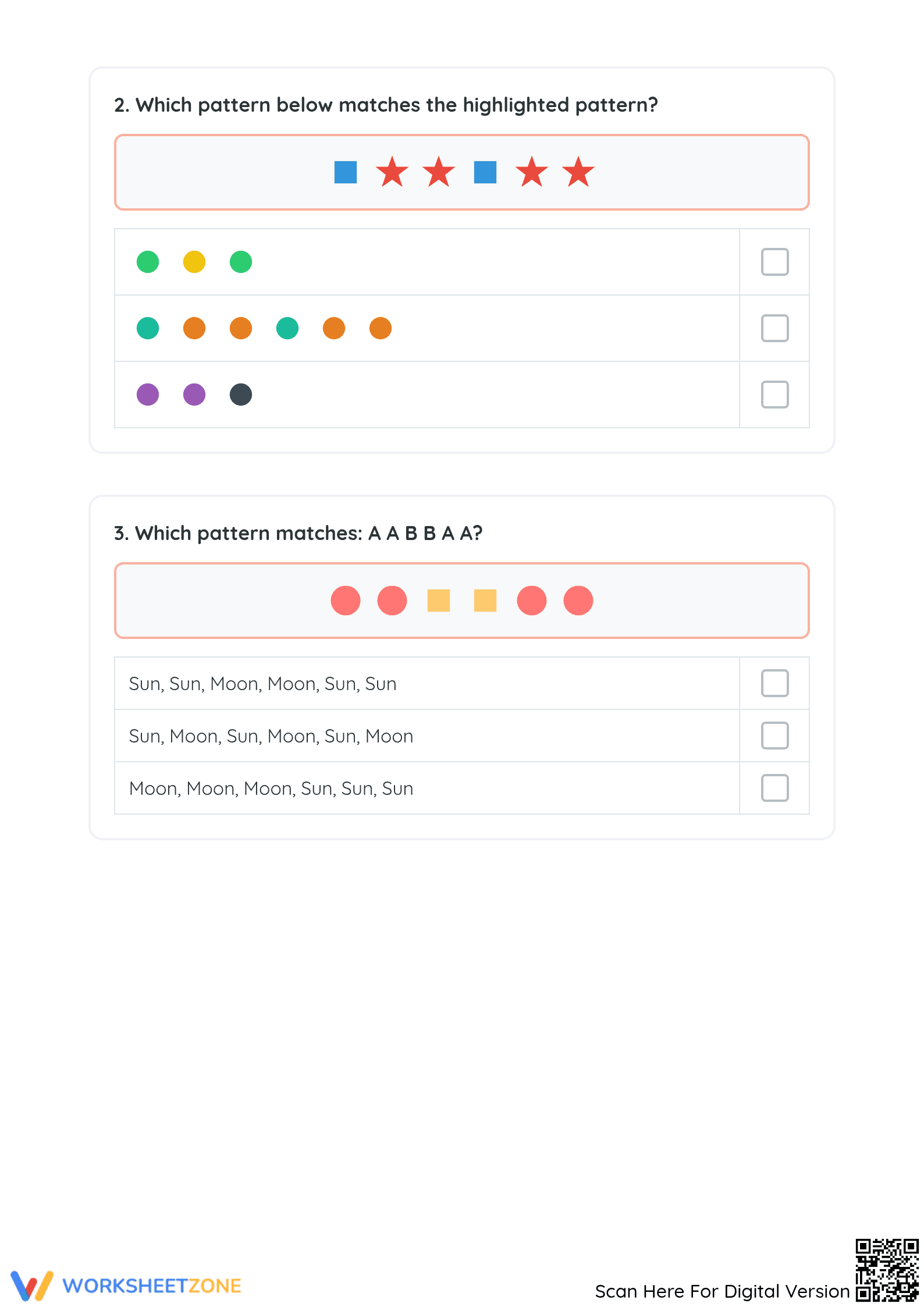
Build foundational algebraic thinking with this worksheet on pattern recognition. Designed for first and second graders, these exercises challenge students to identify the rule in a sequence of shapes and draw what comes next, improving logical reasoning and visual discrimination skills through practice.
At a Glance
- Grade: 1–2 · Subject: Math
- Standard:
CCSS.MATH.CONTENT.1.G.A.2— Compose complex shapes from simpler shapes- Skill Focus: Identifying and continuing visual patterns
- Format: 5 pages · 20 problems · Answer key included · PDF
- Best For: Independent practice, math centers, or homework
- Time: 15–20 minutes
What's Inside
This resource includes five pages of pattern problems (four per page). Students analyze shape sequences to find the next element. A complete five-page answer key is also provided, showing the correct completed pattern for all 20 exercises, allowing for quick and easy review.
Skill Progression
This worksheet uses a gradual release model to build confidence:
- Guided Practice: Use the first page for whole-class instruction, modeling how to find the repeating part of the pattern.
- Supported Practice: The next two pages offer problems for partner work or targeted support.
- Independent Practice: The final two pages have 8 problems for students to solve alone, showing mastery of different patterns.
This structure helps students feel ready before working independently.
Standards Alignment
This worksheet aligns with CCSS.MATH.CONTENT.1.G.A.2, which involves composing shapes. The activity supports this standard by having students analyze how shapes form a sequence. It’s also foundational for future standards like 4.OA.C.5 (Generate and analyze patterns). The standard codes can be copied directly into lesson plans, IEP goals, or curriculum mapping tools.
How to Use It
Use this versatile worksheet after a lesson on patterns or in a math center. For formative assessment, ask students to explain the pattern rule (e.g., "square, circle"). The 20 problems can be completed by most first or second graders in 15-20 minutes. It's an effective tool for providing immediate practice with a core mathematical concept.
Who It's For
This resource is for first and second graders learning to see mathematical structure. It is especially helpful for visual learners. For students needing support, provide pattern blocks to build the pattern physically before drawing. This worksheet pairs well with an anchor chart showing different pattern types.
Recognizing and extending patterns is a cornerstone of early mathematical thinking, forming the basis for algebraic reasoning. This worksheet provides structured practice aligned with foundational skills leading to standards like CCSS.MATH.CONTENT.1.G.A.2. By engaging with visual sequences, students develop the ability to see structure and regularity, a key mathematical practice. Research from Fisher & Frey (2014) highlights the importance of moving from guided to independent practice, a model this worksheet follows to build student autonomy. Completing the 20 pattern problems herein helps students transition from concrete understanding to abstract reasoning. The ability to identify patterns is not just a math skill; it is a critical thinking tool that supports problem-solving across all academic disciplines, reinforcing findings on cognitive development from the RAND AIRS 2024 report on foundational learning.


