


























Views
Downloads

Essential Living and Non-living Things Worksheet | Grade K-1
Paste this activity's link or code into your existing LMS (Google Classroom, Canvas, Teams, Schoology, Moodle, etc.).
Students can open and work on the activity right away, with no student login required.
You'll still be able to track student progress and results from your teacher account.
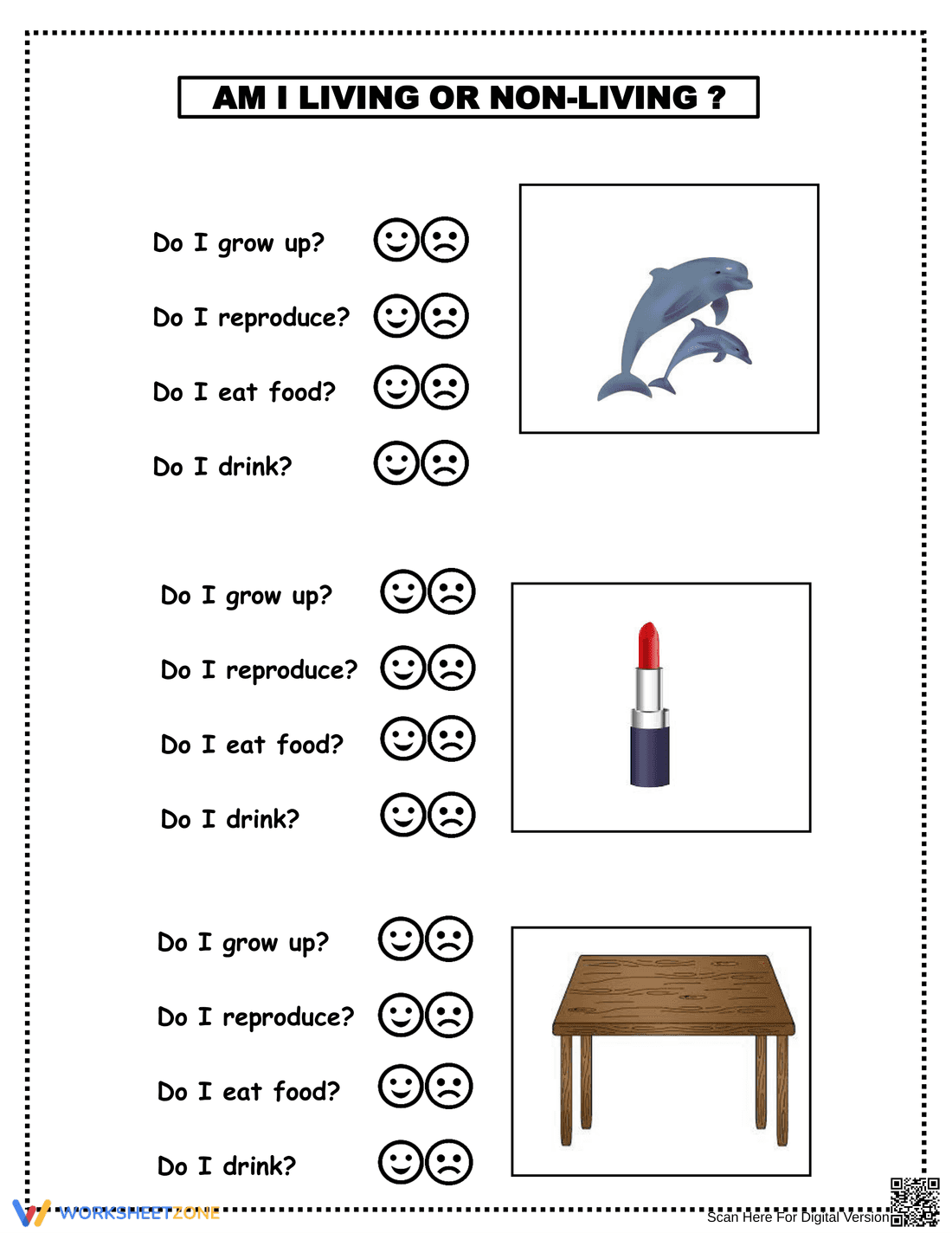
Distinguishing between living organisms and inanimate objects is a foundational scientific skill for early learners. This interactive science worksheet helps Kindergarten and First Grade students categorize items by observing biological needs like growth, nutrition, and reproduction. Students develop critical observation skills while building a conceptual framework for the natural world and biological classifications.
At a Glance
- Grade: K–2 · Subject: Science
- Standard:
K-LS1-1— Use observations to describe patterns of what plants and animals need to survive- Skill Focus: Identifying living and non-living characteristics
- Format: 1 page · 12 tasks · Answer key included · PDF
- Best For: Independent practice or formative assessment
- Time: 15–20 minutes
This single-page PDF includes three distinct categorization tasks featuring a dolphin, a lipstick, and a wooden table. For each object, students respond to four guided questions regarding growth, reproduction, food intake, and hydration using intuitive smiley-face icons. The clear visual layout and repetitive structure support emerging readers and help solidify the four basic criteria used to identify living things.
Teachers can integrate this resource with zero preparation. Simply print the single-page document, distribute it to students during your living things unit, and review answers using the included key. This streamlined design makes it an ideal choice for emergency sub plans, morning work, or a quick exit ticket to check for student understanding in under two minutes of teacher prep.
This worksheet is aligned to K-LS1-1, requiring students to use observations to describe patterns of what plants and animals need to survive. By asking "Do I eat food?" and "Do I drink?", students directly observe the survival needs of organisms compared to inanimate objects. This standard code can be copied directly into lesson plans, IEP goals, or district curriculum mapping tools.
Use this worksheet as a follow-up to a classroom nature walk where students observe living things in their local environment. During the activity, walk around and observe if students can correctly identify that a table does not need food, which serves as an excellent formative-assessment observation tip. Expect students to complete the 12 sub-tasks in approximately 15 to 20 minutes.
This resource is designed for Kindergarten and Grade 1 students, with scaffolding that supports English Language Learners through visual cues and repetitive sentence structures. It pairs naturally with a living vs. non-living anchor chart or a short informational passage about animal habitats and survival needs in the early elementary science curriculum.
Biological classification at the early elementary level is a critical precursor to more advanced life science concepts. According to the RAND AIRS 2024 analysis, structured observation tasks that require students to evaluate specific criteria—such as growth, reproduction, and nutritional needs—significantly improve retention of scientific categories in young learners. This Grade K-1 worksheet utilizes a 12-task inquiry model to reinforce the K-LS1-1 standard, helping students distinguish between living and non-living entities through evidence-based questioning. By grounding abstract concepts in concrete observations of familiar objects like dolphins and furniture, the resource facilitates the development of mental models necessary for future biology units. Educators can use these structured tasks to collect data on student mastery of the plain-English skill: identifying characteristics of living things. This evidence-based approach ensures that students meet foundational NGSS benchmarks while developing the observational rigor required for scientific inquiry.


