


























Views
Downloads

Printable Character Traits Worksheet | Grades 2-4 ELA
Paste this activity's link or code into your existing LMS (Google Classroom, Canvas, Teams, Schoology, Moodle, etc.).
Students can open and work on the activity right away, with no student login required.
You'll still be able to track student progress and results from your teacher account.
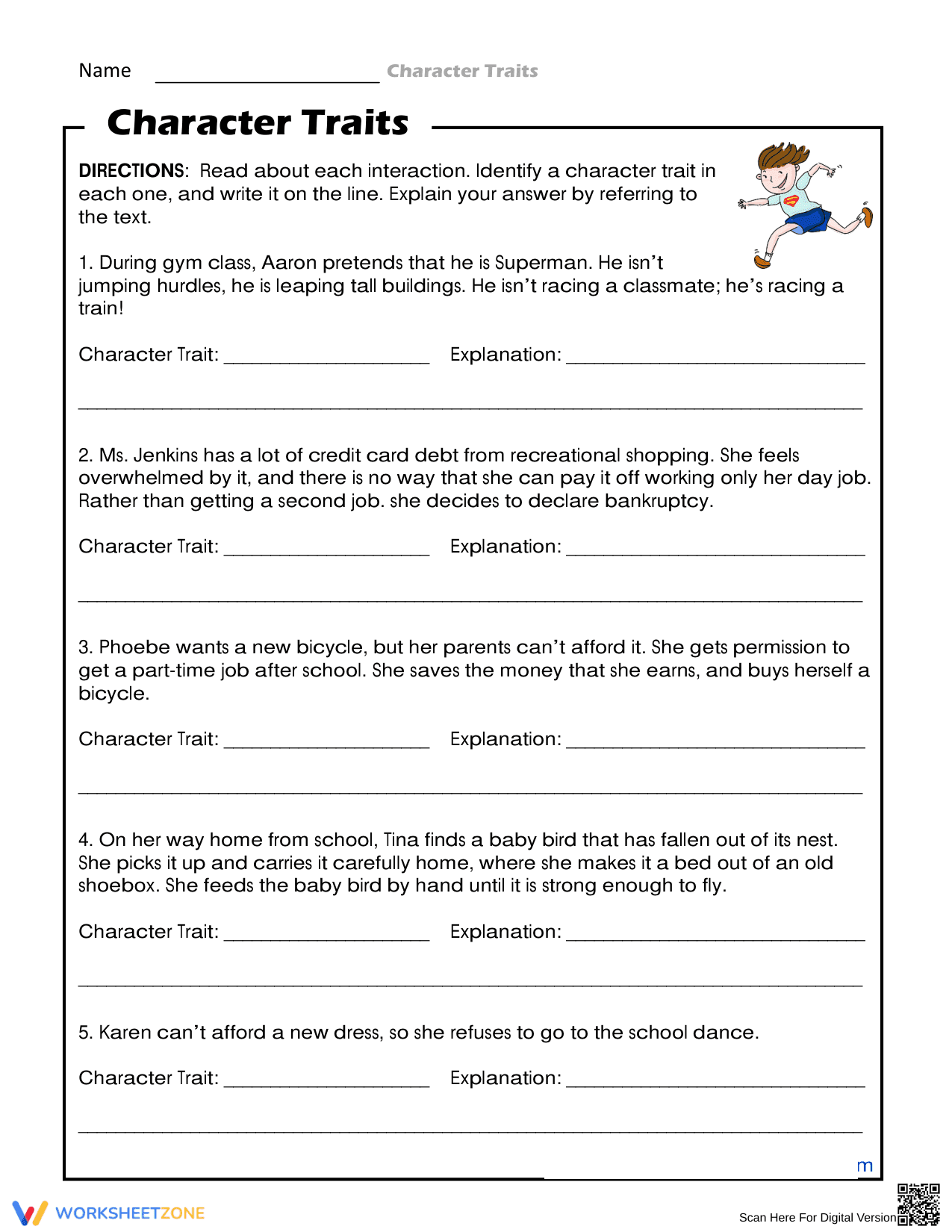
This essential Character Traits worksheet provides Grade 2, 3, and 4 students with structured practice in analyzing character behavior and citing textual evidence. By reading five short, relatable interactions, learners identify specific personality traits and justify their choices using details from the text. It is a proven tool for developing reading comprehension and analytical writing.
At a Glance
- Grade: 3 · Subject: ELA
- Standard:
CCSS.ELA-LITERACY.RL.3.3— Describe characters in a story and explain how their actions contribute to the plot.- Skill Focus: Character Trait Analysis
- Format: 1 page · 5 problems · Answer key included · PDF
- Best For: Quick formative assessment or sub plans.
- Time: 15–20 minutes
The resource features five distinct reading passages, each focusing on a different character interaction. Students are prompted to identify a trait (such as imaginative, responsible, or resilient) and provide an explanation. The layout includes clear writing lines for both the trait and the justification, ensuring students practice complete-sentence responses. A comprehensive answer key is included for rapid grading and student self-correction.
Teachers can implement this resource in three simple steps:
- Print: Select the PDF and print copies for your class (30 seconds).
- Distribute: Hand out the worksheet as a bell-ringer or independent practice task (1 minute).
- Review: Use the provided answer key to facilitate a quick class discussion or grade papers (under 2 minutes).
This streamlined process makes it an ideal choice for emergency sub plans or last-minute lesson extensions.
This worksheet is primarily aligned to CCSS.ELA-LITERACY.RL.3.3, which requires students to describe characters in a story and explain how their actions contribute to the sequence of events. It also supports RL.2.3 and RL.4.3. These standard codes can be copied directly into lesson plans, IEP goals, or district curriculum mapping tools to ensure instructional compliance and simplify the reporting process.
Use this worksheet during the independent practice phase of a lesson on characterization. After a direct instruction session on trait vocabulary, assign these five scenarios to gauge student understanding. For a formative assessment tip, observe if students use transition words like "because" or "since" in their explanations. This helps identify learners who need more support with citing evidence or logical reasoning.
This resource is designed for elementary students in Grades 2 through 4. It is particularly effective for English Language Learners (ELLs) who benefit from short, high-interest scenarios with clear context clues. It pairs naturally with a character trait anchor chart or a short story passage to reinforce the concept of inferring traits from actions rather than relying on explicit descriptions.
According to the RAND AIRS 2024 report on literacy instruction, providing students with frequent, low-stakes opportunities to cite textual evidence significantly improves long-term reading comprehension scores. This worksheet targets the CCSS.ELA-LITERACY.RL.3.3 standard by requiring students to move beyond simple identification to logical justification. By analyzing five specific character interactions, students build the cognitive muscles necessary for higher-order literary analysis. Research by Fisher & Frey (2014) emphasizes that the gradual release of responsibility model is most effective when paired with concise, focused practice tools like this character traits resource. Teachers can use the results of these five tasks to inform small-group instruction or as a component of a comprehensive ELA portfolio. The inclusion of a clear answer key ensures that feedback is immediate and accurate, supporting the mastery of evidence-based writing in the primary grades.


