


























Views
Downloads

Grade 1 2D Shapes — Printable No-Prep Worksheet
Paste this activity's link or code into your existing LMS (Google Classroom, Canvas, Teams, Schoology, Moodle, etc.).
Students can open and work on the activity right away, with no student login required.
You'll still be able to track student progress and results from your teacher account.
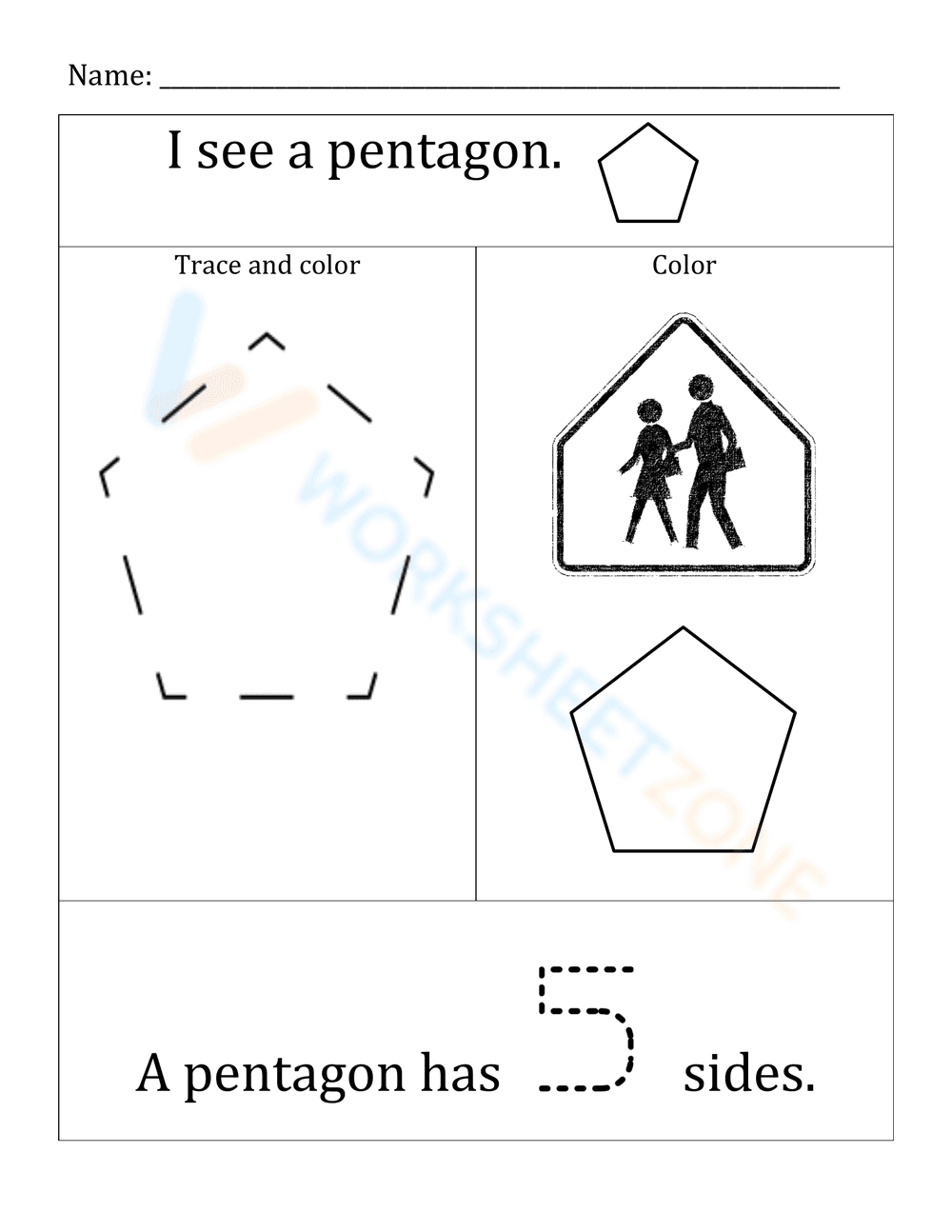
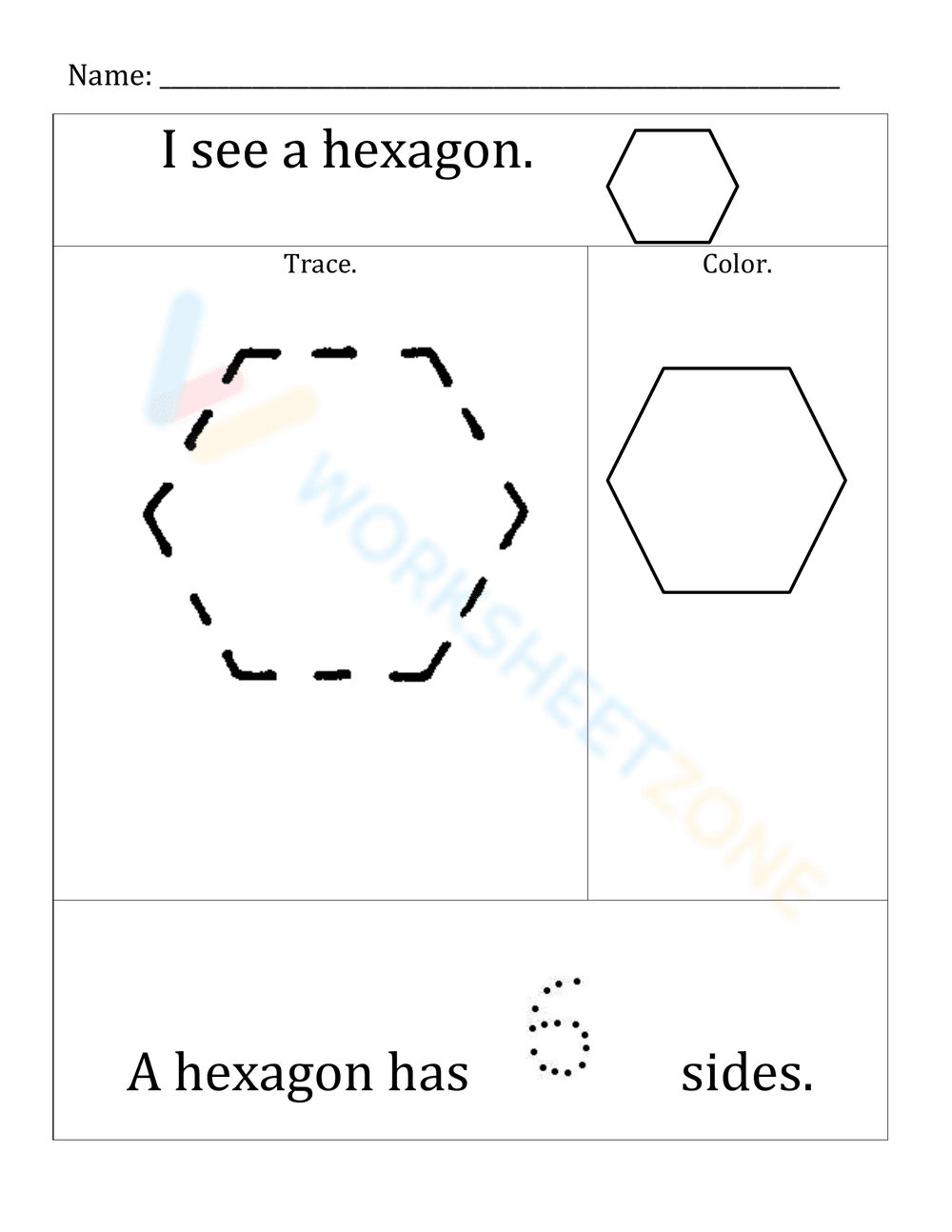
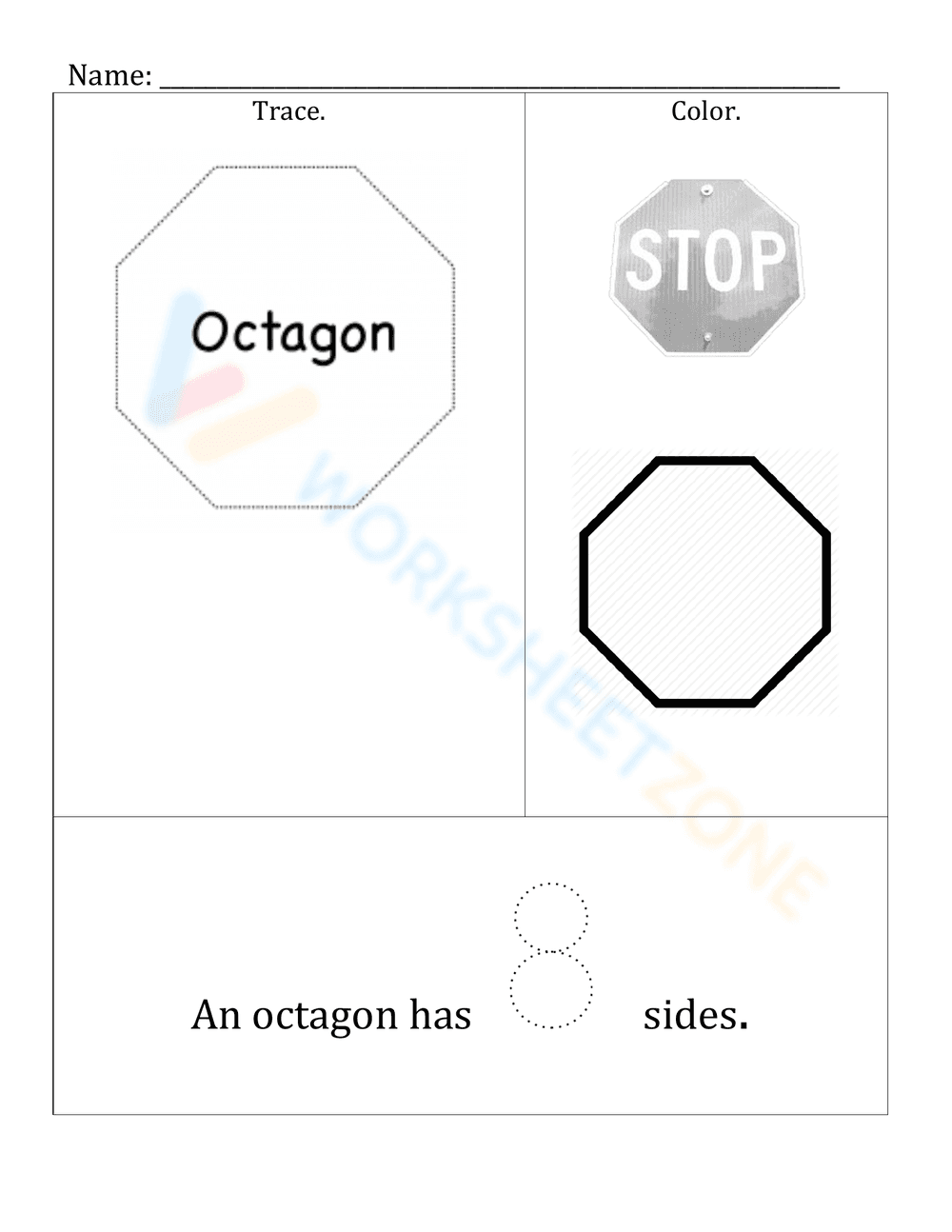
This Grade 1 math worksheet helps students identify and analyze 2D shapes by tracing, coloring, and counting their sides. By connecting abstract geometric concepts to real-world objects like stop signs, young learners build foundational spatial reasoning skills and improve their fine motor control in one engaging activity.
At a Glance
- Grade: 1 · Subject: Math
- Standard:
CCSS.MATH.CONTENT.1.G.A.1— Identify and draw shapes with defining attributes- Skill Focus: 2D Shapes and Side Counting
- Format: 3 pages · 9 problems · No answer key needed · PDF
- Best For: Independent practice or morning work
- Time: 10–15 minutes
This three-page resource focuses on the pentagon, hexagon, and octagon. Each page features a shape profile with three tasks. First, students trace the dashed outline to build muscle memory. Next, they color a real-world representation, like a stop sign. Finally, they trace the numeral corresponding to the shape's total sides, connecting geometry to basic counting.
Zero-Prep Workflow
This resource is designed for immediate classroom implementation with absolutely no teacher preparation required.
- Print (1 minute): Simply print the three-page PDF packet. The black-and-white design is ink-friendly and ready for standard copiers.
- Distribute (1 minute): Hand out the packets along with crayons or colored pencils. The instructions are highly visual, allowing early readers to begin working immediately.
- Review (3 minutes): Circulate the room to ensure students are accurately counting the sides and tracing the correct numerals.
With prep time under two minutes, this is perfect for emergency sub plans.
Standards Alignment
This activity aligns with CCSS.MATH.CONTENT.1.G.A.1: Distinguish between defining attributes (e.g., triangles are closed and three-sided) versus non-defining attributes (e.g., color, orientation, overall size); build and draw shapes to possess defining attributes. Counting sides helps students categorize shapes by geometric properties. Both standard codes can be copied directly into lesson plans, IEP goals, or district curriculum mapping tools.
How to Use It
This worksheet serves as an excellent morning work activity to activate prior knowledge before a direct instruction lesson on geometry. Students can independently trace and color during attendance, or use it as a quiet math center. As a formative assessment tip, observe students while they trace the shapes; check if they are counting each side sequentially as they draw the lines to reinforce the concept of vertices and edges. Expected completion time is between 10 and 15 minutes.
Who It's For
This resource is primarily designed for Grade 1 students mastering basic 2D geometry. It also works for Kindergarten extension or Grade 2 review. The visual nature of the tracing and coloring tasks provides built-in scaffolding for English Language Learners and students developing fine motor skills. Pair this worksheet with a classroom anchor chart displaying various polygons to maximize student success.
Mastering the defining attributes of geometric figures is a critical stepping stone for early elementary mathematics. This resource directly supports CCSS.MATH.CONTENT.1.G.A.1 by requiring students to identify and draw shapes with defining attributes, specifically focusing on the number of sides in pentagons, hexagons, and octagons. According to an EdReports 2024 review of foundational math curricula, integrating fine motor activities like tracing with explicit counting tasks significantly improves young learners' retention of geometric vocabulary. When students physically trace the perimeter of a shape while simultaneously counting its sides, they form a stronger cognitive link between the visual representation and its mathematical properties. This multisensory approach ensures that students do not merely memorize shape names, but actually understand the structural components that define them, paving the way for more advanced spatial reasoning in later grades.


