


























Views
Downloads

Letter I Tracing Worksheet | Essential Grade K Alphabet
Paste this activity's link or code into your existing LMS (Google Classroom, Canvas, Teams, Schoology, Moodle, etc.).
Students can open and work on the activity right away, with no student login required.
You'll still be able to track student progress and results from your teacher account.
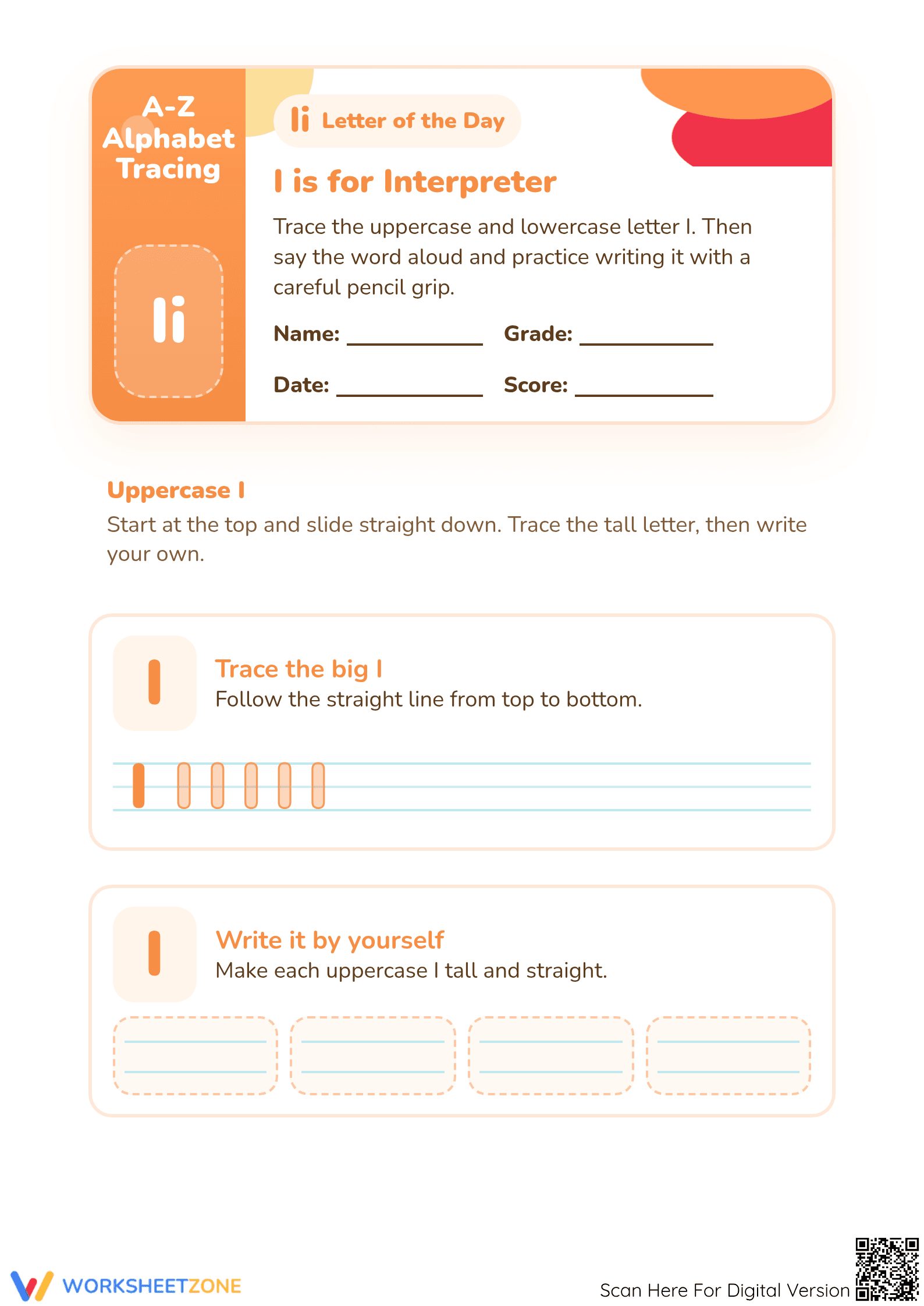
This Grade K Alphabet Tracing worksheet provides a focused environment for young learners to master the letter I. By combining uppercase and lowercase practice with vocabulary reinforcement, students build the foundational penmanship skills necessary for literacy success. It transitions students from guided tracing to independent writing with clear, instructional cues and professional formatting.
At a Glance
- Grade: Kindergarten · Subject: English Language Arts
- Standard:
CCSS.ELA-LITERACY.L.K.1.A— Print many upper- and lowercase letters with proper form and pencil grip- Skill Focus: Letter I Penmanship
- Format: 2 pages · 19 problems · Answer key included · PDF
- Best For: Early literacy centers and morning work
- Time: 15–20 minutes
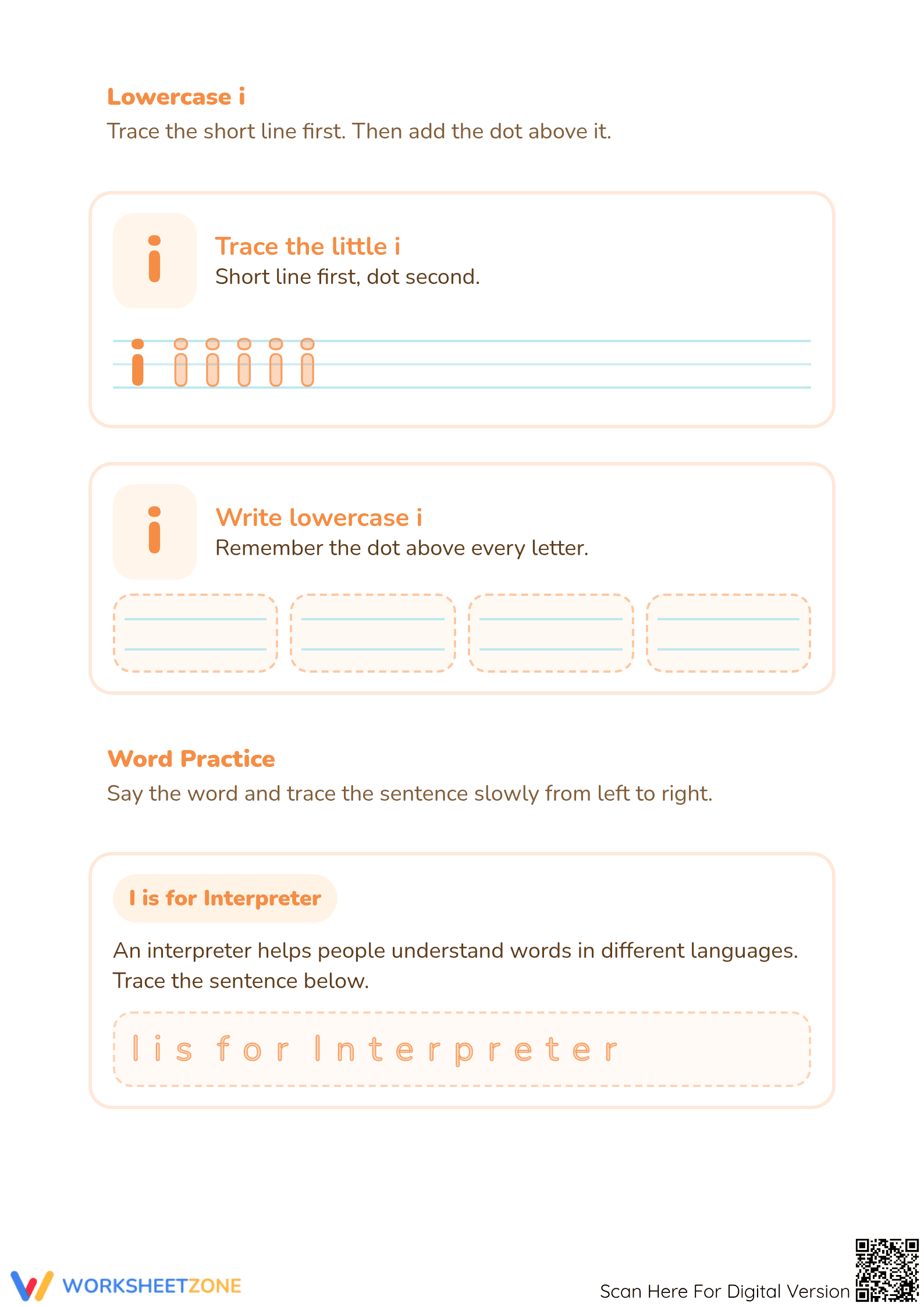
This two-page PDF includes comprehensive practice for both uppercase and lowercase "I." Page one focuses on uppercase I, providing five tracing examples and four writing boxes. Page two mirrors this for lowercase "i," including specific dot placement instructions. The resource concludes with a sentence tracing task featuring the word "Interpreter," integrating phonics and vocabulary into the handwriting exercise.
Skill Progression
- Guided Practice: Students begin by tracing 10 instances of the letter I (5 upper, 5 lower) to internalize the stroke order and height relationships.
- Supported Practice: Eight dedicated writing boxes use primary-ruled lines to help students transition from tracing to self-generated letter formation.
- Independent Practice: The final task requires students to trace a complete sentence, applying their letter formation skills to a real-world vocabulary context.
The gradual-release model ensures that students build confidence with the vertical strokes of the letter I before attempting more complex sentence structures.
Standards Alignment
This worksheet is primarily aligned to CCSS.ELA-LITERACY.L.K.1.A, which requires students to "Print many upper- and lowercase letters." The layout emphasizes top-to-bottom stroke direction and proper dot placement for the lowercase "i." This code can be copied into lesson plans or IEP goals to track writing development.
How to Use It
Use this worksheet during the "You Do" phase of a direct instruction lesson on the alphabet. After modeling the letter I on a whiteboard, distribute the pages for independent practice. Teachers should circulate and observe pencil grip, providing immediate feedback on the "top-to-bottom" motion. It also serves as an excellent formative assessment tool to determine which students require additional fine-motor support.
Who It's For
This resource is designed for Preschool and Kindergarten students who are developing fine motor control. It is particularly helpful for learners who need clear visual cues for letter sizing. Pair this worksheet with a letter-sound anchor chart or a short reading passage about an "Interpreter" to deepen the phonics connection.
Developing letter-writing fluency is a critical predictor of reading achievement in early childhood education. According to the NAEP framework, mastering the physical act of letter formation allows students to shift cognitive resources from penmanship to higher-order composition tasks. This worksheet addresses CCSS.ELA-LITERACY.L.K.1.A by providing 19 targeted opportunities for students to "Print many upper- and lowercase letters." Research from Fisher & Frey (2014) highlights the importance of the gradual release of responsibility, which this resource implements through the progression from guided tracing to independent sentence work. By explicitly teaching the stroke order for the letter I, educators provide the foundational scaffolding required for fluent writing. This systematic approach ensures that students develop the muscle memory and visual-spatial awareness needed for academic success in subsequent grades, where writing demands increase significantly.


