


























Views
Downloads
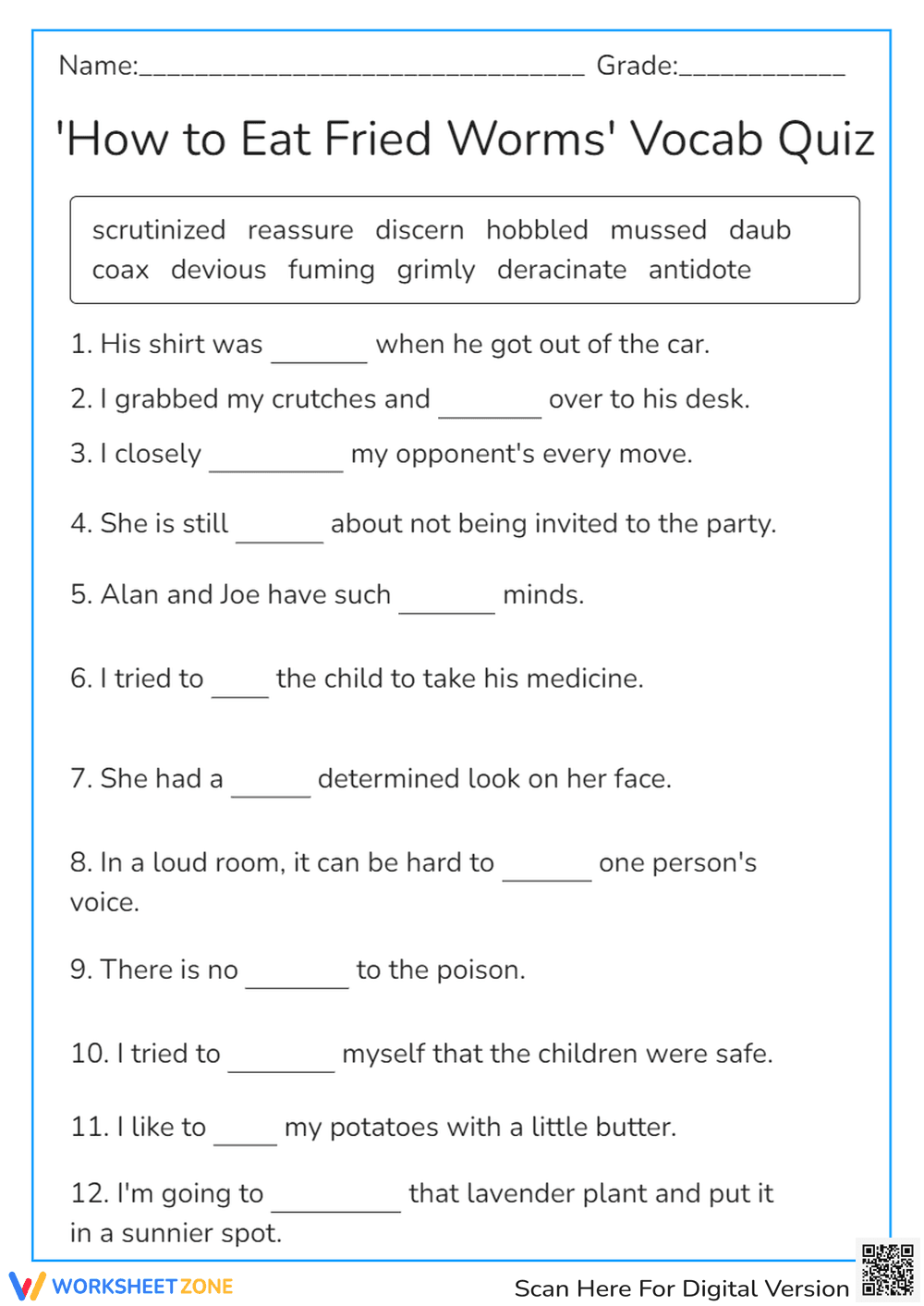

How to Eat Fried Worms Vocab Quiz | Grade 6 Printable
Paste this activity's link or code into your existing LMS (Google Classroom, Canvas, Teams, Schoology, Moodle, etc.).
Students can open and work on the activity right away, with no student login required.
You'll still be able to track student progress and results from your teacher account.
This Grade 6 vocabulary worksheet provides students with targeted practice using context clues to complete sentences. Based on words from "How to Eat Fried Worms," this resource requires learners to analyze sentence structure and meaning to select the correct term from a provided word bank, strengthening overall reading comprehension.
At a Glance
- Grade: 6 · Subject: ELA
- Standard:
CCSS.ELA-LITERACY.L.6.4.A— Use context as a clue to the meaning of a word.- Skill Focus: Vocabulary in Context
- Format: 1 page · 12 problems · Answer key included · PDF
- Best For: Formative assessment or independent practice
- Time: 10–15 minutes
This single-page resource features a clear layout with a word bank containing twelve vocabulary terms, such as "scrutinized" and "antidote." Students will find twelve fill-in-the-blank sentences, each providing context clues to guide them toward the correct word. A complete answer key ensures quick grading.
Zero-Prep Workflow
This worksheet is designed for immediate classroom implementation with minimal teacher preparation.
- Print (1 minute): The single-page PDF ensures rapid printing for an entire class.
- Distribute (1 minute): The intuitive layout means students can begin working immediately after receiving the page, requiring no complex instructions.
- Review (3 minutes): Using the included answer key, teachers can quickly grade the 12 problems or facilitate a whole-class review session.
With a total teacher prep time of under two minutes, this resource is an excellent addition to any emergency sub plan or quick transition activity.
Standards Alignment
This resource is directly aligned to CCSS.ELA-LITERACY.L.6.4.A, requiring students to use context (e.g., the overall meaning of a sentence or paragraph; a word's position or function in a sentence) as a clue to the meaning of a word or phrase. Students actively practice this skill by analyzing the surrounding text. Both standard codes can be copied directly into lesson plans, IEP goals, or district curriculum mapping tools.
How to Use It
This vocabulary quiz is highly versatile and fits easily into various instructional moments. Teachers can assign it as a quick formative assessment after completing a chapter of the novel, or use it as an independent practice activity during literacy centers. As a formative assessment observation tip, monitor students to see if they cross out words in the word bank as they use them; this indicates strong test-taking strategies. The expected completion time range is 10 to 15 minutes.
Who It's For
This worksheet is primarily designed for Grade 6 general education students, but it serves as an excellent tool for any middle school learner needing reinforcement in context clues. For differentiation, teachers can pre-teach the definitions of the words in the bank for English Language Learners or students with IEPs. It pairs naturally with direct instruction on using context clues or as a companion activity while reading "How to Eat Fried Worms."
Mastering vocabulary through context is a critical component of middle school literacy development. According to a recent EdReports 2024 analysis, instructional materials that consistently require students to deduce meaning from surrounding text significantly improve long-term reading comprehension outcomes. This resource directly targets CCSS.ELA-LITERACY.L.6.4.A, prompting students to use context as a clue to the meaning of a word. By engaging with these twelve specific sentences, learners move beyond rote memorization and apply critical thinking to determine how words function within distinct grammatical structures. Regular practice with targeted word banks and contextual sentences helps bridge the gap between basic decoding and advanced textual analysis. This targeted approach ensures students build the robust vocabulary necessary for tackling complex academic texts across all subjects, fostering independent reading skills.


