


























Views
Downloads
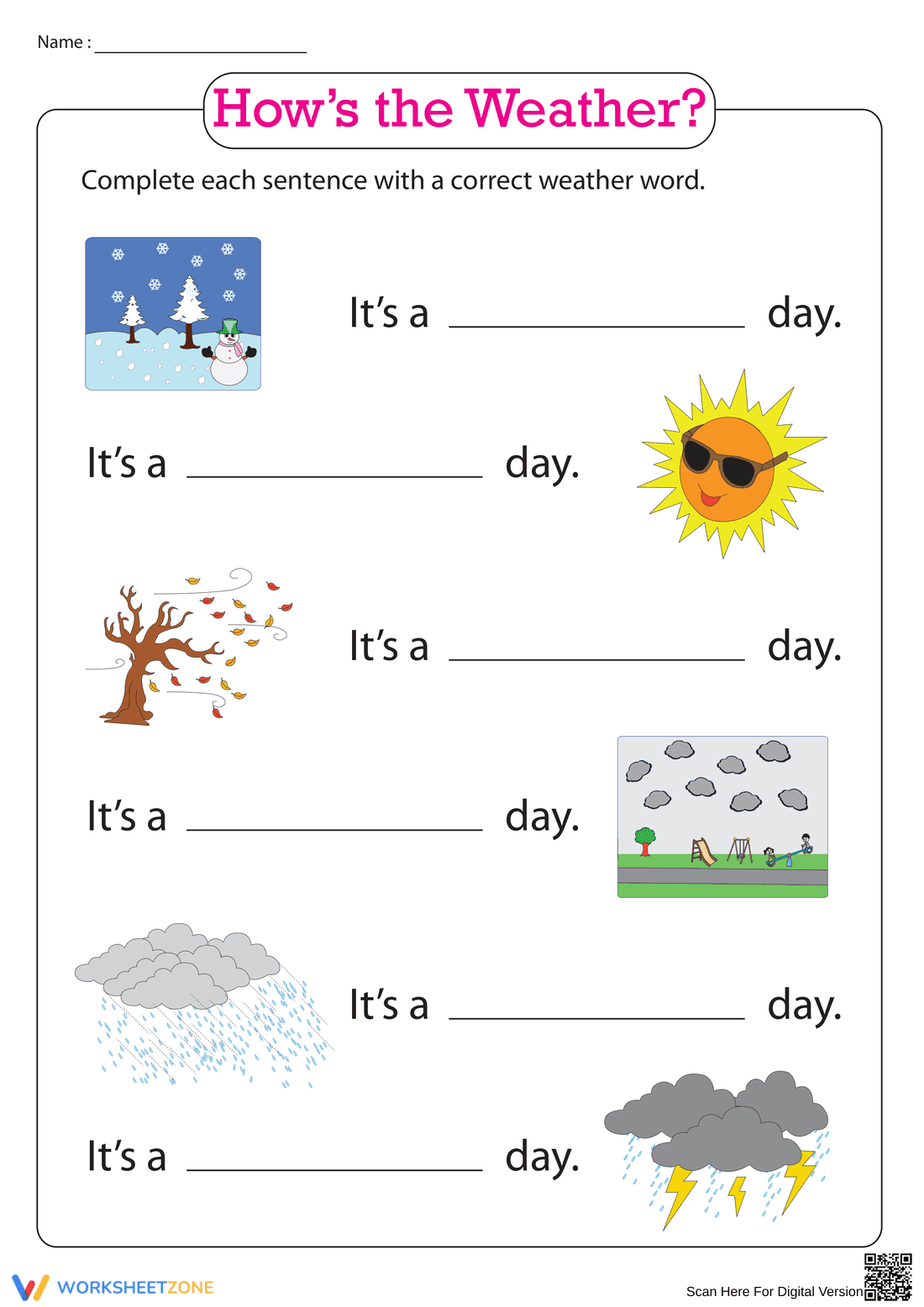

Essential Weather Vocabulary Worksheet | Grade 1-2 Printable
Paste this activity's link or code into your existing LMS (Google Classroom, Canvas, Teams, Schoology, Moodle, etc.).
Students can open and work on the activity right away, with no student login required.
You'll still be able to track student progress and results from your teacher account.
This Grade 1 and 2 science worksheet helps students identify and label common weather patterns through visual cues and sentence completion. By matching illustrations to descriptive terms, learners build foundational vocabulary and observation skills essential for early earth science. Students will demonstrate mastery by correctly identifying snowy, rainy, and stormy conditions in structured sentences.
At a Glance
- Grade: 1–2 · Subject: Science
- Standard:
CCSS.ELA-LITERACY.L.1.5— Identify real-life connections between words and their use- Skill Focus: Weather vocabulary and observation
- Format: 1 page · 6 problems · Answer key included · PDF
- Best For: Morning work or quick science review
- Time: 5–10 minutes
What's Inside
This single-page PDF contains six high-contrast illustrations depicting various meteorological states, including snow, sun, wind, clouds, rain, and thunder. Each image is paired with a fill-in-the-blank sentence ("It's a _______ day") to reinforce sentence structure alongside content knowledge. A comprehensive answer key is included for immediate feedback.
Zero-Prep Workflow
- Print: Generate copies of the single-page document in under 30 seconds.
- Distribute: Hand out to students during a science block or morning transition.
- Review: Check student work instantly using the provided color-coded answer key.
The total preparation time for this activity is under two minutes, making it an ideal choice for emergency sub plans or low-prep science rotations.
Standards Alignment
Aligned to CCSS.ELA-LITERACY.L.1.5, this worksheet focuses on word relationships and nuances in word meanings by connecting visual weather phenomena to their corresponding linguistic labels. It also supports K-ESS2-1 through structured weather observation. Both standard codes can be copied directly into lesson plans, IEP goals, or district curriculum mapping tools.
How to Use It
Use this as a formative assessment after a direct instruction lesson on weather patterns. Have students observe the window and identify the current day's weather before completing the sheet. This provides an instructional moment to observe how students decode visual symbols and apply them to writing. Completion usually takes 5 to 10 minutes depending on writing speed.
Who It's For
This resource is designed for first and second-grade students developing basic literacy and science vocabulary. It is particularly effective for English Language Learners (ELL) who benefit from the direct image-to-word association. Pair this with a daily weather chart or a reading passage about the water cycle for a complete lesson.
This worksheet addresses the core requirement of `CCSS.ELA-LITERACY.L.1.5` by requiring students to identify real-life connections between words (weather terms) and their visual representations. According to Fisher & Frey (2014), the use of visual scaffolds in vocabulary acquisition is critical for early learners to move from concrete observations to abstract linguistic categorization. By providing six distinct weather scenarios, the activity ensures students can distinguish between similar phenomena, such as cloudy versus stormy conditions. The structured 'It's a... day' format further supports syntactic development, a key component of foundational literacy identified in the NAEP framework. This resource facilitates rapid data collection for teachers monitoring vocabulary growth and provides a clear artifact for parent-teacher conferences or student portfolios. Its focus on high-frequency weather terms aligns with the ScienceDirect TpT Analysis 2024 regarding the efficacy of targeted, single-page printable resources for retention in early elementary classrooms.


